

Checked 7 November 2026. This report compares dedicated worldbuilding wikis, general note apps used as story bibles, map makers, timeline software and the new automated continuity checkers. Prices are list prices in US dollars unless shown in pounds, before tax, and they change often; the dates in brackets show when each figure was last checked. Where a review site disagrees with a vendor's own pricing page, the vendor's figure is used and the disagreement is noted in section 10. The recommendations are editorial judgements based on published features and prices, not the results of a controlled TexFaber trial.
1. Master Specification Matrix: Worldbuilding, Mapping, Timeline, and Continuity Tools
Software used by novelists, worldbuilders, and tabletop game masters (GMs) in 2026 divides into four distinct functional layers: dedicated worldbuilding and wiki platforms (World Anvil, Campfire Writing, LegendKeeper, Kanka), general-purpose note-taking workspaces retrofitted for lore management (Obsidian, Notion), specialized cartography applications (Inkarnate, Wonderdraft), and chronology or automated continuity-checking specialists (Aeon Timeline, Book Check Genie, Penseed)[1]. Treating dedicated worldbuilding wikis and general-purpose note applications as a single software category obscures their fundamental architectural trade-off: World Anvil, Campfire, LegendKeeper, and Kanka provide pre-configured relational schemas for fictional entities out of the box, whereas Obsidian and Notion are blank, domain-agnostic canvases on which an author must manually engineer a worldbuilding system from scratch[2].
Category A & B: Dedicated Worldbuilding Platforms vs. General-Purpose Note Canvases
| Field | World Anvil (Dedicated Wiki) | Campfire Writing (Dedicated Modular Suite) | LegendKeeper (Dedicated Wiki) | Kanka (Dedicated TTRPG Wiki) | Obsidian (General Note Canvas) | Notion (General Workspace Canvas) |
|---|---|---|---|---|---|---|
| Pricing Model | Freeman (Free): $0; 2 worlds, 42 articles (5 drafts), 2 maps (10 markers), 2 timelines, 20 statblocks, 100 MB storage (1 MB max file); public-only[1]. Master: $7.00/mo or $54.00/yr ($4.50/mo)[1]. Grandmaster: $12.00/mo, $99.00/yr ($8.25/mo), or $650.00 lifetime[1]. Sage: $34.00/mo, $300.00/yr, or $1,350.00 lifetime (worldanvil.com/pricing, Nov 1, 2026)[1]. | Free: $0; all 18 modules capped by count (25,000 manuscript words, 10 characters, 20 timeline events, 2 maps); free mobile app[3]. Standard: $12.00/mo (list $19), $99.00/yr (list $160), or $336.00 lifetime (list $420)[3]. Custom Lifetime: ~$7.50–$45.00 once per module (campfirewriting.com/pricing, Oct 7, 2026)[4]. | Basic: 14-day free trial (no card); reverts to read-and-export-only for owned projects; free guest access to active subscribers' worlds[5]. Pro: $9.00/mo or $90.00/yr ($7.50/mo billed annually) for unlimited projects and guests (legendkeeper.com/pricing, Oct 7, 2026)[5]. | Kobold (Free): $0 forever; unlimited campaigns and entries with ads, 3 MiB upload cap, 150 MiB gallery, 10 members[6]. Owlbear: $4.16/mo annual ($4.99/mo monthly), 1 premium campaign, 10 MiB files[6]. Wyvern: $8.33/mo annual ($9.99/mo), 3 campaigns, 25 MiB files[6]. Elemental: $20.82/mo annual ($24.99/mo), 7 campaigns, 100 MiB (kanka.io/pricing, Sep 7, 2026)[6]. | Core App: $0 free for personal and commercial use; unlimited local notes and plugins[7]. Sync Standard: $4.00/mo annual ($48/yr) or $5.00/mo monthly (1 vault, 1 GB, 5 MB file cap)[8]. Sync Plus: $8.00/mo annual ($96/yr) or $10.00/mo (10 vaults, 10 GB)[8]. Publish: $8.00/mo annual ($10.00/mo). Commercial: $50/yr optional (obsidian.md/sync, Oct 28, 2026)[8]. | Free: $0 solo; unlimited pages/blocks, 10 guests, 5 MB file upload cap, 7-day history, limited AI trial[9]. Plus: $10.00/member/mo annual ($120/yr) or $12.00/mo monthly; unlimited uploads, 30-day history[10]. Business (includes full Notion AI): $20.00/member/mo annual ($240/yr) or $24.00/mo (breeze.pm/articles/notion-ai-pricing, Oct 26, 2026)[10]. |
| Core Strength | Deepest library of 25-plus structured, genre-specific article templates[11] coupled with granular reader/player access controls, family trees, and diplomatic webs[1]. | Eighteen interconnected, form-driven story modules (including magic systems, languages, and species) paired with per-module lifetime purchasing[1]. | Fastest block-based wiki editor featuring infinitely nested interactive maps, zero-cost multiplayer guest seats, and a v3 REST API/SDK[5]. | Most generous permanent free tier in the dedicated wiki market, offering unlimited entries and campaigns alongside a source-available, self-hostable free version[12]. | Complete data ownership via offline local Markdown files enhanced by bidirectional [[wikilinks]], visual graph views, and over 1,000 community plugins[7]. | Relational databases that unify a worldbuilding bible, manuscript progress tracker, and publishing launch calendar inside one cloud workspace[2]. |
| Key Limitation | The Freeman free tier forces all worlds and articles to remain public, locking privacy, ad removal, and the Manuscripts drafting tool behind the $54.00/year Master tier (worldanvil.com/pricing, Nov 1, 2026)[1]. | The free tier caps the Manuscript module at 25,000 words and Characters at 10 entries, while siloed module panels can fragment lore across 18 separate menus (bookbird.io/software/campfire, Oct 7, 2026)[4]. | Provides no permanent free tier for world creation, reverting accounts to read-and-export-only status after the 14-day trial expires (legendkeeper.com/pricing, Oct 7, 2026)[5]. | Free Kobold campaigns display advertisements, cap file uploads at 3 MiB and map uploads at 5 MiB, and omit native long-form manuscript drafting tools (kanka.io/pricing, Sep 7, 2026)[6]. | Contains zero native worldbuilding templates on installation, forcing writers to invest setup time configuring plugins, CSS, and folder schemas (storyflow.so/blog/best-tools-worldbuilding-2026, 2026)[2]. | Stores all lore exclusively on proprietary cloud servers without local file ownership, and locks full Notion AI capabilities behind the $20.00/month Business tier (hyperautomationlabs.co/compare/notion-vs-obsidian, Oct 26, 2026)[9]. |
| Best For (User Profile) | Deep taxonomic worldbuilders and GMs managing sprawling public or subscriber-gated setting encyclopedias[1]. | Visual, modular novelists who prefer filling out guided character, location, and magic sheets alongside a draft[2]. | Fast-prepping GMs and collaborative writers prioritizing editor speed, clean UI, and nested map exploration[5]. | Budget-conscious GMs and co-writing tabletop groups needing granular per-entity permissions without upfront cost[6]. | Local-files purists and technical novelists who demand permanent plain-text archival longevity and custom workflows[7]. | All-in-one workspace authors who already manage their business operations, marketing, and task boards in Notion[2]. |
| Linking and Retrieval | Instantaneous @-mention auto-linker, category trees, organization charts (Grandmaster+), and tag search[1]. | Element @-tagging across all 18 modules, relationship webs, and multi-panel workspace docking[13]. | Instant @-mentions with hover previews, Wikipedia-style infoboxes, property blocks, backlinks, and auto-link suggestions[14]. | Entity @-mentions with hover tooltips, nested sub-entities, global search, and v3.5 relationship whiteboards[6]. | Native [[wikilinks]], automatic backlink panes, unlinked mention detection, global regex search, local/global network graphs, and Bases database views[9]. | @-page mentions, bidirectional database relations, rollups, filtered gallery/table views, and workspace search[2]. |
| Timeline Support | Native historical timelines (2 on Free; unlimited plus Chronicles parallel map-linked timelines and custom calendars on Master+)[1]. | Native Timeline module (20 events on Free) with Gantt views plus a dedicated custom Calendar creator module[1]. | Native timelines with multi-lane support, @-mention hover previews, and custom calendars supporting multiple moons (v0.17.1, Nov 2025)[14]. | Native timelines, custom calendars with moon phases/seasons, and session reminders across all tiers[1]. | Absent natively; achieved via community plugins (Fantasy Calendar, Timelines, Chronology) or Markdown tables[1]. | Native timeline/Gantt database views tied to real-world Gregorian dates; cannot natively model custom fantasy calendars[2]. |
| Map Handling | Interactive map uploads with pin markers (2 maps/10 markers on Free; marker groups, lines, and polygons on Master/Grandmaster)[1]. | Native interactive Map module (2 maps on Free) supporting pin linking to Locations and Characters[1]. | New map tool (v0.18.0, Jan 2026) plus nested sub-maps, pins, polygonal regions, paths, distance rulers, and multiplayer cursors[1]. | Interactive uploaded maps with custom markers, pin groups, and fog-of-war layers (capped by 5 MiB–100 MiB tier map upload limits)[1]. | Static image embedding natively; interactive pin maps and zoomable canvases require community plugins (Obsidian Leaflet) or core Canvas[1]. | Static image embeds or external iframe embeds (e.g., LegendKeeper or Inkarnate links); no native interactive map pinning[2]. |
| Canon Consistency Features | Manual cross-referencing via @-mentions and secrets blocks; explicitly does not train generative AI on user work[1]. | Manual cross-referencing across module panels; no automated contradiction or continuity checking[1]. | Manual cross-referencing natively; v0.20.0 API enables external AI continuity querying via community MCP servers (swiftj/golk)[1]. | Manual cross-referencing and entity attribute tracking; no automated prose contradiction checking[1]. | Manual natively; supports proactive chapter-by-chapter AI continuity checking via the Penseed community plugin (v1.0.49)[15]. | Manual database cross-referencing; Notion AI ($20/mo Business) can query workspace docs but lacks structured novel continuity auditing[10]. |
| Export and Manuscript Link | Built-in Manuscripts app (Master+ only) exports as HTML; world data exports as JSON or HTML zip (Guild tiers)[1]. | Built-in Manuscript module exports to PDF, EPUB, and DOCX; worldbuilding elements export to DOCX[1]. | Long-form rich-text pages sit alongside lore; exports to HTML, JSON, .lk backups, and Markdown via the v3 REST API[1]. | Built for campaign notes rather than novel drafting; exports full campaigns to JSON, Markdown, or Obsidian vault ZIPs with frontmatter[1]. | Drafts and lore coexist as local .md files in split panes; exports natively to PDF or converts to DOCX/EPUB via Pandoc and Longform plugins[1]. | Drafts and databases coexist in one workspace; exports to Markdown, CSV, HTML, and PDF (lacks native publishing-grade DOCX/EPUB typesetting)[9]. |
| Learning Curve | Steep: Widely reported by authors as complex and over-engineered due to dense menus and 25-plus template types[1]. | Moderate: Guided forms simplify data entry, though managing 18 distinct module types introduces workspace clutter[1]. | Gentle: Clean slash-command (/) and @-mention interface behaves like a modern document editor[14]. | Gentle to Moderate: Standardized RPG entity categories (Characters, Locations, Quests) allow rapid onboarding[6]. | Steep (for worldbuilding): Easy for plain notes, but assembling a relational wiki requires learning Markdown, YAML properties, and plugins[2]. | Moderate: Block editing is intuitive, but designing relational databases, rollups, and filtered templates requires database literacy[2]. |
| Last Verified Date | November 1, 2026 (worldanvil.com/pricing)[1]. | October 7, 2026 (campfirewriting.com/pricing)[3]. | October 27, 2026 (legendkeeper.com/pricing)[5]. | September 7, 2026 (kanka.io/pricing)[6]. | October 28, 2026 (obsidian.md/sync)[8]. | October 26, 2026 (breeze.pm/articles/notion-ai-pricing)[10]. |
Scroll sideways to see all columns →
Category C, D & E: Cartography, Chronology, Continuity Specialists, and a Manuscript Comparator
| Field | Inkarnate (Cartography Specialist) | Wonderdraft (Cartography Specialist) | Aeon Timeline (Chronology Specialist) | Book Check Genie (Continuity Specialist) | Penseed for Obsidian (Continuity Specialist) | Scrivener (Manuscript Comparator) |
|---|---|---|---|---|---|---|
| Pricing Model | Hobby (Free): $0; 3 maps, 787 HD assets, 2K export. Creator: $7.99/mo or $39.99/yr; 100 maps, 25,000+ assets, 8K export. Studio: $14.99/mo or $79.99/yr; unlimited maps, 16K export, commercial use (inkarnate.com/pricing, Nov 7, 2026)[16]. The older $5/mo or $25/yr Pro plan is no longer offered. | One-Time Purchase: $29.99 once (no free tier, no subscription) for Windows, macOS, and Linux, including commercial rights (wonderdraft.net, Nov 7, 2026)[17]. | One-Time License: $65.00 once ($64.99 in-app) for perpetual access to current version across 5 devices (Mac, Win, iOS) + 1 yr updates; optional $35.00/yr update renewal; 14-day trial (aeontimeline.com/pricing, Oct 31, 2026)[18]. | Free Sample: 1 check up to 3,000–5,000 words[19]. Single Pass: £19.00/check (up to 120k words)[19]. Pro Author: £22.00/mo (3 checks/mo + series canon)[19]. Studio/Editor: £49.00/mo (10 checks/mo) (bookcheckgenie.com, Oct 20, 2026)[19]. | Plugin: Free MIT-licensed Obsidian plugin (v1.0.49); connects via Google sign-in to the Penseed cloud service (no price is published on the plugin page) (community.obsidian.md/plugins/penseed, Nov 2026)[15]. | One-Time License: $59.99 once per desktop OS (macOS or Windows; $49 on select promotions); iOS $23.99 separately; 30-day active-use trial (deckle.studio & scyn.app, Aug–Nov 2026)[1]. |
| Core Strength | Browser-based drag-and-drop map creation backed by a continuously updated library of 25,000+ hand-drawn fantasy, regional, and battlemap assets on paid plans[16]. | Procedural continent and coastline generation combined with local GPU-accelerated terrain brushes and a subscription-free ownership model[20]. | Deepest chronological modeling engine for fiction, calculating character ages, relative durations, and multi-era events across custom fantasy calendars[18]. | Automated full-manuscript AI auditing that detects character, timeline, numeric, POV, and lore contradictions while promoting approved facts into a persistent multi-book series bible[19]. | Incremental chapter-by-chapter memory engine that tracks planted foreshadowing threads, character aliases, and causal edit ripples across 500+ chapter serials without re-reading the entire book[15]. | Industry-standard long-form drafting binder and corkboard outliner capable of compiling complex manuscripts into print-ready PDF, EPUB, and DOCX formats[1]. |
| Key Limitation | Requires an active internet connection in the browser and caps free users at 3 map slots and 2K resolution exports (ttrpgstack.com/tools/inkarnate, Sep 2026)[21]. | Lacks a browser interface or built-in collaborative cloud library, requiring manual local installation of third-party custom asset packs (char-gen.com/alternatives/inkarnate, Sep 2026)[20]. | Functions strictly as a chronological planner and structure grid rather than a prose drafting environment or encyclopedic lore wiki (deckle.studio/wiki/workflow/software/aeon-timeline, Oct 31, 2026)[18]. | Operates post-draft via full file uploads (.docx, .pdf, .epub, .md) and transmits manuscript text to third-party APIs (Anthropic Claude and OpenAI) without a zero-data-retention guarantee (bookcheckgenie.com/confidentiality, Oct 20, 2026)[19]. | Requires writers to draft inside Obsidian and send chapter notes to an external cloud server via Google authentication for AI processing (community.obsidian.md/plugins/penseed, Nov 2026)[15]. | Stores research notes passively in binder folders without auto-linking entity names, tracking timelines to scale, or alerting the writer to canon contradictions (deckle.studio, Oct 31, 2026)[1]. |
| Best For (User Profile) | GMs and worldbuilders who want rapid, visually detailed regional, city, and tactical maps without installing software[21]. | Cartography-focused authors who want hand-painted overland world maps and one-time desktop ownership[20]. | Novelists writing time-travel, historical, mystery, or multi-POV epics where exact dates and character ages matter[18]. | Series novelists, rapid-release indie authors, and developmental editors auditing completed drafts for continuity slips[19]. | Web-serial writers and epic fantasy novelists drafting inside Obsidian who need live tracking of dangling plot threads[15]. | Manuscript-first novelists who prioritize distraction-free scene drafting, corkboard restructuring, and book compilation[1]. |
| Linking and Retrieval | Internal stamp layering and text labels only; no wiki hyperlinking[21]. | Internal map labels and symbols only; no wiki database or text linking[20]. | Relational links between events, characters, locations, and story arcs with filterable dependency views[18]. | Extracts story facts into a searchable series bible with chapter quotes and character relationship maps[19]. | Automatically links character names, aliases, locations, and planted clues across analyzed chapter notes[15]. | Manual document links, binder folders, keywords, and split-screen reference panes; no automatic @-mention wiki linking[1]. |
| Timeline Support | Absent[21]. | Absent[20]. | Industry benchmark: custom fantasy calendars, down-to-the-minute or multi-billion-year scales, and automatic character age tracking[18]. | Automatically extracts a story-order timeline and sequence audit from uploaded manuscript prose[19]. | Tracks chronological chapter order and causal sequence dependencies across hundreds of chapters[15]. | Absent natively; relies on flat corkboard sequence or external two-way sync with Aeon Timeline[18]. |
| Map Handling | Native creation engine for world, regional, city, and isometric/top-down battlemaps; exports static PNG/JPG up to 8K–16K[21]. | Native creation engine for overland continents and regional maps with hex/square grids; exports high-res static images[21]. | Absent[18]. | Audits text descriptions of geography and travel times for logical consistency; no visual map editor[19]. | Tracks location names and rules in text; no visual map handling[15]. | Static image files stored in the Research binder folder[1]. |
| Canon Consistency Features | Absent[21]. | Absent[20]. | Flags chronological impossibilities and overlapping event constraints via hard date logic[18]. | Core function: flags contradictions across 6 narrative categories and checks sequels against approved series canon[19]. | Core function: warns of eye-color, history, magic-rule, and reader-knowledge contradictions; identifies exact chapters affected by rewrites[15]. | Manual only[1]. |
| Export and Manuscript Link | Exports PNG/JPG image files for import into World Anvil, LegendKeeper, Kanka, or VTTs[21]. | Exports PNG/JPG image files and multi-plane slices for import into wiki platforms or VTTs[20]. | Two-way live sync with Scrivener and Ulysses binders; exports timelines to CSV and PNG/PDF images[18]. | Accepts .docx, .pdf, .epub, .rtf, .txt, .md; exports continuity reports as PDF, Word, CSV, or read-only editor share links[19]. | Operates directly inside the user's Obsidian Markdown vault where chapters are drafted[15]. | Compiles manuscripts to DOCX, PDF, EPUB, Fountain, and Markdown[1]. |
| Learning Curve | Gentle: Intuitive stamp placement and masking tools allow beginners to produce finished maps in under an hour[21]. | Moderate: Requires adjusting brush sizes, land-mass seeds, and third-party asset folders for small-scale maps[20]. | Moderate: Detailed metadata panels and custom calendar rules take deliberate setup before syncing with Scrivener[18]. | Gentle: Zero setup; upload a manuscript file and review quoted contradiction cards in a browser dashboard[19]. | Gentle: One-click Google OAuth connection inside Obsidian settings; batch-analyzes chapters in order[15]. | Moderate to Steep: Binder navigation is straightforward, but mastering the Scrivener Compile engine requires dedicated study[22]. |
| Last Verified Date | September 2026 (ttrpgstack.com/tools/inkarnate)[21]. | September 2026 (char-gen.com/alternatives/inkarnate)[21]. | October 31, 2026 (aeontimeline.com/pricing)[18]. | October 20, 2026 (bookcheckgenie.com)[19]. | November 2026 (community.obsidian.md/plugins/penseed)[15]. | November 1, 2026 (deckle.studio/wiki/workflow/software/world-anvil)[1]. |
Scroll sideways to see all columns →
2. Head-to-Head Pairing Matrix: Use-Case Verdicts and Dimensional Trade-Offs
Because no single application optimizes simultaneously for taxonomic depth, drafting speed, local file ownership, and zero-cost access, tool selection depends entirely on the creator's primary bottleneck[1]. The following ten pairings evaluate the most frequently searched head-to-head decisions in 2026.
2.1 World Anvil vs. Campfire Writing (Taxonomic Wiki Depth vs. Modular Novel Planning)
Verdict: World Anvil wins for encyclopedic worldbuilders and game masters who want a web-publishable setting wiki with granular reader permissions, whereas Campfire Writing wins for novelists who prefer guided, form-based story modules integrated with an offline-capable desktop manuscript editor[1].
| Dimension | World Anvil | Campfire Writing |
|---|---|---|
| Depth of Structure | 25-plus specialized wiki templates covering diplomacy, ethnicities, RPG statblocks, and family trees[1]. | 18 dedicated story modules (Characters, Magic, Languages, Species, Cultures) using customizable attribute panels[1]. |
| Linking & Retrieval | Instantaneous @-mention auto-linker, hierarchical category trees, and interactive diplomatic webs[1]. | Cross-module @-tagging and relationship webs, though lore is compartmentalized into 18 separate module menus[23]. |
| Timeline & Map Handling | Chronicles parallel timelines linked to map coordinates; interactive maps with polygon and line markers (Master/Grandmaster)[1]. | Gantt-style Timeline module (20 events free) plus a dedicated Calendar module and pin-linked Map module[1]. |
| Price | Free tier (public-only, 42 articles); Master $54.00/yr ($7.00/mo); Grandmaster $99.00/yr ($12.00/mo) or $650.00 lifetime (worldanvil.com/pricing, Nov 1, 2026)[1]. | Free tier (private, capped per module); Standard $12.00/mo, $99.00/yr, or $336.00 lifetime; custom lifetime ~$7.50–$45.00/module (campfirewriting.com/pricing, Oct 7, 2026)[3]. |
| Learning Curve | Steep; dense interface designed for web publishing and CSS customization[1]. | Moderate; clean form inputs, though navigating 18 modules creates organizational overhead[23]. |
Scroll sideways to see all columns →
Creators should choose World Anvil if the project is a multi-campaign TTRPG setting or public lore bible requiring subscriber access roles, family trees, and deep encyclopedic cross-linking, whereas they should choose Campfire Writing if the goal is drafting a novel alongside structured character and magic sheets with offline desktop access and direct exports to DOCX, EPUB, or PDF[1]. Two 2025–2026 pricing changes directly affect this verdict: World Anvil deprecated its entry-level Journeyman tier on its primary pricing page, making the $54.00/year Master tier the mandatory baseline for private worlds and access to the Manuscripts tool[1]. Simultaneously, Campfire expanded its catalog to 18 modules with an all-access $99.00/year annual plan and a $336.00 Standard Lifetime tier while preserving custom per-module lifetime purchases[3].
2.2 World Anvil vs. LegendKeeper (Structured Templates vs. Speed and Clean UI)
Verdict: LegendKeeper wins for writers and GMs who prioritize editor responsiveness, real-time multiplayer collaboration, and infinitely nested maps, whereas World Anvil wins for creators who rely on rigid, pre-built article questionnaires to guide their lore creation[1].
| Dimension | World Anvil | LegendKeeper |
|---|---|---|
| Depth of Structure | Pre-built form fields for 25-plus worldbuilding categories; custom templates require Grandmaster ($99.00/yr)[1]. | Blank-page block editor enhanced by Wikipedia-style Infoboxes and @-mention Properties blocks (v0.19.1, Aug 18, 2026)[14]. |
| Linking & Retrieval | @-mention auto-linking and hierarchical content trees, but multi-tab editing requires browser workarounds[1]. | Instant @-mentions, slash commands, automatic backlinks, hover previews, and programmatic REST API access (v0.20.0, Oct 12, 2026)[14]. |
| Timeline & Map Handling | Chronicles timelines and marker-grouped maps; map uploads capped at 3.5 MB (Free) to 25 MB (Paid)[1]. | Nested sub-maps with pins, polygons, paths, distance rulers, fantasy navigation, and multiplayer cursors (v0.18.0, Jan 10, 2026)[14]. |
| Price | Free public tier; Master $54.00/yr; Grandmaster $99.00/yr for 9 co-authors (worldanvil.com/pricing, Nov 1, 2026)[1]. | 14-day free trial (then read/export-only); Pro $9.00/mo or $90.00/yr with unlimited free collaborator seats (legendkeeper.com/pricing, Oct 7, 2026)[5]. |
| Learning Curve | Steep; form-heavy backend separated from the rendered frontend view[1]. | Gentle; WYSIWYG block editing matches the typing speed of Notion or Google Docs[14]. |
Scroll sideways to see all columns →
Writers should choose World Anvil if they want guided questionnaires covering hundreds of cultural, geographical, and biological prompts or need a permanent free public showcase under 42 articles, and choose LegendKeeper if they want a fast, distraction-free writing surface, uninterrupted map zooming from continent scale to tavern floorplan, and unlimited free seats for co-authors or players[1]. In 2025–2026, LegendKeeper's "Foundations" updates (v0.18.0 through v0.21.0) narrowed the structure gap by adding Infoboxes, Properties blocks, multi-moon calendars, in-project chat, and an official REST API/SDK (v0.20.0, October 12, 2026), plus an upgraded World Anvil .zip importer (v0.17.1.2, November 18, 2025) that automatically converts World Anvil @-mentions and sidebar metadata[14].
2.3 World Anvil vs. Kanka (Premium Publishing Depth vs. Generous Free Tier)
Verdict: Kanka wins for solo creators and tabletop groups seeking a private, ad-supported wiki with unlimited entries at zero cost, whereas World Anvil wins for authors and professional GMs who want public showcase customization, CSS theming, and integrated novel drafting[1].
| Dimension | World Anvil | Kanka |
|---|---|---|
| Depth of Structure | 25-plus genre templates, diplomatic webs, family trees, and custom RPG character sheet designers[1]. | Standardized entity modules (Characters, Locations, Families, Organizations, Quests, Journals, Items)[1]. |
| Linking & Retrieval | @-mention linking, secret blocks (Master+), and 4-level co-author permission hierarchies[1]. | Entity @-mentions with hover previews, granular per-entity role permissions, and v3.5 visual Whiteboards[6]. |
| Timeline & Map Handling | Capped at 2 maps and 2 timelines on Free; unlimited on Master ($54.00/yr)[1]. | Unlimited maps, timelines, and custom calendars on the Free tier, constrained only by 3 MiB file and 5 MiB map upload caps[6]. |
| Price | Free (42 articles, public-only); Master $54.00/yr; Grandmaster $99.00/yr (worldanvil.com/pricing, Nov 1, 2026)[1]. | Free Kobold tier (unlimited entries/campaigns, private options included); Owlbear $4.16/mo annual ($4.99/mo); Wyvern $8.33/mo annual (kanka.io/pricing, Sep 7, 2026)[6]. |
| Learning Curve | Steep; complex dashboard navigation[1]. | Gentle; logical sidebar layout tailored to campaign and lore tracking[6]. |
Scroll sideways to see all columns →
Users should choose World Anvil if the project requires an integrated Manuscripts novel editor, custom CSS styling for public readers, or a one-time lifetime purchase option ($650.00 Grandmaster), and choose Kanka if they need unlimited private lore entries, calendars, and up to 10 campaign co-writers without hitting an article paywall, or prefer a platform whose free version can be self-hosted (without premium features or official support)[12]. In November 2025, Kanka released Version 3.5, introducing native Whiteboards and raised campaign limits for Wyvern and Elemental subscribers while maintaining its unlimited free Kobold tier[6].
2.4 LegendKeeper vs. Kanka (Editor Polish vs. Price and Free Access)
Verdict: LegendKeeper wins for paid subscribers ($90.00/year) who demand a modern, real-time block editor and deep interactive cartography, while Kanka wins for creators who refuse to pay a mandatory subscription just to create and edit their own world[5].
| Dimension | LegendKeeper | Kanka |
|---|---|---|
| Depth of Structure | Freeform pages augmented by modular Infoboxes, Properties blocks, Meters, and Boards[14]. | Structured relational database forms for predefined RPG and worldbuilding entity types[6]. |
| Linking & Retrieval | Live block-level editing, @-mentions, tag tree filtering, and full read/write REST API (v0.20.0)[14]. | Form-based entity linking, nested sub-entities, and REST API (30 req/min free, 90 req/min paid)[6]. |
| Timeline & Map Handling | Interactive maps with polygonal regions, paths, rulers, and nested pins; multi-lane timelines[14]. | Standard pin-based maps (5 MiB free map cap; 10–100 MiB paid) and structured calendars/timelines[6]. |
| Price | No permanent free creation tier (14-day trial); Pro $9.00/mo or $90.00/yr (legendkeeper.com/pricing, Oct 7, 2026)[5]. | Free forever (Kobold); Owlbear $49.92/yr ($4.16/mo); Wyvern $99.96/yr ($8.33/mo) (kanka.io/pricing, Sep 7, 2026)[6]. |
| Learning Curve | Gentle; immediate typing and slash-command workflow[14]. | Gentle; database-style entry creation[6]. |
Scroll sideways to see all columns →
Worldbuilders should choose LegendKeeper if their budget accommodates $90.00/year for nested map tooling, faster prose composition on wiki pages, offline caching with sync recovery, and an AI-ready SDK, and choose Kanka if they want a $0 permanent worldbuilding database or a lower entry subscription ($49.92/year Owlbear) with built-in Obsidian vault ZIP exports[1]. LegendKeeper's October 2026 launch of its v3 REST API and SDK (v0.20.0) and collaborative activity feeds and in-project chat (v0.21.0, October 27, 2026) widened its lead in real-time workspace ergonomics for paying subscribers[14].
2.5 Obsidian vs. Notion for Worldbuilding (Local Markdown Vault vs. Cloud Database Workspace)
Verdict: Obsidian wins for solo novelists and privacy-minded worldbuilders who want offline speed, permanent local Markdown files, and specialized narrative plugins, whereas Notion wins for collaborative teams and authors who want zero-setup relational databases integrated with their publishing business workflow[2].
| Dimension | Obsidian (Retrofitted Note App) | Notion (Retrofitted Workspace App) |
|---|---|---|
| Depth of Structure | Unstructured Markdown files by default; structured via YAML properties, the Bases core plugin (public since August 2025), and Dataview[7]. | Native relational databases with customizable properties, multi-view filters (Table, Gallery, Board), and page templates[2]. |
| Linking & Retrieval | Instant local [[wikilinks]], unlinked mention detection, visual force-directed graphs, and offline regex search[7]. | @-mentions and bidirectional database relations; search and page loads depend on cloud connection speed[9]. |
| Timeline & Map Handling | Requires community plugins (Fantasy Calendar, Leaflet) for interactive pins and custom chronologies[1]. | Native Gregorian timeline views; cannot model fantasy calendars or interactive pin maps without external embeds[2]. |
| Price | $0 core app (personal & commercial); Sync Standard $4.00/mo annual ($48.00/yr); Publish $8.00/mo annual (obsidian.md/sync, Oct 28, 2026)[7]. | $0 Free solo (5 MB upload cap); Plus $10.00/mo annual ($120.00/yr); Business with Notion AI $20.00/mo annual ($240.00/yr) (breeze.pm, Oct 26, 2026)[9]. |
| Learning Curve | Steep to configure as a full wiki; requires assembling and maintaining community plugins[2]. | Moderate; building linked databases is visual and requires no code or plugin management[2]. |
Scroll sideways to see all columns →
Authors should choose Obsidian if they work primarily solo, refuse to store unpublished manuscripts on corporate cloud servers, want to run the Penseed continuity plugin, or want zero mandatory subscription fees, and choose Notion if they collaborate in real time with co-authors or editors, prefer visual database tables out of the box, and already use Notion to manage book marketing and task tracking[2]. Two 2025–2026 shifts reshaped this pairing: on February 20, 2025, Obsidian made commercial use completely free, and by October 2026 its Sync Standard price settled at $4.00/month billed annually alongside the new Bases database plugin[7]. Conversely, Notion folded full Notion AI exclusively into its $20.00/member/month Business plan, doubling the cost for writers who want workspace AI compared to the $10.00/month Plus plan[10].
2.6 World Anvil vs. Obsidian (Purpose-Built Cloud Wiki vs. DIY Local Linked Notes)
Verdict: World Anvil wins for creators who want an immediate, pre-architected worldbuilding encyclopedia with built-in interactive maps and public portals, while Obsidian wins for writers who want a distraction-free local environment where their worldbuilding notes and novel manuscript live as plain text on their own hard drive[1].
| Dimension | World Anvil | Obsidian |
|---|---|---|
| Depth of Structure | Turnkey templates for 25-plus lore categories, family trees, calendars, and RPG statblocks[1]. | DIY architecture; the user creates templates using Markdown headers, YAML properties, and Templater[2]. |
| Linking & Retrieval | Cloud-indexed @-mentions and category trees; requires an active browser connection[1]. | Local [[wikilinks]], automatic backlink panels, and dynamic network graphs that operate 100% offline[1]. |
| Timeline & Map Handling | Built-in Chronicles timelines and interactive pin/polygon maps on paid Guild tiers[1]. | Requires third-party community plugins (Leaflet, Timelines) that can break if plugin developers cease maintenance[1]. |
| Price | Master $54.00/yr; Grandmaster $99.00/yr or $650.00 once; Sage $300.00/yr (worldanvil.com/pricing, Nov 1, 2026)[1]. | $0 forever (local or synced via free iCloud/Git/Dropbox); $48.00/yr with official Obsidian Sync Standard (obsidian.md/sync, Oct 28, 2026)[7]. |
| Learning Curve | Steep due to vendor UI complexity and BBCode/Euclid formatting rules[1]. | Steep due to system-design responsibility (choosing folder structures and plugins)[2]. |
Scroll sideways to see all columns →
Creators should choose World Anvil if they want structured prompts to spark worldbuilding ideas and plan to share a themed, interactive web portal with players or beta readers, and choose Obsidian if they want permanent local ownership of .md files, side-by-side chapter drafting next to lore notes, and freedom from cloud lock-in or annual privacy paywalls[1]. The introduction of Obsidian's Bases database view and AI continuity plugins (Penseed) in 2025–2026 narrowed the functional gap with dedicated wikis for novelists, though World Anvil retains a clear advantage in turnkey map and calendar presentation[15].
2.7 Campfire Writing vs. Scrivener (Modular Worldbuilding Suite vs. Manuscript-First Binder)
Verdict: Scrivener wins for manuscript-first novelists who want a one-time $59.99 desktop drafting and book-compilation engine, whereas Campfire Writing wins for world-first planners who want structured relational modules for characters, timelines, and magic systems alongside cloud-synced drafting[1].
| Dimension | Campfire Writing | Scrivener |
|---|---|---|
| Depth of Structure | 18 specialized worldbuilding modules with structured attribute fields and visual relationship webs[1]. | Unstructured Research binder folder paired with a scene-level Corkboard, Outliner, and custom metadata fields[1]. |
| Linking & Retrieval | Live @-mention tagging across all modules; updates propagate across linked panels[13]. | Split-screen editor allows viewing a research sheet next to a scene, but lacks automatic entity @-linking[1]. |
| Timeline & Map Handling | Native Timeline module, Calendar creator, and interactive pin-linked Map module[1]. | No native timeline or interactive map tool; relies on external two-way sync with Aeon Timeline ($65.00)[18]. |
| Price | Free (capped at 25k manuscript words); Standard $12.00/mo, $99.00/yr, or $336.00 lifetime; 4 core modules ~$128.00 once (campfirewriting.com/pricing, Oct 7, 2026)[4]. | $59.99 one-time perpetual license per desktop platform (macOS or Windows; $49.00 on select promotions); iOS $23.99 (deckle.studio, Nov 1, 2026)[1]. |
| Learning Curve | Moderate; clean UI across browser, desktop, and mobile apps[4]. | Moderate for drafting; steep when configuring the multi-format Compile engine[22]. |
Scroll sideways to see all columns →
Novelists should choose Campfire Writing if the project is a lore-heavy fantasy or sci-fi series requiring built-in magic, species, and calendar modules or real-time browser collaboration with co-authors, and choose Scrivener if the priority is writing, restructuring, and compiling the actual book offline with a single $59.99 payment and no ongoing subscription[1]. In 2026, over a three-year horizon, Campfire Standard annual ($297.00 total) or Lifetime ($336.00) costs roughly five times Scrivener's $59.99 one-time fee, making Campfire's custom 4-module lifetime bundle (~$128.00) its primary price-competitive configuration against Scrivener[1].
2.8 Inkarnate vs. Wonderdraft (Browser Stamp Library vs. One-Time Desktop Procedural Cartography)
Verdict: Inkarnate wins for game masters and worldbuilders who want browser convenience and a massive library of pre-drawn fantasy and battlemap assets, whereas Wonderdraft wins for authors who want a one-time desktop purchase with procedural landmass generation and hand-painted cartography aesthetics[21].
| Dimension | Inkarnate | Wonderdraft |
|---|---|---|
| Depth of Structure & Assets | 25,000+ built-in HD assets on paid plans, covering overland worlds, cities, and tactical battlemaps[16]. | Focused on overland continents and regional maps; relies on built-in painterly brushes plus community asset packs[20]. |
| Workflow & Retrieval | Cloud-hosted browser editor with built-in hex/square grids and community map cloning[21]. | Local desktop software (Windows, macOS, Linux) with procedural terrain generators and coastline roughing brushes[20]. |
| Output & Export | 2K export on Free (max 3 maps); 8K on Creator; 16K and commercial use on Studio[16]. | High-resolution local exports, multi-plane detail slices, and commercial use rights included out of the box[20]. |
| Price | Free tier (3 maps, 787 assets); Creator $7.99/mo or $39.99/yr; Studio $14.99/mo or $79.99/yr (inkarnate.com/pricing, Nov 7, 2026)[16]. | $29.99 one-time payment; no subscription (wonderdraft.net, Nov 7, 2026)[17]. |
| Learning Curve | Gentle; drag-and-drop stamp placement[21]. | Moderate; requires configuring scale settings and installing external PNG brush packs for variety[20]. |
Scroll sideways to see all columns →
Mapmakers should choose Inkarnate if they need both world maps and tactical encounter battlemaps in a browser without managing local asset folders, and choose Wonderdraft if they want to generate fractal coastlines offline, prefer a classic book-frontispiece map aesthetic, and refuse recurring software subscriptions[21]. Inkarnate's older $25.00/year Pro plan has been replaced by Creator ($39.99/year, 8K export) and Studio ($79.99/year, 16K export and commercial use), which sharpens Wonderdraft's one-time price advantage[16].
2.9 Aeon Timeline vs. Campfire's Timeline Module (Chronology Specialist vs. Integrated Suite Module)
Verdict: Aeon Timeline wins for authors managing intricate, multi-POV chronologies, time jumps, and automatic character age calculations synced with Scrivener, whereas Campfire's Timeline and Calendar modules win for worldbuilders who want visual event cards connected directly to their Campfire character and location sheets[23].
| Dimension | Aeon Timeline 3 | Campfire Writing (Timeline + Calendar Modules) |
|---|---|---|
| Chronological Depth | True scaled time axis supporting custom fantasy calendars, down-to-the-minute precision, and automatic character ages from birth dates[18]. | Sequence-based Gantt/card views in the Timeline module paired with a separate custom Calendar module[1]. |
| Linking & Retrieval | Tracks dependencies, participant roles, observers, locations, and story arcs across filterable spreadsheet/mindmap views[18]. | Links timeline events directly to Campfire Characters, Locations, and Manuscript chapters via @-tags[13]. |
| Manuscript Sync | Two-way live synchronization with Scrivener and Ulysses binders[18]. | Internal link to Campfire's own Manuscript module; exports elements to DOCX while online[1]. |
| Price | $65.00 one-time perpetual license (includes 1 yr updates across 5 devices); optional $35.00/yr update plan (aeontimeline.com/pricing, Oct 31, 2026)[18]. | Free up to 20 timeline events; unlocked via Standard ($12.00/mo, $99.00/yr, $336.00 lifetime) or custom module purchase (~$30.00 Timeline + ~$45.00 Calendar) (asermu.com/blog/asermu-vs-campfire, Oct 2026)[4]. |
| Learning Curve | Moderate; requires defining calendar structures and entity types[18]. | Gentle; card-based drag-and-drop interface[23]. |
Scroll sideways to see all columns →
Writers should choose Aeon Timeline if the novel involves non-linear narration, generational sagas where character ages must be mathematically verified at every scene, or a Scrivener/Ulysses drafting workflow, and choose Campfire's Timeline Module if they already build their world inside Campfire and only need a visual sequence of historical eras and scene beats tied to Campfire lore panels[23]. Notably, buying Campfire's Timeline (~$30.00) and Calendar (~$45.00) modules permanently via the custom lifetime plan costs roughly $75.00 combined in 2026—exceeding Aeon Timeline's $65.00 one-time perpetual license while providing less mathematical chronology validation[23].
2.10 Dedicated Wiki vs. General Notes App (The Category-Level Decision)
Verdict: Dedicated worldbuilding wikis (World Anvil, LegendKeeper, Kanka, Campfire) win when a creator needs immediate domain-specific tooling—such as interactive map pins, custom fantasy calendars, and player/reader permission gates—whereas general-purpose note apps (Obsidian, Notion) win when a solo writer prioritizes zero marginal cost, local plain-text longevity, and keeping prose drafting inside the same environment as lore notes[1].
| Dimension | Dedicated Worldbuilding Wikis | General-Purpose Note Apps |
|---|---|---|
| Onboarding vs. Setup Tax | Zero structural setup; templates, map pin layers, and fantasy calendars work immediately upon account creation[1]. | High setup tax; the writer must design folder hierarchies, database schemas, or install community plugins before entering lore[2]. |
| Domain-Specific Tooling | Native support for non-Gregorian moons/calendars, polygon map regions, family trees, and per-paragraph secret blocks[24]. | Lacks native fantasy calendars or nested map pinning without community plugins (Obsidian) or external embeds (Notion)[1]. |
| Drafting Integration | World-first architecture; manuscript modules (World Anvil, Campfire) are secondary attachments[1]. | Agnostic canvas; chapters and wiki notes sit side-by-side in the same vault or workspace[1]. |
| Data Ownership & Lock-In | Cloud-hosted proprietary databases; leaving requires parsing JSON/HTML exports or running migration scripts[1]. | Obsidian stores future-proof local .md files; Notion uses cloud storage with Markdown/CSV export[1]. |
| Three-Year Cost | $0 (Kanka Free) to $162.00–$336.00 (World Anvil Master, LegendKeeper Pro, Campfire Standard)[24]. | $0 (Obsidian local / Notion Free) to $144.00 (Obsidian Sync Standard) or $360.00 (Notion Plus)[9]. |
Scroll sideways to see all columns →
Creators should choose a Dedicated Wiki if the project is a tabletop RPG campaign requiring player-facing secret toggles, an interactive atlas with nested regional maps, or a complex multi-moon calendar system, and choose a General Notes App if they are a solo novelist who wants to draft chapters and reference lore in a single window without paying an additional subscription or locking canon into a proprietary web format[1]. In late 2026, LegendKeeper's API/SDK release (v0.20.0) and Kanka's Obsidian Vault ZIP export lowered migration friction between the two categories, while Obsidian's Bases database plugin and Penseed continuity tracker allow local Markdown vaults to rival dedicated wikis for novelists[15].
3. Price-Tier, Access-Model, and Three-Year Total Cost of Ownership Analysis
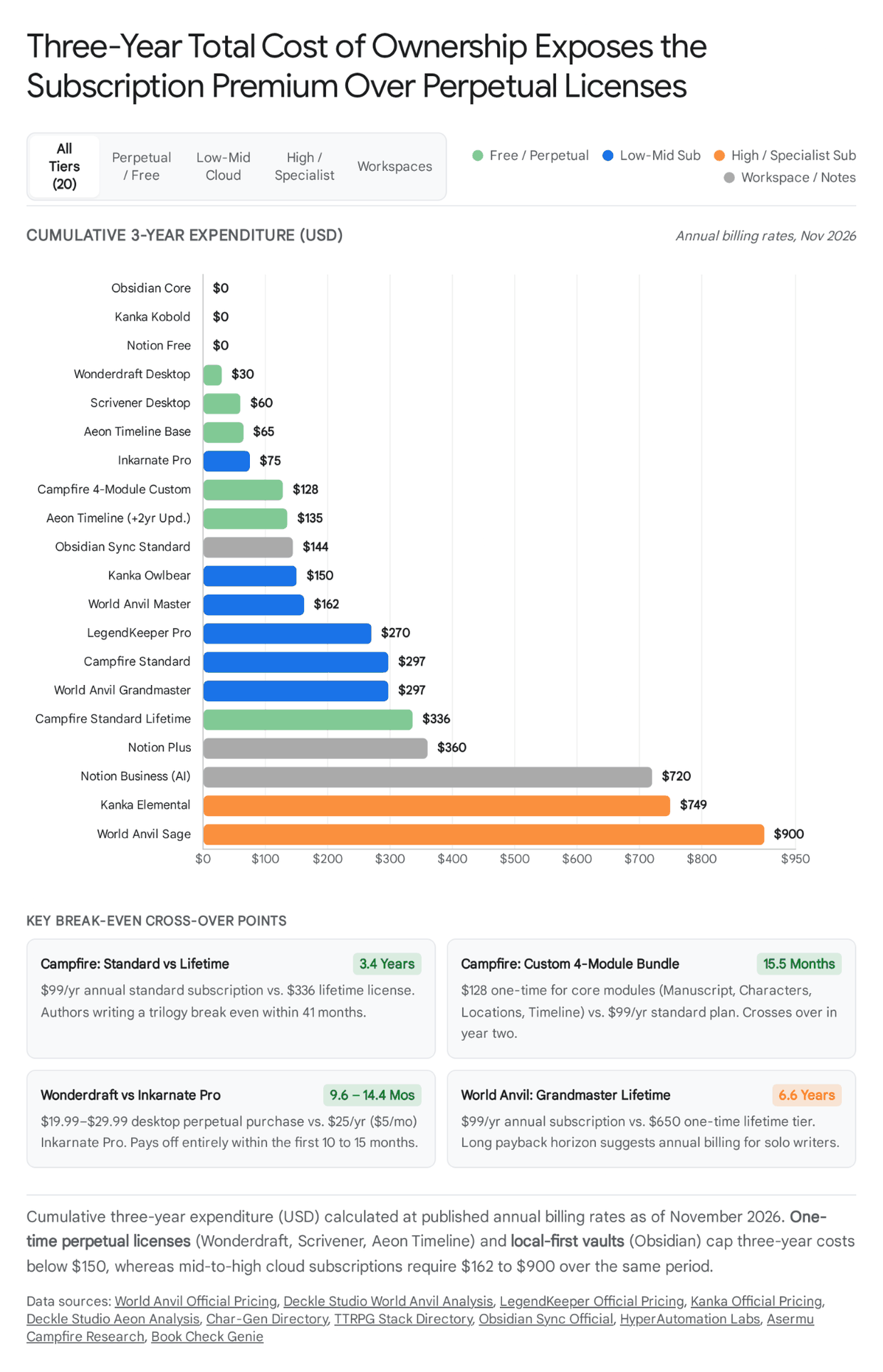
Evaluating creative writing software by monthly headline price conceals the cumulative financial divergence between free/local tools, recurring cloud subscriptions, and perpetual one-time licenses over a multi-year novel or campaign cycle[1].
Access-Model Grouping and Break-Even Matrix
| Access Model Tier | Tools & Specific Plans Included | Year 1 Cost | 3-Year Total Cost | 5-Year Total Cost | Break-Even Horizon vs. Adjacent Tier |
|---|---|---|---|---|---|
| [1]. Generous Free Tier (Core worldbuilding usable indefinitely) | Kanka Kobold: $0 (unlimited entries/campaigns, with ads, 3 MiB file cap)[6]; Obsidian Core: $0 (unlimited local notes, plugins, commercial use)[7]; Notion Free: $0 (unlimited solo pages, 5 MB file cap)[9]; Inkarnate Free: $0 (3 maps, 2K export)[16]. | $0.00 | $0.00 | $0.00 | Baseline ($0). Upgrading to Low Subscription is triggered strictly by convenience (automated device sync, ad removal, or 10 MiB+ map image uploads) rather than entity limits[7]. |
| [2]. Limited Free / Trial-Only (Paywall blocks privacy, scale, or editing) | World Anvil Freeman: $0 (public-only, 42 articles, 2 maps, no Manuscripts)[1]; Campfire Free: $0 (25k manuscript words, 10 characters, 20 timeline events)[4]; LegendKeeper Basic: $0 (14-day trial; reverts to read/export-only)[5]; Book Check Genie Free: $0 (1 sample check up to 3k–5k words)[19]. | $0.00 | $0.00 | $0.00 | Immediate paywall: LegendKeeper forces a paid upgrade at Day 15[5]; World Anvil forces a $54.00/yr upgrade on Day 1 if the writer requires privacy[1]; Campfire forces an upgrade around Chapter 8 (~25,000 words)[4]. |
| [15]. One-Time Perpetual Purchase (Buy once, own current version forever) | Wonderdraft: $29.99 once[17]; Scrivener (Desktop): $59.99 once ($49.00 promo)[1]; Aeon Timeline 3: $65.00 once (includes 1 yr updates; optional $35.00/yr after)[18]; Campfire Custom Lifetime (4 Core Modules): ~$128.00 once[23]; Deckle (Comparator): $197.00 once[1]. | $29.99 – $197.00 | $29.99 – $197.00 (Aeon with 2 optional update renewals = $135.00)[18] | $29.99 – $197.00 (Aeon with 4 update renewals = $205.00)[18] | Wonderdraft ($29.99) vs. Inkarnate Creator ($39.99/yr): Breaks even in 9 months[16]. Scrivener ($59.99) vs. Campfire Annual ($99.00/yr): Breaks even in 7.3 months[1]. Campfire 4-Module Custom ($128.00) vs. Campfire Annual ($99.00/yr): Breaks even in 15.5 months[23]. |
| [21]. Low Subscription (Under $95/year) | Inkarnate Creator: $39.99/yr ($7.99/mo monthly)[16]; Obsidian Sync Standard: $48.00/yr ($4.00/mo annual; $28.80/yr student/nonprofit)[25]; Kanka Owlbear: $49.92/yr ($4.16/mo annual; $4.99/mo monthly)[6]; LegendKeeper Pro: $90.00/yr ($9.00/mo monthly)[5]. | $39.99 – $90.00 | $119.97 – $270.00 | $199.95 – $450.00 | Annual vs. Monthly Billing: Inkarnate Creator annual ($39.99) breaks even vs. monthly ($7.99/mo) at Month 6[16]; Obsidian Sync annual ($48.00) and LegendKeeper annual ($90.00) break even vs. monthly at Month 10[5]. |
| [19]. Mid Subscription & Pay-Per-Pass ($54 to $188/year) | World Anvil Master: $54.00/yr ($7.00/mo monthly; $58.00/yr in legacy third-party logs)[1]; Obsidian Sync Plus / Publish: $96.00/yr each ($8.00/mo annual)[8]; Campfire Standard: $99.00/yr annual ($144.00/yr at $12.00/mo monthly; list $160.00/yr)[3]; Kanka Wyvern: $99.96/yr ($8.33/mo annual)[6]; Notion Plus: $120.00/yr ($10.00/mo annual; $144.00/yr monthly)[10]; Book Check Genie Single Pass: £19.00/check (2 checks/yr = £38.00/yr)[19]. | $54.00 – $144.00 (or £38.00/yr for 2 single checks) | $162.00 – $432.00 | $270.00 – $720.00 | World Anvil Master Annual ($54.00) vs. Monthly ($7.00/mo): Breaks even at Month 8[24]. Campfire Standard Annual ($99.00/yr) vs. Standard Lifetime ($336.00): Breaks even at 3.39 years (41 months); at monthly billing ($12.00/mo), Lifetime breaks even in 28 months[23]. Book Check Genie Single Pass (£19.00) vs. Pro Author (£22.00/mo): Single Pass is cheaper unless running 14+ checks per year[19]. |
| [24]. High Subscription & Specialist Tiers ($99–$300+/year or $250+ one-time) | World Anvil Grandmaster: $99.00/yr ($144.00/yr at $12.00/mo monthly; $105.00/yr in Mar 2026 logs)[1]; Campfire Standard Lifetime: $336.00 once (list $420.00; previously ~$254.00 in earlier waves)[23]; Notion Business (with AI): $240.00/yr ($20.00/mo annual)[10]; Kanka Elemental: $249.84/yr ($20.82/mo annual; $299.88/yr monthly)[6]; World Anvil Sage: $300.00/yr ($34.00/mo monthly)[1]; Book Check Genie Pro Author / Studio: £264.00/yr (£22.00/mo) to £588.00/yr (£49.00/mo)[19]; World Anvil Lifetime: $650.00 (Grandmaster) / $1,350.00 (Sage) once[1]. | $99.00 – $1,350.00 | $297.00 (WA Grandmaster Annual) – $900.00 (WA Sage Annual) | $336.00 (Campfire Lifetime) – $1,500.00 (WA Sage Annual) | World Anvil Grandmaster Lifetime ($650.00) vs. Annual ($99.00/yr): Requires 6.57 years to break even[1]. World Anvil Sage Lifetime ($1,350.00) vs. Annual ($300.00/yr): Breaks even at 4.50 years[1]. |
Scroll sideways to see all columns →
Direct Query Resolutions: Privacy and Marginal-Cost Economics
Query 1: "Is World Anvil worth it if a writer only needs a private wiki?"
No. Paying $54.00 per year ($162.00 over three years) for World Anvil Master solely to make a world private is economically inefficient when Kanka's free Kobold tier provides unlimited private campaigns and entries at $0.00 forever (kanka.io/pricing, verified September 7, 2026) and Obsidian provides 100% offline local privacy on the user's hard drive at $0.00 (obsidian.md/sync, verified October 28, 2026)[1]. World Anvil Master only justifies the $54.00 annual expenditure when the author actively utilizes the specialized tooling bundled alongside privacy: the 25-plus structured worldbuilding templates, Chronicles parallel map-linked timelines, interactive family trees, diplomatic relation webs, and custom calendars (worldanvil.com/pricing, verified November 1, 2026)[1].
Query 2: "Is a dedicated worldbuilding tool worth it versus Obsidian or Notion when a writer already pays for them?"
For a solo novelist, rarely; for a tabletop game master or visual cartographer, yes. When a writer already pays $48.00/year for Obsidian Sync or $120.00/year for Notion Plus, the marginal software cost of hosting a story bible inside that existing workspace is $0.00[9]. Furthermore, keeping the worldbuilding bible inside Obsidian or Notion eliminates app-switching friction during manuscript drafting[1]. Adding a $90.00/year LegendKeeper Pro or $99.00/year Campfire Standard subscription on top of an existing notes application is only justified if the project depends on three domain-specific capabilities that general note apps cannot replicate natively without brittle workarounds: multi-layered interactive cartography that zooms through nested regional maps with distance rulers, polygon overlays, and fog-of-war (LegendKeeper, World Anvil, Kanka)[24]; non-Gregorian calendar mathematics capable of modeling custom fantasy months, leap years, and multi-moon phases natively (LegendKeeper, World Anvil, Campfire, Aeon Timeline)[24]; and granular player or reader spoiler gating that shares a live wiki URL where specific paragraphs or entity fields remain hidden behind secret tags (World Anvil, Kanka, LegendKeeper)[24].
4. The "World Documented vs. Book Written" Structural Gap
Most software comparisons evaluate worldbuilding platforms as if compiling an exhaustive encyclopedia is the creative end goal. For a novelist, it is not—the completed manuscript is[1]. Across the creative writing ecosystem, a structural chasm separates world documentation from chapter composition, and this gap is the primary reason novelists abandon dedicated worldbuilding subscriptions mid-draft[1].
4.1 Architectural Taxonomy: World-First vs. Manuscript-First vs. Agnostic Canvas
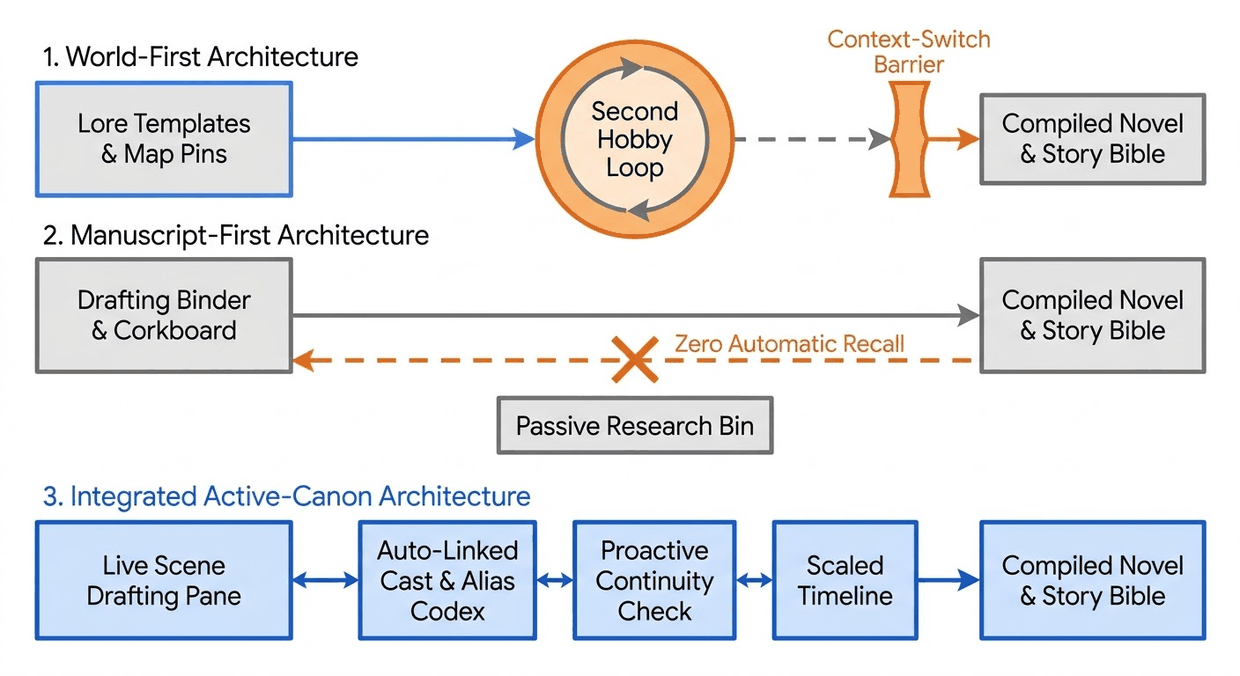
Software tools dictate creative behavior through their default interface hierarchy. World-first platforms with attached manuscript modules—specifically World Anvil and Campfire Writing—place the encyclopedia at the center of the user experience[1]. World Anvil's primary navigation revolves around 25-plus article templates, interactive maps, and timelines; its Manuscripts tool is locked behind the $54.00/year Master tier, functions exclusively online in a browser, and exports drafts only as HTML (deckle.studio/wiki/workflow/software/world-anvil, verified November 1, 2026)[1]. Campfire Writing provides a more capable Manuscript module that supports desktop offline drafting and PDF, EPUB, and DOCX exports, yet the manuscript remains just 1 of 18 equal modules competing for screen space alongside species, languages, calendars, and magic systems[1].
Conversely, manuscript-first environments with a research bin—exemplified by Scrivener—center the entire interface on the manuscript binder, scene corkboard, and compilation pipeline[1]. Worldbuilding in Scrivener resides inside an unstructured "Research" folder at the bottom of the binder, where a character profile is a static document with no relational awareness of the prose scenes above it[1]. Sitting outside both camps, domain-agnostic canvases like Obsidian and Notion are neither world-first nor manuscript-first; they treat a novel chapter and a lore article as identical primitives (a Markdown file in Obsidian; a page block in Notion)[1]. That symmetry makes cross-linking a scene directly to a character sheet via [[wikilinks]] or @-mentions frictionless, but the software offers zero native structure for novel compilation, fantasy chronology, or narrative pacing[1].
4.2 The "Second Hobby" Risk (Productive Procrastination)
User reports across fantasy and science-fiction writing communities consistently identify a behavioral hazard in template-heavy platforms: worldbuilding becomes a substitute for writing the novel[1]. When a platform presents 25-plus empty template categories (World Anvil) or 18 distinct modular dashboards (Campfire), completing database fields triggers a psychological sense of creative progress without advancing the narrative plot[1]. A novelist can spend months designing custom lunar calendars, diplomatic relation webs, and regional flora articles as a way of feeling productive without writing chapter eleven[1]. This dynamic is a user-reported workflow risk rather than a software defect; for hobbyist worldbuilders and TTRPG campaign creators, deep encyclopedic creation is a rewarding standalone activity[1]. For a deadline-driven novelist, however, every form field unrelated to an active scene introduces procrastination risk.
4.3 The Recall Problem: Passive Storage vs. Active Surfacing
Storing canon is straightforward; retrieving the exact right detail at the moment of prose composition is the actual bottleneck in long-form fiction[1]. Traditional binders like Scrivener, Notion Free, and Kanka rely on passive storage: Scrivener will hold a character sheet forever and never once remind the author during Chapter 24 that the character had a brother established in Chapter 31. Because the writer must pause drafting, remember that a fact might exist, and manually search the binder, forgotten details slip past unsearched and create continuity errors[15].
A second tier of tools employs reactive auto-linking and contextual casting (World Anvil, LegendKeeper, Obsidian, OnlyWorlds Atlas, and Deckle)[1]. As the writer types @ or [[, or as an auto-linker scans the text, entity names and aliases become hoverable tooltips[1]. Newer 2026 architectures—such as Deckle's alias-aware Codex (deckle.studio, November 1, 2026) and OnlyWorlds Atlas's writing pane (onlyworlds.com/changelog, November 2, 2026), which automatically populates a scene's Cast sidebar with every linked character, protagonist, antagonist, narrator, and zone alongside Suggested secondary links—surface relevant lore in the writer's peripheral vision without manual queries[1]. The third and highest tier—represented by proactive continuity interception in Penseed and Book Check Genie—actively reads the drafted chapter against the accumulated story state and warns the writer when a rule, physical trait, or timeline sequence is contradicted[15].
4.4 Direct Verdict: "Do I need a worldbuilding tool to write a novel?"
No—a standalone novel with a linear timeline and a limited cast can be written entirely inside a standard word processor or Scrivener's binder without a dedicated worldbuilding tool[1]. However, the retrieval problem grows non-linearly with series length, cast size, and chronological complexity[15]. Once a project expands past Book One into a multi-book series or a 200+ chapter web serial, human working memory cannot reliably track incidental canon such as minor character ages, travel durations, planted foreshadowing clues, and magic constraints[15]. At that scale, tools that merely store lore in isolated folders add administrative overhead, whereas the tools that solve active retrieval and continuity checking during drafting are the ones worth paying for[1].
5. Automated Canon Consistency and Continuity Checking: The Emerging Layer
Between 2025 and late 2026, automated narrative continuity checking emerged as a distinct software category above traditional worldbuilding wikis[15]. Historically, catching canon contradictions required hiring a human continuity editor or manually cross-referencing a series bible spreadsheet. Specialist applications now apply large language models (LLMs) and incremental state-tracking graphs directly to manuscript prose[15].
5.1 What Dedicated Continuity Tools Do in 2026
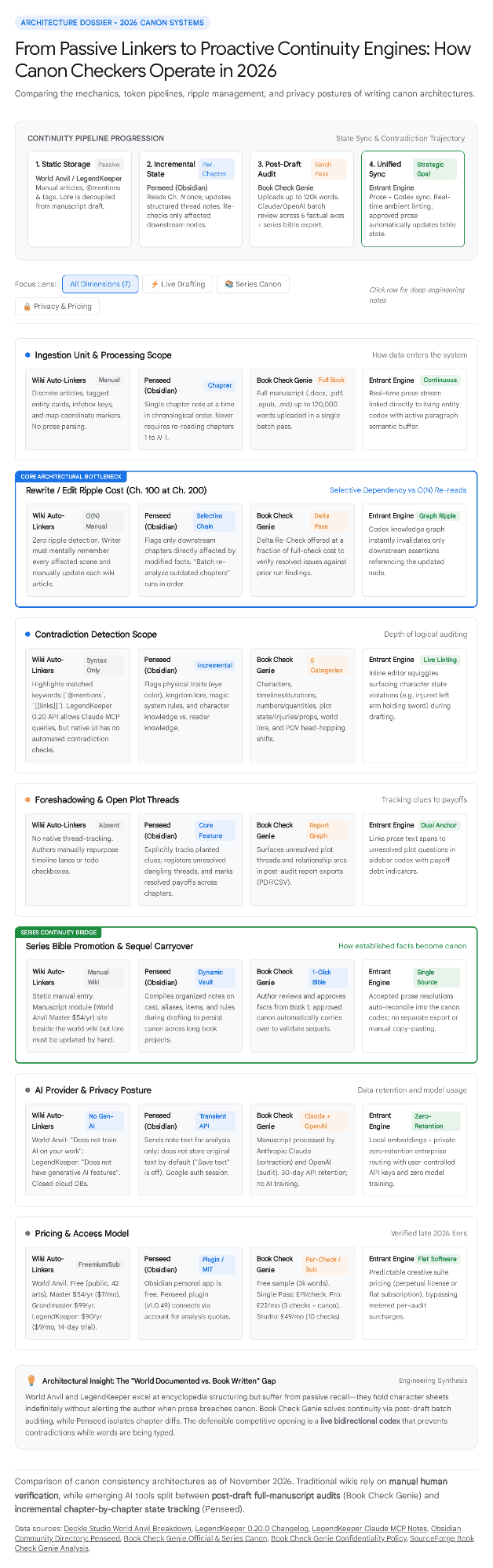
Founded in the United Kingdom in 2025 and launched across startup directories in October 2026 (bookcheckgenie.com, verified October 20, 2026), Book Check Genie operates as an automated continuity auditor for completed manuscript drafts[19]. Authors upload a full manuscript file (.docx, .pdf, .epub, .rtf, .txt, or .md up to 120,000 words per Single Pass at £19.00, or 3 checks per month on Pro Author at £22.00/month)[19]. The platform sends the manuscript text to Anthropic's Claude API to extract structured story facts, timelines, relationships, and summaries; during a full check, the continuity audit step is executed by either Anthropic's Claude API or OpenAI's API (bookcheckgenie.com/confidentiality, updated October 20, 2026)[26]. Book Check Genie flags chapter-referenced, quote-supported contradictions across six narrative domains: Characters (appearance, ages, names, relationships), Timeline and Sequence (dates, durations, event order), Numbers and Facts (distances, quantities, countdowns), Plot State and Physical Logic (injuries, props, role changes), Worldbuilding and Lore (world rules, geography, travel times), and Point of View and Voice (head-hopping, tense shifts)[19]. Rather than rewriting prose, the tool allows the author to mark findings as resolved, intended, or dismissed and approve story facts into a persistent Series Bible against which subsequent sequels are automatically audited, with discounted Delta Re-Checks (using Anthropic only) verifying revisions[19].
Operating inside the drafting environment rather than post-draft, Penseed (v1.0.49, MIT license, verified on community.obsidian.md/plugins/penseed in November 2026) is an Obsidian plugin developed by Reborn Walker that tracks narrative consistency chapter by chapter[15]. Whereas standard AI writing plugins re-read the entire book from Chapter 1 on every query—making analysis of Chapter 500 slow and expensive—Penseed reads each chapter once as it is written and maintains organized notes on planted foreshadowing threads, character aliases, world rules, and reader knowledge boundaries[15]. By default, Penseed uses the transmitted text only to build its story notes and does not store the author's original chapter prose on its servers[15]. Crucially, when an author rewrites an earlier chapter (such as editing Chapter 100 while at Chapter 200, or Chapter 205 in a 500-chapter serial), Penseed calculates causal ripple dependencies to identify the exact handful of later chapters affected by that change, allowing the author to re-analyze only the outdated chapters in order[15].
5.2 Native Wiki Linking vs. Proactive Contradiction Detection
A fundamental engineering distinction separates dedicated wiki tools (World Anvil, LegendKeeper, Kanka, Campfire) from continuity checkers: wikis perform storage and hyperlinking, not proactive contradiction detection[1]. World Anvil's auto-linker cross-references entity names as the author types, and LegendKeeper generates @-mention backlinks, infoboxes, and relationship boards[1]. However, if a character sheet states that a character has green eyes and lost their sword in Chapter 2, and the novelist writes in Chapter 14 that the character blinked their brown eyes and drew that same sword, a wiki auto-linker will hyperlink the character's name without raising any alert[1]. Even when LegendKeeper's October 2026 REST API (v0.20.0) is paired with the unofficial Claude Desktop MCP server (swiftj/golk, November 2026) to answer lore queries like "What do we know about the Brine Witch?", the system waits for the writer to remember to ask rather than intercepting contradictions automatically[27].
5.3 What No Current Tool Does Yet
Disclosure: TexFaber, which publishes this report, is building writing software with a story wiki of this kind. No product in this section is available to buy; the comparison above covers tools that writers can use today.
Benchmarking the incumbents across linking depth, timeline management, map integration, and continuity checking defines the exact competitive opening for a new wiki-building engine embedded inside creative writing software. Current tools force a trade-off: dedicated wikis (World Anvil, Campfire, LegendKeeper, Kanka) store structured canon before drafting but cannot verify manuscript prose against it[1]; post-draft checkers (Book Check Genie) audit prose only after a full manuscript upload to third-party APIs[19]; and incremental plugins (Penseed) require configuring an unguided Obsidian vault[15].
A wiki that actively checks canon against the manuscript as chapters are written—rather than waiting for the writer to remember to check a passive article—is a fundamentally different product category from a wiki that merely stores canon[1]. By unifying an alias-aware Story Codex, a scaled timeline that computes character ages from birth fields (matching Aeon Timeline and Deckle), a scene-linked cast sidebar (matching OnlyWorlds Atlas), and incremental chapter-level contradiction detection (matching Penseed's ripple efficiency) inside the primary drafting studio, a new entrant eliminates both the context-switch barrier and the full-manuscript re-upload bottleneck[1].
5.4 Direct Verdict: "Can AI find plot holes in my novel?"
Yes, partially—AI continuity tools reliably detect factual, chronological, numeric, POV, and world-rule contradictions across a manuscript, though deeper structural or motivational plot holes still require human editorial judgment[15]. Book Check Genie is the current specialist for full-manuscript auditing (£19.00 per single check up to 120,000 words or £22.00/month for series tracking on bookcheckgenie.com, verified October 20, 2026), extracting timelines and character facts to flag contradictions with chapter quotes[19]. Its primary limitation is that it operates post-draft via a full manuscript upload to external cloud APIs (Anthropic Claude and OpenAI) rather than catching errors live during scene composition, where Penseed (v1.0.49 for Obsidian) serves incremental chapter-by-chapter writers[15].
6. "Best For X" Reader Profile Verdicts
Best Worldbuilding Tool for Deep Fantasy/Sci-Fi Worldbuilders
World Anvil is the premier platform for taxonomic worldbuilding, offering 25-plus interconnected templates covering species, diplomacy, family trees, and parallel Chronicles timelines from $54.00/year on the Master tier (worldanvil.com/pricing, verified November 1, 2026)[1]. Campfire Writing ($12.00/month, $99.00/year, or $336.00 lifetime) is the runner-up for novelists wanting guided magic, language, and culture modules beside a draft[1].
Best Worldbuilding Tool for Fast-Prepping Game Masters
LegendKeeper ($9.00/month or $90.00/year after a 14-day trial on legendkeeper.com/pricing, verified October 7, 2026) wins for fast-prepping game masters through its slash-command block editor, instant @-mention hover previews, nested regional maps, and free player seats[5]. Kanka ($0 Kobold tier; $4.16/month annual Owlbear) is the runner-up when zero upfront cost is mandatory[6].
Best Free Worldbuilding Tool
Kanka (Kobold tier, $0 forever on kanka.io/pricing, verified September 7, 2026) is the best dedicated free worldbuilding wiki, providing unlimited private campaigns, unlimited entries, custom calendars, timelines, and interactive maps (capped at 5 MiB per map file) with ads[6]. Obsidian ($0 forever) is the co-winner for writers building local Markdown vaults without file-size caps[7].
Best Worldbuilding Tool for Novelists Who Hate Setup
Scrivener ($59.99 one-time desktop license per OS on deckle.studio, verified November 1, 2026) wins for setup-averse novelists by placing scenes on a visual corkboard and keeping research notes in a binder beside the draft with zero template configuration[1]. Campfire Writing ($0 up to 25,000 words; $12.00/month Standard) is the runner-up for ready-made character forms[4].
Best Local / Privacy-First Worldbuilding Setup
Obsidian ($0 core app; optional $4.00/month annual encrypted Sync on obsidian.md/sync, verified October 28, 2026) is the unmatched choice for local-first privacy, storing every note and chapter as plain-text Markdown files on the author's hard drive with no account required[7]. Kanka's self-hosted free version (source-available, without premium features or official support) is the runner-up for private self-hosted wikis[12].
Best All-in-One Workspace for Writers Who Already Use Notion
Notion ($0 Free solo tier; $10.00/month annual Plus tier on breeze.pm/articles/notion-ai-pricing, verified October 26, 2026) wins for existing Notion users because its marginal cost is zero and its relational databases directly cross-link a series bible with manuscript trackers and launch calendars[2]. Obsidian (using the Bases core plugin) is the runner-up for local database views[9].
Best Modular Worldbuilding Tool
Campfire Writing (campfirewriting.com/pricing, verified October 7, 2026) is the definitive modular platform, organizing lore into 18 distinct tools (Characters, Locations, Magic, Timeline, Calendar, Languages, Manuscript) unlocked via a custom per-module lifetime plan (~$7.50–$45.00 once per module) or a $99.00/year subscription[3]. Obsidian ($0) is the runner-up via its toggleable community plugins[7].
Best Map-Making Tool for Worldbuilders
Wonderdraft ($29.99 one-time desktop purchase for Windows, macOS, and Linux on wonderdraft.net, verified November 7, 2026) wins for overland cartographers who want procedural continent generation, custom terrain brushes, and subscription-free ownership[21]. Inkarnate ($0 for 3 maps at 2K; $7.99/month or $39.99/year Creator for 8K export and 25,000+ assets) is the co-winner for browser convenience[21].
Best Timeline Tool for Complex Chronologies
Aeon Timeline 3 ($65.00 one-time perpetual license across 5 Mac, Windows, and iOS devices on aeontimeline.com/pricing, verified October 31, 2026) is the specialist winner for complex chronologies, offering custom fantasy calendars, automatic character age calculations, and two-way Scrivener and Ulysses sync[18]. World Anvil Chronicles ($54.00/year Master) is the runner-up for map-linked parallel histories[1].
Best Tool for Canon Consistency Across a Series
Book Check Genie (£19.00 Single Pass up to 120,000 words or £22.00/month Pro Author on bookcheckgenie.com, verified October 20, 2026) wins for series continuity, scanning full manuscripts to flag character, timeline, numeric, and lore contradictions while promoting approved facts into a Series Bible[19]. Penseed for Obsidian (v1.0.49) is the runner-up for chapter-by-chapter tracking[15].
Best Tool for TTRPG Campaign Management
Kanka ($0 Kobold tier; $4.16/month annual Owlbear on kanka.io/pricing, verified September 7, 2026) wins on TTRPG campaign value, delivering per-entity player permissions, quests, journals, calendars, and v3.5 whiteboards for up to 10 free members[6]. LegendKeeper Pro ($90.00/year) is the runner-up for GMs prioritizing nested tactical maps, multiplayer cursors, and in-project chat (v0.21.0)[5].
Best Worldbuilding Tool for Pantsers (Discovery Writers)
Obsidian ($0 free forever on obsidian.md/sync, verified October 28, 2026) is the optimal environment for discovery writers ("pantsers") because lore stays out of the way: authors type inline [[wikilinks]] for new characters or towns mid-sentence without leaving the chapter, fleshing out notes later[1]. LegendKeeper ($90.00/year) is the runner-up for browser-based inline @-mention creation[5].
7. Reader Questions This Report Answers
| Tool or pairing | Questions writers ask |
|---|---|
| World Anvil (Standalone) | "Is World Anvil worth it for novelists", "World Anvil free plan limitations", "Is World Anvil worth it if I only need a private wiki", "World Anvil Master vs Grandmaster pricing 2026", "Did World Anvil remove Journeyman tier", "World Anvil lifetime subscription cost", "Can you write a novel in World Anvil Manuscripts" |
| Campfire Writing (Standalone) | "Is Campfire Writing worth it", "Campfire Writing per module pricing list", "Campfire Standard lifetime price 2026", "Campfire free tier 25000 word limit", "Does Campfire Writing work offline on desktop", "Cheapest way to buy Campfire modules for life" |
| LegendKeeper (Standalone) | "LegendKeeper no free tier", "Is LegendKeeper Pro worth $90 a year", "What happens to LegendKeeper project when trial ends", "LegendKeeper API SDK 0.20 release", "How to connect Claude AI to LegendKeeper MCP", "Do players have to pay for LegendKeeper" |
| Kanka (Standalone) | "Is Kanka really free forever", "Kanka Owlbear vs Wyvern vs Elemental pricing", "What does Kanka paid tier buy", "Kanka file upload limit", "Can I self-host Kanka", "How to export Kanka campaign to Obsidian vault" |
| Obsidian (Standalone) | "Is Obsidian free for commercial use 2026", "Is Obsidian Sync worth $4 a month", "Obsidian Sync Standard vs Plus limits", "How to sync Obsidian for free without paying", "Best Obsidian plugins for fantasy worldbuilding", "How to build a story bible in Obsidian with Bases" |
| Notion (Standalone) | "Notion Plus vs Business pricing for writers 2026", "Did Notion remove the $10 AI add-on", "Notion free plan 5MB file limit worldbuilding", "Best all-in-one Notion workspace for indie authors" |
| Inkarnate & Wonderdraft (Standalone) | "Best map maker for fantasy writers", "Inkarnate Creator vs Studio price", "Inkarnate free version 3 map limit", "Wonderdraft one time purchase price", "Does Wonderdraft have a monthly subscription", "One time purchase fantasy map software offline" |
| Aeon Timeline (Standalone) | "Is Aeon Timeline 3 a subscription or one time purchase", "Aeon Timeline $65 license and $35 update plan", "Best timeline software for custom fantasy calendars", "How to sync Aeon Timeline with Scrivener 3", "Software that automatically calculates character ages" |
| Book Check Genie & Penseed (Standalone) | "Can AI find plot holes in my novel", "How to keep track of canon in a series", "Book Check Genie pricing £19 single pass", "Book Check Genie review continuity checker", "Penseed Obsidian plugin narrative consistency", "How to track foreshadowing in a 500 chapter novel" |
| Pairing 1: World Anvil vs. Campfire | "World Anvil vs Campfire which is better", "World Anvil vs Campfire Writing for novelists 2026", "Campfire modular worldbuilding vs World Anvil templates" |
| Pairing 2: World Anvil vs. LegendKeeper | "World Anvil vs LegendKeeper", "LegendKeeper vs World Anvil UI speed and maps", "How to import World Anvil zip into LegendKeeper" |
| Pairing 3: World Anvil vs. Kanka | "Kanka vs World Anvil free tier", "World Anvil vs Kanka for D&D campaign", "Best free alternative to World Anvil with private worlds" |
| Pairing 4: LegendKeeper vs. Kanka | "LegendKeeper vs Kanka", "Is LegendKeeper worth $90 over Kanka free tier", "Campfire vs LegendKeeper vs Kanka" |
| Pairing 5: Obsidian vs. Notion | "Obsidian vs Notion for worldbuilding", "Notion vs Obsidian for story bible 2026", "Local markdown files vs Notion databases for writers" |
| Pairing 6: World Anvil vs. Obsidian | "Can Obsidian replace World Anvil", "World Anvil vs Obsidian for fantasy writers", "DIY Obsidian vault vs World Anvil subscription" |
| Pairing 7: Campfire vs. Scrivener | "Campfire vs Scrivener", "Campfire Writing vs Scrivener for fantasy novelists", "Scrivener research bin vs Campfire modules" |
| Pairing 8: Inkarnate vs. Wonderdraft | "Inkarnate vs Wonderdraft", "Wonderdraft vs Inkarnate for book maps", "Browser map maker vs desktop map software" |
| Pairing 9: Aeon Timeline vs. Campfire | "Aeon Timeline vs Campfire timeline", "Is Aeon Timeline better than Campfire timeline and calendar modules", "Aeon Timeline vs Plottr vs Campfire" |
| Pairing 10: Wiki vs. Notes App & Workflow Gap | "Is a dedicated worldbuilding tool worth it versus Obsidian or Notion", "Do I need a worldbuilding tool to write a novel", "Best tool for series bible", "Best free worldbuilding tool for writers", "How to stop worldbuilding procrastination and write my book" |
Scroll sideways to see all columns →
8. "Is X Worth It?" Decision Case Studies
8.1 Is World Anvil Master Worth It? (~$54/Year)
Verdict: World Anvil Master ($54.00/year or $7.00/month, verified on worldanvil.com/pricing November 1, 2026) is worth the subscription only if a creator actively utilizes its 25-plus structured lore templates, family trees, custom calendars, and Chronicles timelines; if the sole requirement is making a world private, staying on Kanka's free tier or Obsidian is the superior financial decision[1].
World Anvil's free Freeman tier enforces strict ceilings: worlds and articles are public-only, storage caps at 100 MB (1 MB per image), maps and timelines are limited to two each, articles cap at 42, and the Manuscripts drafting tool is disabled[1]. Following the deprecation of the legacy Journeyman tier on World Anvil's primary pricing page, Master ($4.50/month billed annually at $54.00/year, or $6.50/month and $58.00/year in March 2026 third-party logs) is the entry gate for privacy, ad removal, unlimited articles across 10 worlds, 2 GB storage, 4 co-authors, 10 subscribers, secret blocks, family trees, diplomatic relation webs, and Manuscripts[1].
The decisive factor is whether the depth of World Anvil's pre-built templates justifies its steep learning curve[1]. For taxonomic worldbuilders who rely on guided questionnaires to develop ecology, mythologies, and political factions—or GMs who need interactive map marker groups and player secrets—Master delivers unmatched structural breadth for $54.00/year[1]. Conversely, novelists who simply want a private story bible without public web-publishing complexity find World Anvil's interface over-engineered, and should use Kanka's free Kobold tier ($0 private entries) or Obsidian ($0 local files) instead[1].
8.2 Is Campfire Standard Worth It? ($12/Month, $99/Year, or $336 Lifetime)
Verdict: Campfire Standard ($12.00/month, $99.00/year, or $336.00 lifetime, verified on campfirewriting.com/pricing October 7, 2026) is worth paying for only if an author uses five or more of its 18 worldbuilding modules; writers who only need core character, location, timeline, and manuscript tools should either buy a custom 4-module lifetime bundle (~$128.00 once) or use Scrivener ($59.99 once)[1].
Campfire's free tier grants indefinite access to all 18 modules on web and desktop (alongside a free mobile app) but enforces hard element limits: 25,000 manuscript words, 10 characters, 20 timeline events, and 2 maps[3]. Because a full-length novel runs 80,000 to 120,000 words, any novelist drafting in Campfire hits the free cap roughly a quarter of the way through Book One[19]. Upgrading to Standard unlocks unlimited elements across all 18 modules, offline desktop access, and DOCX, EPUB, and PDF exports[1].
The decisive factor is whether the writer wants to build the world as a set of structured modules or write the book first[1]. At $99.00/year ($297.00 over three years) or $336.00 for Standard Lifetime, paying for all 18 modules is only cost-effective for speculative fiction authors who populate specialized panels like Magic, Species, Languages, Cultures, and Calendars, and who want future modules included[3]. If a writer only needs Characters (~$30.00), Locations (~$22.50), Timeline (~$30.00), and Manuscript (~$45.00), Campfire's custom lifetime plan unlocks those four modules permanently for roughly $128.00 once[23]. Writers who prefer drafting chapters first with unstructured research notes are better served by Scrivener at $59.99 once[1].
8.3 Is LegendKeeper Pro Worth It? ($90/Year)
Verdict: LegendKeeper Pro ($9.00/month or $90.00/year billed annually, verified on legendkeeper.com/pricing October 7, 2026) is worth the investment for collaborative tabletop GMs and worldbuilders who value editor speed, nested interactive cartography, and API extensibility above template count, whereas casual creators are priced out by the lack of a permanent free tier[5].
Unlike World Anvil, Campfire, and Kanka, LegendKeeper has no permanent free tier for creating a world[5]. New accounts receive a 14-day free trial without a credit card; once the trial expires, the free Basic plan restricts the creator to viewing and exporting existing projects, or collaborating as a guest inside another active subscriber's project[5]. Maintaining edit access to an owned world requires the $90.00/year Pro plan ($270.00 over three years)[5].
The decisive factor is whether UI speed and collaborative polish matter more than pre-built template depth[5]. LegendKeeper's block editor is the fastest in the dedicated wiki market, combining slash commands, instant @-mentions, Wikipedia-style Infoboxes (v0.19.1), and an interactive map engine (v0.18.0) that nests regional, city, and dungeon sub-maps with polygonal regions, distance rulers, and multiplayer cursors[14]. Furthermore, an unlimited number of players or co-authors join, chat (v0.21.0), and edit for free, whereas World Anvil requires the $99.00/year Grandmaster tier for 9 co-authors[24]. With the October 2026 release of its v3 REST API and SDK (v0.20.0), Pro users can also link Claude Desktop via MCP to automate lore queries[27].
8.4 Is Kanka (Any Paid Tier) Worth It? ($4.16 to $20.82/Month)
Verdict: For solo novelists and text-focused worldbuilders, Kanka's paid tiers (Owlbear at $4.16/month, Wyvern at $8.33/month, and Elemental at $20.82/month billed yearly, verified on kanka.io/pricing September 7, 2026) are rarely needed; upgrading is only worth it for visual GMs who require 10 MiB to 100 MiB high-resolution map uploads, ad removal, and boosted campaign limits[6].
Kanka's free Kobold tier is the most generous in the dedicated wiki category, providing unlimited campaigns, unlimited entries across all core entity types (Characters, Locations, Families, Organizations, Calendars, Timelines, Quests), per-entity permissions, and full JSON, Markdown, and Obsidian Vault ZIP exports forever[6]. Because no core worldbuilding feature is locked behind a paywall, most solo writers never need to pay[6].
What the paid tiers actually buy is fileupload capacity, ad removal, higher API rate limits (90 vs. 30 requests per minute), and "active premium campaigns"—1 on Owlbear ($49.92/year), 3 on Wyvern ($99.96/year), and 7 on Elemental ($249.84/year)[6]. On the free Kobold plan, standard campaigns cap at 10 members, 3 roles, 150 MiB of gallery storage, and a 3 MiB upload size per image or file and 5 MiB per map[6]. If a creator exports an 8K overland map from Inkarnate or Wonderdraft weighing 15 MiB, Kobold rejects the file; upgrading to Owlbear raises the upload cap to 10 MiB, Wyvern to 25 MiB (plus higher v3.5 whiteboard limits), and Elemental to 100 MiB[6]. Unless a creator hits that 5 MiB map ceiling or runs large multi-table groups, Kobold is sufficient[6].
8.5 Is Obsidian + Sync Worth It? ($4–$5/Month)
Verdict: Obsidian Sync Standard ($4.00/month billed annually at $48.00/year, or $5.00/month monthly, verified on obsidian.md/sync October 28, 2026) is worth paying for if a writer drafts across multiple operating systems and wants zero-maintenance end-to-end encrypted syncing, whereas single-device users or technical self-hosters should pay $0[7].
The core Obsidian app costs $0 for both personal and commercial use (following the February 20, 2025 removal of the mandatory commercial license), with unlimited local notes, backlinks, graph views, and over 1,000 community plugins[7]. Because an Obsidian vault is simply a local folder of plain-text .md files, the decisive question is first whether the author is willing to build their own worldbuilding templates, and second whether they want managed cross-device syncing[2].
Writers working on a single computer—or purely across Mac, iPhone, and iPad via free iCloud Drive—never need to pay for Obsidian Sync[7]. Technical users who want complete server control can also self-host sync for free using a CouchDB Docker container paired with the Self-hosted LiveSync community plugin, or sync via Git, Dropbox, or S3/WebDAV (Remotely Save)[7]. However, third-party cloud drives frequently trigger file-locking conflicts or slow background syncing on mobile iOS and Android devices[28]. Paying $48.00/year for Sync Standard ($28.80/year with the 40% student, faculty, and nonprofit discount) provides turnkey end-to-end encryption, 1 GB storage, 5 MB max file sizes, and 1 month of version history (while Sync Plus at $96.00/year expands limits to 10 vaults, 10 GB storage, and 200 MB files for heavy map users)[8].
9. 2025–2026 Market Shifts, Pricing Discrepancies, and Freshness Signals
9.1 World Anvil Tier Deprecation and Pricing Discrepancies
World Anvil's official feature documentation (https://www.worldanvil.com/learn/account/list-features, verified November 1, 2026) confirms that the Journeyman tier is officially deprecated and no longer available for new purchases, though legacy grandfathered accounts retain its expanded limits (5 worlds, 10 campaigns, unlimited articles)[1]. On World Anvil's live pricing page (https://www.worldanvil.com/pricing, rendered October 21 and November 1, 2026), the active tiers are Freeman ($0; 2 worlds, 42 articles, 100 MB storage, public-only), Master ($7.00/month or $54.00/year, granting 2 GB storage, 4 co-authors, 10 worlds, privacy, and Manuscripts), Grandmaster ($12.00/month, $99.00/year, or $650.00 one-time, granting 5 GB storage, 9 co-authors, and custom templates), and Sage ($34.00/month, $300.00/year, or $1,350.00 one-time, granting 15 GB storage and 20 co-authors)[1]. Where sources disagree: Kindlepreneur (https://kindlepreneur.com/world-anvil/, updated March 27, 2026) still lists Journeyman at $5.00/month ($50.00/year), Master at $6.50/month ($58.00/year), and Grandmaster at $12.00/month ($105.00/year)[1]; Storyflow (https://storyflow.so/blog/best-tools-worldbuilding-2026, 2026) lists Journeyman at $4.99/month, Master at $7.99/month, and Grandmaster at $12.99/month[2]; and CharGen (https://char-gen.com/blogs/best-ai-worldbuilding-tools-dnd-ttrpg-2026, checked August 2026) reports Master at $6.50/month with 0 co-authors and Grandmaster at $12.00/month with 4 co-authors[29].
9.2 Campfire Writing's Subscription Positioning vs. Per-Module Lifetime Purchases
Campfire Writing (https://campfirewriting.com/pricing, verified August 2 – October 7, 2026) expanded its platform to 18 modules and shifted its primary marketing toward all-access subscriptions: Standard Monthly at $12.00/month (discounted from a $19.00 list price), Standard Annual at $99.00/year (discounted from $160.00 list), and Standard Lifetime at $336.00 one-time (discounted from $420.00 list; earlier promotional waves and currency conversions cited ~$254.00 or $375.00) (https://asermu.com/blog/asermu-vs-campfire, October 2026)[3]. Despite the subscription-first layout, per-module purchasing remains active via Campfire's Custom Lifetime builder, where individual modules cost ~$7.50 to $45.00 once (with Manuscript and Calendar at ~$45.00 each, and Characters and Timeline at ~$30.00 each and Locations at ~$22.50, totalling ~$128.00 for four core modules)[23]. Official terms (https://campfirewriting.com/pricing) note that Standard Lifetime includes all future modules, whereas Custom Lifetime packages only receive updates for the selected modules[3].
9.3 LegendKeeper Version 0.20.0 API/SDK Release and Ecosystem Integration
On October 12, 2026, LegendKeeper released Version 0.20.0 (Foundations Vol. 3) (https://www.legendkeeper.com/changelog/legendkeeper-0-20-0-1/ and https://www.legendkeeper.com/developers/), introducing the official LegendKeeper v3 REST API and SDK (@legendkeeper/sdk) for paid Pro accounts ($9.00/month or $90.00/year)[5]. The API enables programmatic reading and writing of pages, blocks, maps, timelines, calendars, tags, templates, and images (expanded in v0.20.1 on October 14, 2026 to include text and cell colors)[27]. This release transformed LegendKeeper's integration story: by early November 2026, open-source developer swiftj released golk (v0.2.0 to v0.4.2, https://github.com/swiftj/golk/releases), a Go SDK and Model Context Protocol (MCP) plugin that lets Claude Desktop and Cowork read and write lossless LegendKeeper Markdown, create map pins and Harptos calendar timeline events, batch-generate up to 100 linked NPC pages with dry-run protection, and migrate Notion campaigns directly into LegendKeeper[30]. LegendKeeper also shipped v0.18.0 (new interactive map engine, January 10, 2026), v0.19.1 (Infoboxes and Properties blocks, August 18, 2026), and v0.21.0 (activity feed, in-project chat, and dice engine, October 27, 2026) (https://www.legendkeeper.com/tag/changelog/)[14].
9.4 Kanka Version 3.5 Whiteboards and Self-Hosting Status
Kanka (https://blog.kanka.io/2025/11/13/version-3-5-whiteboards-and-higher-limits/, November 13, 2025; pricing verified on https://kanka.io/pricing September 7, 2026) released Version 3.5, adding native relationship Whiteboards and raising campaign limits for Wyvern ($8.33/month annual; $9.99/month monthly) and Elemental ($20.82/month annual; $24.99/month monthly) subscribers while keeping the free Kobold tier unlimited for entries and campaigns[6]. Kanka's free version remains source-available and can be self-hosted without premium features or official support (https://docs.kanka.io/en/latest/self-hosting.html)[12]; a community-maintained Docker deployment also exists (https://github.com/Kanka-CE/kanka-ce-deploy)[31]. Kanka supports native campaign exports to JSON, Markdown, and Obsidian Vault ZIPs with frontmatter (https://rollsummary.com/alternatives/kanka, September 2026)[32].
9.5 Obsidian's Free Commercial License, Sync Tiers, and Bases Plugin
On February 20, 2025, Obsidian removed its mandatory commercial license requirement; the core desktop and mobile app is now 100% free for both personal and workplace/commercial use, with the $50.00/user/year Commercial license retained strictly as an optional supporter contribution (https://www.usecarly.com/blog/obsidian-pricing/, verified October 2026)[7]. On https://obsidian.md/sync (verified October 28, 2026), Sync Standard is priced at $4.00/month billed annually ($48.00/year; $5.00/month monthly) for 1 vault, 1 GB storage, and a 5 MB file size limit, while Sync Plus costs $8.00/month billed annually ($96.00/year; $10.00/month monthly) for 10 vaults, 10 GB storage, and 200 MB file limits[8]. On August 18, 2025, Obsidian 1.9.10 made its native Bases core plugin public, adding database views backed by local Markdown files and properties (https://obsidian.md/changelog/2025-08-18-desktop-v1.9.10/)[33].
9.6 Notion's AI Bundling into the $20/Month Business Tier
Notion overhauled its AI pricing model (https://hyperautomationlabs.co/compare/notion-vs-obsidian and https://www.breeze.pm/articles/notion-ai-pricing, verified October 26, 2026): rather than offering Notion AI as a standalone $8.00–$10.00/month add-on for Free or Plus ($10.00/member/month annual) accounts, Notion folded full Notion AI capabilities (Notion Agent, AI Meeting Notes, Enterprise Search) exclusively into its $20.00/member/month Business plan (billed annually; $24.00/month monthly), with Custom Agents billed extra at $10.00 per 1,000 credits[10]. Free and Plus plans now receive only a limited Notion AI trial, doubling the annual cost for solo writers who want AI inside Notion from $120.00/year to $240.00/year[10].
9.7 Emergence of Continuity Checkers and Cartography Price Variations
The launch of Book Check Genie (https://www.bookcheckgenie.com/, founded 2025, public launch October 4, 2026; Terms and Confidentiality updated September 30 and October 20, 2026) at £19.00 per Single Pass (120,000 words) and £22.00/month for Pro Author (3 checks/month plus automatic series canon) alongside Penseed (https://community.obsidian.md/plugins/penseed, v1.0.49, November 2026) established automated continuity checking as a dedicated software layer[15]. Where sources disagree on cartography pricing: Wonderdraft is listed at $19.99 one-time on https://www.ttrpgstack.com/tools/inkarnate/ and in community threads[21], but its own site and https://char-gen.com/alternatives/inkarnate give $29.99 one-time[17][20]. For Inkarnate, review sites such as ttrpgstack.com still list a Pro plan ($5.00/month or $25.00/year), but Inkarnate's own pricing page now offers only Free (3 maps, 2K export), Creator ($7.99/month or $39.99/year, 8K export) and Studio ($14.99/month or $79.99/year, 16K export) plans[16].
10. Consolidated Verification and Pricing Audit Log
| Tool / Platform | Verified Pricing & Tier Summary | Discrepancies / Secondary Figures Recorded | Primary Source URL | Last Verified Date |
|---|---|---|---|---|
| World Anvil | Freeman: $0 (public, 2 worlds, 42 articles, 100 MB). Master: $7.00/mo or $54.00/yr. Grandmaster: $12.00/mo, $99.00/yr, or $650.00 once. Sage: $34.00/mo, $300.00/yr, or $1,350.00 once. Journeyman deprecated[1]. | Kindlepreneur (Mar 27, 2026) lists Journeyman $50/yr, Master $6.50/mo ($58/yr), Grandmaster $105/yr[1]. Storyflow (2026) lists $4.99 / $7.99 / $12.99/mo[2]. CharGen (Aug 2026) lists 0 co-authors on Master vs. 4 on live table[24]. | https://www.worldanvil.com/pricing & https://www.worldanvil.com/learn/account/list-features[1] | November 1, 2026[1] |
| Campfire Writing | Free: $0 (capped at 25k manuscript words, 10 chars, 20 timeline events, 2 maps). Standard: $12.00/mo (list $19), $99.00/yr (list $160), or $336.00 lifetime (list $420). Custom Lifetime: ~$7.50–$45.00/module[3]. | Earlier waves/conversions cited ~$254 or $375 lifetime, and $1.50–$15/mo per-module subscriptions[22]. | https://campfirewriting.com/pricing & https://asermu.com/blog/asermu-vs-campfire[3] | October 7, 2026[4] |
| LegendKeeper | Basic: 14-day free trial (no card), then read/export-only for owned worlds; free guest collab. Pro: $9.00/mo or $90.00/yr ($7.50/mo annual). API/SDK shipped in v0.20.0 (Oct 12, 2026)[5]. | Storyflow (2026) cited $8/mo or $80/yr[2]; official pricing page confirms $9/mo and $90/yr USD[5]. | https://www.legendkeeper.com/pricing/ & https://www.legendkeeper.com/tag/changelog/[5] | October 27, 2026[34] |
| Kanka | Kobold: $0 (unlimited entries/campaigns, 3 MiB files, ads). Owlbear: $4.16/mo annual ($4.99/mo). Wyvern: $8.33/mo annual ($9.99/mo). Elemental: $20.82/mo annual ($24.99/mo)[6]. | Consistent across all 2026 sources; v3.5 (Nov 13, 2025) added Whiteboards and raised Wyvern/Elemental limits[6]. | https://kanka.io/pricing & https://blog.kanka.io/2025/11/13/version-3-5-whiteboards-and-higher-limits/[6] | September 7, 2026[32] |
| Obsidian | Core App: $0 free (personal & commercial since Feb 20, 2025). Sync Standard: $4.00/mo annual ($48/yr) or $5.00/mo. Sync Plus: $8.00/mo annual ($96/yr) or $10.00/mo. Publish: $8.00/mo annual ($10/mo). Commercial: $50/yr optional[7]. | Older comparisons still treat the $50/yr Commercial license as mandatory for teams; official docs confirm it is voluntary since Feb 20, 20257. | https://obsidian.md/sync & https://academy.techpresso.co/reviews/is-obsidian-worth-it[8] | October 28, 2026[8] |
| Notion | Free: $0 solo (5 MB file cap, 7-day history). Plus: $10.00/member/mo annual ($120/yr) or $12.00/mo. Business (with full Notion AI): $20.00/member/mo annual ($240/yr) or $24.00/mo. Custom Agents: $10/1,000 credits[10]. | Standalone Notion AI add-on was folded into the $20/mo Business tier; Free and Plus include only a limited AI trial[10]. | https://hyperautomationlabs.co/compare/notion-vs-obsidian & https://www.breeze.pm/articles/notion-ai-pricing[10] | October 26, 2026[10] |
| Inkarnate | Free: $0 (3 map slots, 787 assets, 2K export). Creator: $7.99/mo or $39.99/yr (100 maps, 25,000+ assets, 8K export). Studio: $14.99/mo or $79.99/yr (unlimited maps, 16K, commercial use)[16]. | ttrpgstack.com and older comparisons still list a $5/mo ($25/yr) Pro plan, which the vendor no longer offers[21]. | https://inkarnate.com/pricing[16] | November 7, 2026 |
| Wonderdraft | One-time desktop purchase (Win/Mac/Linux), no free tier, no subscription, commercial rights included[21]. | Vendor price is $29.99 one-time; ttrpgstack.com and Reddit threads list an older $19.99[21]. | https://www.wonderdraft.net/[17] | November 7, 2026 |
| Aeon Timeline 3 | One-time perpetual license: $65.00USD ($64.99 in-app) for 5 devices (Mac, Win, iOS) + 12 mos updates. Optional update renewal: $35.00/yr ($34.99 in-app). 14-day free trial[18]. | boldly.blue mischaracterizes the $65 fee as an annual subscription; aeontimeline.com/pricing explicitly confirms it is a one-time perpetual purchase[18]. | https://www.aeontimeline.com/pricing & https://www.aeontimeline.com/licensing-model[18] | October 31, 2026[18] |
| Book Check Genie | Free Sample: 1 check up to 3,000 words (5,000 on directory promos). Single Pass: £19.00/check (120k words). Pro Author: £22.00/mo (3 checks/mo + series canon). Studio/Editor: £49.00/mo (10 checks/mo)[19]. | Landing page (bookcheckgenie.com) states 3,000-word free sample[19]; SourceForge and PostYourStartup listings state 5,000 words / 3 chapters[35]. | https://www.bookcheckgenie.com/ & https://www.bookcheckgenie.com/confidentiality[19] | October 20, 2026[26] |
| Penseed | Free MIT-licensed Obsidian plugin (v1.0.49); connects via Google sign-in to the Penseed cloud service; no price is published on the plugin page[15]. | None; consistent across Obsidian community plugin directory and stats tracker[15]. | https://community.obsidian.md/plugins/penseed & https://www.obsidianstats.com/plugins/penseed[15] | November 2026[15] |
| Scrivener (Comparator) | One-time perpetual desktop license: $59.99 per OS (macOS or Windows); iOS $23.99. 30-day active-use trial[1]. | scyn.app (Aug 2026) cites $49.00 one-time; deckle.studio (Nov 1, 2026) and boldly.blue confirm $59.99 standard USD price[1]. | https://deckle.studio/wiki/workflow/software/world-anvil/ & https://scyn.app/blog/best-story-planning-software-2026[1] | November 1, 2026[1] |
Scroll sideways to see all columns →
Sources and references
The research drew on vendor pricing pages, changelogs and documentation, plus review sites and community posts where those were the only public record. Key prices were rechecked against the vendors' own pages on 7 November 2026; review-site figures that disagree are noted in section 10.
- World Anvil: Features, Price, Offline Use and Alternatives (2026). deckle.studio. ↩
- The 12 Best Tools for Worldbuilding in 2026 (We Tested Them All). storyflow.so. ↩
- Campfire Software Pricing and Account Plans. campfirewriting.com. ↩
- Campfire Pricing (2026): Free Plan, Paid From $12/mo · Review. bookbird.io. ↩
- Pricing - Best Worldbuilding App for GMs - LegendKeeper. legendkeeper.com. ↩
- Kanka Plans & Pricing - Worldbuilding Tool Subscriptions. kanka.io. ↩
- Obsidian Pricing in 2026: What the Free App Actually Costs - Carly AI. usecarly.com. ↩
- Is Obsidian Worth It in 2026? Free App, Sync and Publish. academy.techpresso.co. ↩
- Notion vs Obsidian vs Roam Research Pricing 2026. getpricepulse.com. ↩
- Notion vs Obsidian (2026): Pricing, Pros & Cons, Verdict. hyperautomationlabs.co. ↩
- Article template guides — World Anvil Knowledge Base. worldanvil.com. ↩
- Kanka documentation: Self-hosting. docs.kanka.io. ↩
- Campfire Writing Alternative for Novelists | NovelOS Studio. novelos.studio. ↩
- Changelog - LegendKeeper - Worldbuilding for Game Masters. legendkeeper.com. ↩
- Penseed - Obsidian Plugin. community.obsidian.md. ↩
- Inkarnate Pricing and Plans. inkarnate.com. ↩
- Wonderdraft. wonderdraft.net. ↩
- Aeon Timeline Review: Price, Features and Alternatives - Deckle. deckle.studio. ↩
- Book Check Genie — Manuscript Checks & Series Canon. bookcheckgenie.com. ↩
- Inkarnate Alternatives: 5 Tools I Use for D&D Maps in 2026 - CharGen. char-gen.com. ↩
- Inkarnate Review, Pricing & Alternatives (2026) | TTRPG Stack. ttrpgstack.com. ↩
- Best Story Planning Software 2026 (Free & Paid) - Scyn. scyn.app. ↩
- Campfire Writing Pricing 2026 & an Alternative - Asermu. asermu.com. ↩
- Guild Membership Pricing - World Anvil. worldanvil.com. ↩
- Obsidian Sync. obsidian.md. ↩
- Confidentiality and your data - Book Check Genie. bookcheckgenie.com. ↩
- LegendKeeper 0.20.0. legendkeeper.com. ↩
- Self-hosting Obsidian | Pinggy Blog. pinggy.io. ↩
- Best AI Worldbuilding Tools for D&D and TTRPGs in 2026 - CharGen. char-gen.com. ↩
- Unofficial MCP for LegendKeeper. Lets AI assistants read or ... - Reddit. reddit.com. ↩
- Kanka-CE/kanka-ce-deploy: The Kanka Community Edition ... - GitHub. github.com. ↩
- Kanka alternative for session notes - RollSummary. rollsummary.com. ↩
- Obsidian 1.9.10 Desktop (Public) changelog. obsidian.md. ↩
- LegendKeeper Review (2026): Pricing, Features & Score - BookBird. bookbird.io. ↩
- Atticus vs. Book Check Genie Comparison - SourceForge. sourceforge.net. ↩
Generated by Gemini 4 Argon, Deep Research


