

1. Platform Architecture and Structured Data Profiles
Independent publishing infrastructure in 2026 is divided into three distinct operational categories that determine how a book reaches the market, how royalties are calculated, and who controls retail metadata[1]. Direct retail platforms—specifically Amazon Kindle Direct Publishing (KDP)[2], Kobo Writing Life[3], and Apple Books for Authors[4]—allow the author to contract directly with the consumer-facing storefront, charging zero setup fees and retaining the full retail royalty share of 70% on eligible digital titles and 60% minus manufacturing costs on Amazon print[5]. Digital aggregators—principally Draft2Digital[6] and its internal retail storefront Smashwords[7]—ingest a single manuscript and metadata file to distribute across multiple retail storefronts and library networks simultaneously, charging a $20 one-time account activation fee (introduced April 14, 2026) and retaining approximately 10% of the retail list price (around 15% of net retail proceeds)[1]. Trade wholesalers and print-on-demand (POD) networks—led by IngramSpark[8]—feed titles directly into the global Ingram Book Network and Lightning Source wholesale catalog rather than operating a consumer storefront, connecting with over 45,000 physical bookstores, libraries, universities, and online retailers on a wholesale trade-discount model (40% to 55%) with optional bookstore returnability[5].
| Field | Amazon KDP (Direct Retailer) | Kobo Writing Life (Direct Retailer) | Apple Books for Authors (Direct Retailer) | Draft2Digital (Aggregator & POD) | Smashwords Store (via D2D) | IngramSpark (Trade Wholesaler & POD) | KDP Select / Kindle Unlimited (Exclusivity Program) |
|---|---|---|---|---|---|---|---|
| Platform Category & Primary URL | Direct Retailer (https://kdp.amazon.com)[5] | Direct Retailer (https://www.kobo.com/us/en/p/writinglife)[9] | Direct Retailer (https://authors.apple.com)[10] | Digital & Print Aggregator (https://draft2digital.com)[11] | D2D-Owned Retail Storefront (https://draft2digital.com/blog/royalty-rates/)[12] | Trade Wholesaler & POD (https://www.ingramspark.com/pricing)[5] | eBook Exclusivity & Subscription (https://kdp.amazon.com/help/topic/G200634560)[10] |
| Royalty Model | eBook: 70% of list price minus delivery fee (within band) or 35% of list price (no delivery fee) (verified Jul 7, 2026)[10]. Print (Amazon): 60% of list price minus print cost (≥$9.99) or 50% minus print cost (<$9.99) (effective Jun 10, 2025)[13]. Expanded Dist.: 40% of list minus print cost[13]. | eBook: 70% of list price (≥$2.99) or 45% (<$2.99); 20% public domain (verified Oct 12, 2026)[14]. OverDrive Library: 50% of library price[14]. Audio: 45% à la carte (≥$2.99), 35% (<$2.99), 32% subscription token[14]. | eBook: Flat 70% of list price at every price point and territory (verified Oct 4, 2026)[10]. Audio (Digital Narration): Up to 52% direct or 70% gross via preferred partner share[15]. | eBook: ~60% of list price at major retailers (after retailer cut and D2D's ~10% of list / 15% of net fee); 55% at Vivlio; 46% OCOU / 3.8%–4.6% CPC at libraries (verified Oct 13, 2026)[1]. D2D Print: 45% of list price minus print cost[16]. | eBook: 75% of list price (≥$2.99) or 40% of list price (<$2.99) (effective Jan 1, 2026)[12]. | Print: List price minus wholesale trade discount (40%–55% US; 35%–55% intl), minus print cost, minus 1.875% market access fee (effective Feb 1, 2026)[5]. eBook: 85% of net receipts from retailers[17]. | eBook Subscription: Per-page share of monthly KU Global Fund ($62.2M in Jan 2026), paying ~$0.0042–$0.00[18] per KENPC page read ($0.004312 in Q2 2026)[19]. Unlocks 70% sales royalty in Brazil, Japan, Mexico, and India[10]. |
| Pricing Bands | eBook 70%: $2.99–$12.99 USD (£1.77–£12.99 GBP; C$2.99–C$12.99 CAD); must sit ≥20% below print list price[20]. eBook 35%: $0.99–$200.00 (min $1.99 at 3–10 MB; $2.99 at ≥10 MB)[20]. Print 60%/50% Cliff: $9.99 USD (£7.99 GBP)[21]. | eBook 70%: ≥$2.99 USD (£1.99 GBP, $2.99 CAD/AUD/NZD, €1.99 EUR) with no upper price cap[14]. eBook 45%: $0.99–$2.98 USD (or free)[14]. | eBook 70%: All prices ($0.99 to maximum allowed) and permanently free ($0.00) with no price band cliffs[10]. | eBook 60%: Applies across all price points at Apple, Kobo, B&N, Tolino, Gardners, and Fable[22]. Library: Recommended 2×–3× retail price (min $0.99)[16]. | eBook 75%: ≥$2.99 USD (no upper cap)[22]. eBook 40%: <$2.99 USD (or $0.00 free)[22]. | Print Trade Discount: 40%–55% in US/Canada (55% required by most physical bookstores; 45% reported as expanded floor in select trade channels in Sept 2026)[17]. | Countdown Deals: Retains 70% royalty rate even when discounted below $2.99 (down to $0.99) on Amazon.com and Amazon.co.uk[10]. |
| Free Tier / Setup Fees | $0 account setup, $0 title upload, $0 revisions, $0 free KDP ISBN[13]. Delivery Fee: $0.15/MB on 70% eBook tier in US (£0.10/MB UK, €0.12/MB EU)[20]. | $0 account setup, $0 title upload, $0 revisions, $0 delivery fees[14]. | $0 account setup, $0 title upload, $0 revisions, $0 delivery fees[10]. | $20 USD one-time activation fee for new accounts (introduced Apr 14, 2026; covers Year 1)[1]. $12 USD/yr maintenance fee only if active account nets <$100/yr (effective May 14, 2026)[1]. Formatting & D2D ISBNs are $0[11]. | Covered under parent Draft2Digital account fees ($20 activation + $12/yr if total D2D net earnings <$100/yr)[12]. No separate storefront fee[23]. | Verified Live Rate Card: $0 setup (removed May 2023), $0 revisions (removed Feb 1, 2026), 1.875% market access fee on distributed sales[5]. (Discrepancy Note: Legacy/Aug–Sept 2026 guides cite $49 setup and $25–$49 post-eproof revision fees; see Section 10.4)[24]. | $0 enrollment fee[19]. Carries implicit opportunity cost of foregone wide retail and library eBook revenue during each 90-day window[10]. |
| Distribution Reach | Amazon global Kindle and print marketplaces (US, UK, DE, FR, ES, IT, NL, JP, BR, CA, MX, AU, IN, etc.), plus Expanded Distribution for print[25]. | Kobo global bookstores in 190+ countries, Walmart (US partnership), FNAC, Bol.com, Tolino alliance, and OverDrive libraries[14]. | Apple Books ecosystem across 51+ countries on iPhone, iPad, and Mac (1.5B+ active devices)[26]. | Apple Books, Kobo, B&N, Smashwords, Tolino, Vivlio, Gardners, Bookshop.org, Fable, Everand, OverDrive, BorrowBox, cloudLibrary, Hoopla[1]. (No Google Play; Amazon by invite only)[1]. | Smashwords.com direct consumer storefront (indie and genre-heavy reader community)[23]. | 45,000+ independent and chain bookstores, libraries, universities, Amazon, B&N, Waterstones, Foyles, and global online retailers via Ingram/Lightning Source[17]. | Amazon Kindle Unlimited subscription ecosystem across US, UK, DE, JP, FR, IT, ES, IN, CA, MX, BR, AU[10]. |
| Exclusivity Required? | No for standard KDP eBook, paperback, or hardcover[10]. | No (both standard retail and Kobo Plus are non-exclusive)[9]. | No[4]. | No[27]. | No[23]. | No[28]. | Yes: 90-day auto-renewing exclusivity for the eBook edition only (print and audio remain non-exclusive)[10]. |
| Print Cost Model | US Black Ink Paperback (110–828 pp): $1.00 fixed + $0.012/page (300 pp = $4.60; 200 pp = $3.40)[29]. US Black Ink Hardcover: $5.65 fixed + $0.012/page (300 pp = $9.25)[30]. UK Black Ink (110–828 pp): £0.85 + £0.010/page (300 pp = £3.85)[31]. | N/A (Digital only: eBook and Audiobook)[26]. | N/A (Digital only: eBook and Audiobook)[9]. | US Black Ink Paperback (6x9): $1.34 fixed + $0.0147/page (300 pp = $5.75; 200 pp = $4.28)[27]. Paperback black-and-white only (no hardcover or color)[27]. | N/A (Digital storefront only)[23]. | US Black Ink Paperback (≤6.15” wide, 50 lb): $1.33 fixed + $0.0146/page (300 pp = $5.71; 200 pp = $4.25)[29]. US Black Ink Hardcover (Case Laminate): $5.31 + $0.0132/page (jacketed: $7.76 + $0.0147/page)[29]. | N/A (Applies to digital Kindle eBook edition only)[10]. |
| Formatting Requirements | eBook: EPUB, DOCX, or KPF (via Kindle Create)[32]. Print: Any well-formed PDF with embedded fonts and flattened transparencies; RGB or CMYK accepted; 0.125" outer bleed; KDP auto-places barcode if left clear; min [33] pages for spine text (80 with Cover Creator)[34]. | eBook: Validated EPUB or DOCX (auto-converted)[14]. Audio: MP3/M4B files meeting KWL audio specs[18]. | eBook: Validated EPUB or direct export from Apple Pages[4]. Web upload via authors.apple.com[10]. | eBook: DOCX, DOC, RTF, ODT, TXT (free auto-conversion) or validated EPUB[1]. Print: Print-ready interior PDF (or auto-converted from eBook) and wraparound cover (or auto-generated)[16]. | Uses files uploaded to Draft2Digital (DOCX or EPUB)[11]. | Print: Strict PDF/X-1a:2001 (or PDF/X-3), CMYK only, 240% total ink coverage cap, no spot colors, embedded fonts, 0.125" bleed on all 4 sides, mandatory 100% black-on-white barcode in cover file, min [35] pages for paperback spine text[29]. | Standard KDP eBook formatting (EPUB, DOCX, KPF)[10]. |
| Payment Schedule | Monthly, approximately [36] days after the end of the month of sale ($100 check threshold; $0 EFT/direct deposit threshold)[37]. | [32] days after the end of the month of sale; minimum threshold CAD $50 across combined currencies[14]. | Monthly, approximately 30–45 days after the end of the fiscal month of sale[10]. | Monthly on or around the 15th[11]. Minimums: $10 US Direct Deposit / PayPal, $20 Intl Direct Deposit / Payoneer, $100 Check[11]. | Consolidated into monthly Draft2Digital payout on the 15th[11]. | 90 days after the end of the month of sale[26]. Print royalties reported net of bookstore returns from Sept 2026[38]. | Monthly, [36] days after the end of the month in which pages were read (paid alongside KDP sales)[37]. |
| Best For (Author Profile) | Every author for Amazon eBook and print sales; mandatory baseline channel (83% of indie authors' top revenue source)[26]. | International authors (Canada, UK, EU, ANZ) and wide authors seeking direct 70% uncapped royalties plus OverDrive library reach[39]. | Wide authors targeting iOS/Mac readers, authors selling $0.99 loss-leaders or $13.00+ box sets/nonfiction, and image-heavy eBooks[10]. | Wide authors wanting single-dashboard distribution to smaller stores (Tolino, Vivlio, Fable) and libraries (BorrowBox, cloudLibrary, Hoopla)[1]. | Romance, erotica, sci-fi/fantasy, and multi-book bundle authors leveraging Smashwords' 75% royalty and store-wide promotional events[23]. | Print-first authors, nonfiction speakers, literary authors, and publishers targeting physical bookstores, libraries, and jacketed hardcovers[13]. | Series genre fiction authors (romance, fantasy, thriller, LitRPG, cozy mystery) whose readers binge via subscription[19]. |
| Last Verified Date | October 18, 2026[17] | October 12, 2026[14] | October 4, 2026[10] | October 13, 2026[1] | October 13, 2026[22] | October 18, 2026[5] | October 18, 2026[10] |
Scroll sideways to see all columns →
2. Platform Pairing Matrix
2.1 Amazon KDP vs. Draft2Digital (Direct Amazon vs. Wide Distribution)
Verdict: Amazon KDP wins for every author's Amazon sales because it is a direct retail storefront paying up to 70% on eBooks and 60% on print with zero upfront fees, whereas Draft2Digital wins as a complementary wide distributor to reach non-Amazon retailers and libraries from a single dashboard[27].
| Dimension | Amazon KDP (https://kdp.amazon.com) | Draft2Digital (https://draft2digital.com) |
|---|---|---|
| Platform Role & Reach | Direct retail storefront for Amazon global marketplaces only; does not distribute eBooks to Apple, Kobo, or Barnes & Noble[5]. | Digital and print aggregator distributing to Apple, Kobo, B&N, Smashwords, Tolino, Vivlio, Fable, Everand, and 4 library networks; Amazon eBook delivery is invite-only[1]. |
| Royalty Rate | eBook: 70% ($2.99–$12.99
minus $0.15/MB delivery) or 35% (verified Jul 7,
2026). Print: 60% (≥$9.99) or 50% (<$9.99) minus print cost (effective Jun 10, 2025)[13]. |
eBook: 60% of list price at major stores (75% at Smashwords ≥$2.99; 55% at Vivlio) (verified Oct 13, 2026)[1]. Print: 45% of list price minus print cost[16]. |
| Upfront & Annual Fees | $0 activation, $0 annual maintenance, $0 per-book setup[13]. | $20 one-time activation fee for new accounts (Apr 14, 2026); $12/year maintenance fee if net royalties are under $100/year (May 14, 2026)[1]. |
| Formatting Burden | Accepts DOCX, EPUB, or Kindle Create files; print requires separate manual cover template sizing[32]. | Free automated conversion of clean Word (.docx) files into styled EPUBs and print-ready wraparound paperbacks[11]. |
| Exclusivity | Non-exclusive by default; optional 90-day eBook exclusivity if enrolled in KDP Select[10]. | Strictly non-exclusive; titles can be delisted at any time[40]. |
Scroll sideways to see all columns →
Decision Criteria & 2025–2026 Adjustments: Choose Amazon KDP when publishing Kindle eBook and Amazon paperback or hardcover editions directly to capture the full 70% eBook and 60% print royalty rates without paying an aggregator commission[13]. Choose Draft2Digital when expanding a non-Select book to Apple Books, Kobo, Barnes & Noble, Smashwords, European retailers (Tolino, Vivlio), and public library systems (OverDrive, BorrowBox, cloudLibrary, Hoopla) without managing five to ten separate vendor tax and banking portals[1]. Two major 2026 policy changes govern this pairing: on April 14, 2026 (with maintenance billing starting May 14, 2026)[41], Draft2Digital ended 14 years of free account access by introducing a $20 activation fee for new accounts and a $12 annual maintenance fee for accounts netting under $100/year to combat AI content farms[1]. Concurrently, on July 7, 2026[20], Amazon KDP expanded its 70% eBook price ceiling from $9.99 to $12.99, allowing wide nonfiction and box-set authors to earn 70% directly on Amazon at $10.99–$12.99[10].
2.2 Amazon KDP vs. IngramSpark for Print (Amazon-Centric vs. Trade Distribution)
Verdict: Amazon KDP wins for direct Amazon consumer print sales by paying nearly six times more per copy ($4.39 vs. $0.75 on a $14.99 paperback at full 55% trade discount), while IngramSpark wins for physical bookstore, library, and academic distribution where returnability and wholesale catalog placement are mandatory[29].
| Dimension | Amazon KDP Print (https://kdp.amazon.com) | IngramSpark Print (https://www.ingramspark.com) |
|---|---|---|
| Distribution & Trade Credibility | Dominates Amazon.com retail availability (never shows "temporarily out of stock"); Expanded Distribution is avoided by brick-and-mortar bookstores due to non-returnable terms and Amazon competitor sourcing[42]. | Distributes through the core Ingram wholesale catalog to 45,000+ independent and chain bookstores, libraries, and universities globally with full returnability options[17]. |
| Royalty & Compensation Math | 60% of list price (≥$9.99) or 50% (<$9.99) minus lower printing cost ($4.60 for 300 pp 6x B&W)[29] (verified Oct 18, 2026)[17]. | List price minus wholesale trade discount (40%–55%), minus higher printing cost ($5.71 for 300 pp 6x B&W)[29], minus 1.875% market access fee (effective Feb 1, 2026)[29]. |
| Fee Structure | $0 setup, $0 revisions, $0 market access fee[5]. | $0 setup and $0 revisions on the live rate card since Feb 1, 2026, plus 1.875% market access fee per distributed sale (legacy/secondary sources cite $49 setup and $25–$49 post-eproof revisions)[5]. |
| Returnability Risk | None; all sales are final[13]. | Publisher selects Non-Returnable, Returnable-Destroy (author charged wholesale price of $7.65 on a $16.99 book), or Returnable-Deliver ($10.65 US / $27.65 intl per returned copy)[29]. |
Scroll sideways to see all columns →
Decision Criteria & 2025–2026 Adjustments: Choose Amazon KDP Print when selling primarily to online Amazon shoppers and seeking maximum per-copy margin ($4.39 on a $14.99 300-page paperback) with zero financial exposure to bookstore returns[29]. Choose IngramSpark Print when pitching physical bookstores, organizing in-store signings, supplying public or university libraries, or requiring jacketed hardcovers—ideally used in tandem with KDP Print using the same author-owned ISBN (with KDP Expanded Distribution left unchecked)[28]. Three 2025–2026 adjustments reshaped this comparison: on June 10, 2025[36], KDP reduced royalties on paperbacks and hardcovers priced below $9.99 from 60% to 50%[21]. On February 1, 2026[43], IngramSpark removed its $25 file revision fee while increasing its market access fee from 1.5% to 1.875% of list price and updating its per-page print rate card[5]. Additionally, starting with September 2026 statements, print royalties are displayed net of bookstore returns, highlighting the financial hazard of enabling returnability without organic bookstore demand[38].
2.3 Draft2Digital Print vs. IngramSpark for Print (Aggregator Print vs. Trade Print)
Verdict: IngramSpark wins for serious print publishers requiring hardcover formats, color interiors, wholesale discount customization, and bookstore returnability, whereas Draft2Digital Print wins only for digital-first authors who want a low-effort paperback listing on non-Amazon online stores without mastering PDF/X-1a prepress specifications[27].
| Dimension | Draft2Digital Print (https://draft2digital.com/knowledge-base/) | IngramSpark Print (https://www.ingramspark.com/pricing) |
|---|---|---|
| Underlying Print Network | Uses Ingram / Lightning Source printing facilities under the hood, providing comparable physical manufacturing quality[11]. | Direct access to the Ingram / Lightning Source global print-on-demand and wholesale network[29]. |
| Royalty Formula | Fixed 45% of list price minus print cost ($1.34 + $0.0147/page for 6x B&W; 300 pp = $5.75 print cost, netting $1.00 at $14.99)[29] (verified Sept 30, 2026)[27]. | Configurable wholesale discount (40% to 55% in US) minus print cost ($1.33 + $0.0146/page = $5.71) minus 1.875% fee, netting $3.00 at 40% discount or $0.75 at 55% discount on a $14.99 book (verified Oct 18, 2026)[29]. |
| Format & Return Options | Black-and-white paperbacks only (6 trim sizes, 32–1,050 pages); no hardcover, no color ink, and no bookstore returnability program[27]. | Full trim matrix, 50 lb white/cream B&W, standard color, ultra-premium color, case-laminate hardcover, and dust-jacketed hardcover; full returnability controls[29]. |
| Formatting & Revision Rules | Converts eBook files and front covers into wraparound print files automatically; provides 1 free change token every 90 days[27]. | Requires strict PDF/X-1a:2001 compliance, 240% CMYK ink limit, and custom template builds; unlimited free revisions since Feb 1, 2026[5]. |
Scroll sideways to see all columns →
Decision Criteria & 2025–2026 Adjustments: Choose Draft2Digital Print when operating as an eBook-focused writer who wants an automated, zero-headache paperback edition distributed to online retailers (Barnes & Noble, Bookshop.org) from the same dashboard as the eBook, and who does not pitch physical bookstores[11]. Choose IngramSpark Print when maximizing online wholesale margins (choosing the 40% discount to earn $3.00 per copy vs. D2D's $1.00 on a $14.99 book), publishing hardcovers or color books, or enabling bookstore returnability[29]. In January 2026, Draft2Digital Print adjusted its base and per-page printing rates upward ($1.34 + $0.0147/page), while IngramSpark's February 1, 2026 elimination of its $25 revision fee neutralized D2D Print's historical advantage of offering free 90-day revision tokens[29].
2.4 Kobo Writing Life vs. Apple Books for Authors (International & Library Reach vs. Flat-Rate Ecosystem)
Verdict: Apple Books wins on pure royalty mathematics for sub-$2.99 pricing ($0.99 loss-leaders earn 70% vs. Kobo's 45%) and built-in iOS ecosystem reach, while Kobo Writing Life wins for international market penetration (particularly Canada, Europe, and ANZ), integrated Kobo Plus subscription revenue, and direct OverDrive library distribution[14].
| Dimension | Kobo Writing Life (https://kobowritinglife.zendesk.com) | Apple Books for Authors (https://authors.apple.com) |
|---|---|---|
| Royalty Structure | 70% of list price at ≥$2.99 USD (£1.99 GBP, €1.99 EUR) with no upper price cap; 45% below $2.99; 0 delivery fees (verified Oct 12, 2026)[14]. | Flat 70% of list price at all price points ($0.99 to maximum) with no price tiers, no upper cap, and 0 delivery fees (verified Oct 4, 2026)[10]. |
| Library & Subscription Channels | Direct opt-in to Kobo Plus (subscription pool paid per minute read) and OverDrive public libraries (paying 50% of library price)[14]. | No native library distribution and no subscription reading pool; focuses on à la carte retail sales and Apple Digital Narration audiobooks[10]. |
| Geographic & Device Footprint | Market leader/co-leader in Canada (190+ countries overall), strong European retail partnerships (FNAC in France, Bol.com in Netherlands/Belgium, Tolino in Germany) and Walmart in the US[26]. | Pre-installed across 1.5B+ iPhones, iPads, and Macs across 51+ countries; captures affluent iOS users who purchase directly on device[44]. |
| Promotional & Upload Tools | Built-in promotions tab (access to Kobo daily deals, BOGO, and seasonal sales after qualifying), browser-based upload, CAD $50 payout minimum at 45 days[9]. | Browser-based upload at authors.apple.com (no Mac required), 250 free promo codes per book, Apple Affiliate link commissions, monthly payouts[10]. |
Scroll sideways to see all columns →
Decision Criteria & 2025–2026 Adjustments: Choose Kobo Writing Life when targeting readers in Canada, the UK, Australia, New Zealand, and continental Europe, or when seeking direct access to Kobo's merchandising promos, Kobo Plus subscription readers, and 50% royalties on OverDrive library purchases[14]. Choose Apple Books for Authors when running $0.99 first-in-series promotions (keeping $0.69 per sale at 70% vs. $0.45 on Kobo or $0.35 on KDP), publishing large image-heavy eBooks with zero delivery fees, or utilizing Apple's Digital Narration program for AI audiobooks[10]. Because Apple Books has completely transitioned to a web-based publishing portal at authors.apple.com—eliminating the legacy requirement to own a Mac computer running iTunes Producer—wide authors in 2026 routinely upload directly to both Kobo Writing Life and Apple Books rather than choosing between them[1].
2.5 KDP Select vs. Wide Distribution (D2D + Kobo + Apple) (The Exclusivity Decision)
Verdict: KDP Select wins for debut authors and series genre fiction writers (romance, fantasy, thriller, LitRPG) whose target readers binge within the Kindle Unlimited subscription ecosystem, whereas Wide distribution wins for nonfiction, literary fiction, and established multi-channel authors who combine retail storefronts with library and direct sales[19].
| Dimension | KDP Select (https://kdp.amazon.com) | Wide Distribution (KDP Non-Select + Apple + Kobo + D2D) |
|---|---|---|
| Revenue Mechanics | Combines 70% Amazon retail sales with Kindle Unlimited page reads (~$0.0042–$0.00 per KENPC page; $0.004312 in Q2 2026; ~$1.30–$1.50 per 300-page read)[18][10]. | Combines 70% Amazon retail sales with 70% direct sales at Apple/Kobo, 60% via D2D at B&N/Tolino/Vivlio, 75% at Smashwords, and library OCOU/CPC income[1]. |
| Algorithmic & Promo Leverage | Borrows count toward Amazon sales rank immediately; includes Kindle Countdown Deals (70% royalty on $0.99 promos) and 5 free promo days per 90-day term[10]. | Access to Kobo promotions, Smashwords end-of-year/seasonal storewide sales, Apple promo codes, and permanent $0.00 "permafrees" for series starters[9]. |
| International Royalty Rules | Unlocks 70% eBook royalties in Brazil, Japan, Mexico, and India[10]. | Amazon eBook royalties in Brazil, Japan, Mexico, and India drop to 35% once a title leaves KDP Select[10]. |
| Platform Dependency & Risk | 100% of digital eBook income is tied to a single algorithm and account; locked in 90-day auto-renewing terms[10]. | Diversified across 15+ storefronts, subscription services (Kobo Plus, Everand), libraries, and direct webstores (Payhip, Gumroad, WooCommerce)[1]. |
Scroll sideways to see all columns →
Decision Criteria & 2025–2026 Adjustments: Choose KDP Select when launching a debut novel with zero existing audience or writing rapid-release series fiction in KU-dominant genres where page-read volume and Amazon rank velocity easily eclipse non-Amazon retail sales[10]. Choose Wide Distribution when writing nonfiction, standalone literary fiction, or regional/international fiction, or when possessing an email list and marketing infrastructure capable of driving direct sales and multi-store merchandising[37]. KDP's July 7, 2026 expansion of the 70% royalty band to $12.99 reduced one of the historical triggers for nonfiction authors to abandon Amazon focus, as $10.99–$12.99 books now earn 70% on KDP just as they do on Apple and Kobo[10]. Meanwhile, the KU per-page rate dipped slightly in Q2 2026 to $0.004312 (down from $0.004601 in July 2025), and Written Word Media's 2025/2026 survey data shows a near-even split among growing authors, with 38% all-in on Select, 30% fully wide, and 32% hybrid[37].
2.6 Draft2Digital vs. Smashwords (The Aggregator vs. The Owned Storefront)
Verdict: Draft2Digital and Smashwords are no longer competing upload platforms following their completed merger; Draft2Digital is the mandatory publishing dashboard and wide aggregator, while the Smashwords Store is a high-margin (75% royalty) retail storefront checkbox inside Draft2Digital that every wide author should enable for books priced at $2.99 or above[12].
| Dimension | Draft2Digital (https://draft2digital.com) | Smashwords Store (https://draft2digital.com/blog/royalty-rates/) |
|---|---|---|
| Operational Function | The central account portal, formatting engine, tax/payout processor, and B2B distributor to external retailers and libraries[11]. | A direct-to-consumer digital bookstore (smashwords.com) owned by Draft2Digital since March 2022 and selected as a distribution target inside D2D16. |
| Royalty Rate | Passes through 60% of list price on sales made at external partners (Apple, Kobo, B&N, Tolino, Fable, Gardners) and 55% at Vivlio (verified Oct 13, 2026)[1]. | Pays 75% of list price for eBooks priced at $2.99 and above, and 40% of list price for eBooks priced below $2.99 (effective Jan 1, 2026)[22]. |
| Account Fees | Charges the $20 one-time activation fee (new accounts, Apr 14, 2026) and $12/year maintenance fee if combined net royalties across all D2D channels fall below $100/year[1]. | No separate fee; Smashwords Store earnings count toward the $100/year D2D net royalty threshold that waives the $12 maintenance fee[12]. |
| Merchandising & Audience | Provides Universal Book Links (Books2Read), automated author pages, and payment splitting across co-authors[16]. | Hosts major seasonal storewide discounting events (e.g., End of Year Sale, Read an Ebook Week) with strong traction in romance, erotica, speculative fiction, and box sets[45]. |
Scroll sideways to see all columns →
Decision Criteria & 2025–2026 Adjustments: Choose Draft2Digital Distribution when sending an eBook out to external retail chains and public library networks via a unified dashboard[1]. Choose the Smashwords Store Checkbox inside Draft2Digital when pricing wide eBooks at $2.99 or higher—where the 75% royalty rate beats even direct-to-retail platforms (70% at KDP, Apple, and Kobo)—while avoiding sub-$2.99 pricing on the storefront unless running a deliberate loss-leader promo[22]. Effective January 1, 2026[22], Draft2Digital retired Smashwords' legacy complex royalty formula (which previously paid up to ~80% net after PayPal micro-transaction fees) and replaced it with a clean two-tier structure: 75% at $2.99+ and 40% below $2.99[12]. This change penalized $0.99–$2.49 short-fiction sellers (dropping their cut from ~60–80% down to 40%) while preserving a market-leading 75% rate for standard-priced novels and bundles[45].
2.7 KDP Print vs. IngramSpark Print (Quality, Cost, and Formatting Burden)
Verdict: IngramSpark wins on manufacturing consistency, sharper text/color reproduction, and trade-grade binding options, whereas KDP Print wins on lower unit printing costs ($4.60 vs. $5.71 for a 300-page paperback), cheaper author copies, and a forgiving file upload workflow[29].
| Dimension | KDP Print (https://kdp.amazon.com) | IngramSpark Print (https://www.ingramspark.com) |
|---|---|---|
| Manufacturing & Print Quality | Good commercial POD quality, though paper thickness, trim precision, and cover saturation can vary across regional Amazon fulfillment facilities[17]. | Widely regarded as offset-grade POD via Lightning Source, offering more consistent paper stock (50 lb white/cream, 70 lb color), sharper text, and truer CMYK color reproduction[29]. |
| Unit Print Cost & Author Copies | 300-pp 6x[29] B&W: $4.60 ($1.00 + $0.012/p)[29]. 200-pp 6x[29] B&W: $3.40[29]. 100-pp Premium Color: $7.50 (verified Oct 18, 2026)[17]. Eligible for Prime/standard Amazon shipping on author copies[29]. | 300-pp 6x[29] B&W: $5.71 ($1.33 + $0.0146/p)[29]. 200-pp 6x[29] B&W: $4.25[29]. 100-pp Premium Color: $8.56 (effective Feb 1, 2026)[17]. Basic shipping adds $2.99/order + $0.50/copy (10 copies of 200-pp book = $50.49 total)[29]. |
| Proof Copy Markings | Physical proof copies are printed with a permanent "Not for Resale" ribbon across the cover[46]. | Physical proofs are unmarked (identical to retail copies and can be sold or gifted once approved)[46]. |
| Prepress Formatting Burden | Accepts standard PDFs in RGB or CMYK; auto-generates barcode; includes browser-based Print Previewer that flags margin/bleed errors visually[25]. | Enforces strict PDF/X-1a:2001 (or X-3), CMYK with 240% ink cap, no spot colors, and embedded barcode; rejects non-compliant files at upload[47]. |
Scroll sideways to see all columns →
Decision Criteria & 2025–2026 Adjustments: Choose KDP Print when ordering low-cost author copies for events ($1.11 cheaper per 300-page book before shipping) or publishing without professional desktop-publishing software like Adobe InDesign[29]. Choose IngramSpark Print when requiring unmarked early proof copies, ultra-premium color reproduction (for photography, children's picture books, or art monographs), or uniform paper and binding tolerances for retail bookshop shelves[29]. Following IngramSpark's February 1, 2026 rate card update, the manufacturing cost gap widened slightly in KDP's favor ($5.71 on IngramSpark vs. $4.60 on KDP for a 300-page 6x paperback)[29], making it standard practice for dual-platform authors to order bulk event stock from KDP while using IngramSpark strictly for trade fulfillment[29].
2.8 IngramSpark vs. KDP for Hardcover (Board Width, Spine Tables, and File Compatibility)
Verdict: IngramSpark wins for hardcover production due to its support for dust jackets, cloth/board combinations, wider page-count limits (18 to 840 pages), and slightly lower base printing cost on case-laminate editions, while KDP Hardcover wins only for simple Amazon-only case-laminate releases[29].
| Dimension | Amazon KDP Hardcover (https://kdp.amazon.com) | IngramSpark Hardcover (https://www.ingramspark.com) |
|---|---|---|
| Binding & Jacket Options | Case laminate only (printed directly onto the board; no dust jackets offered); available in 5 trim sizes (5.5x8.5 to 8.25x11) and limited to 75–550 pages; not supported on Amazon.co.jp[17]. | Case laminate AND dust-jacketed hardcovers (cloth/textured boards under a printed flap jacket); supports [22] to 840 pages across a broad trim matrix[29]. |
| Mechanical Board & Spine Geometry | Board is engineered wider than the interior trim size with KDP-specific wrap, hinge, and spine thickness tables[17]. | Board is engineered narrower than the interior trim benchmark (−0.185" variance relative to KDP wrap geometry) with distinct spine width formulas (e.g., a 6x hardcover cover measures 14.5675" x 10.5" vs. 13.0" x 9.25" paperback)[29][17]. |
| Print Cost & Royalty Math | US B&W Hardcover: $5.65 fixed + $0.012/page (300 pp = $9.25; 350 pp = $9.85). At $24.99 list price (60% rate), a 350-page book nets ~$4.99–$5.14 (verified Sept 15, 2026)[30]. | US B&W Hardcover (50 lb): Case laminate is $5.31 + $0.0132/page (300 pp = $9.27); Jacketed is $7.76 + $0.0147/page (300 pp = $12.17). At $24.99 list and 55% trade discount, a 350-page book nets ~$0.53–$1.00 after the $0.47 (1.875%) fee (effective Feb 1, 2026)[29]. |
| File Portability | Cover PDFs are 100% incompatible with IngramSpark due to board width, wrap area, and spine fold differences[17]. | Cover PDFs are 100% incompatible with KDP; requires generating a dedicated cover on IngramSpark's Template Generator[17]. |
Scroll sideways to see all columns →
Decision Criteria & 2025–2026 Adjustments: Choose KDP Hardcover when offering a case-laminate collector's edition exclusively to Amazon shoppers at a healthy ~$5.00+ per-copy royalty without designing dust-jacket flaps[30]. Choose IngramSpark Hardcover when publishing a traditional dust-jacketed hardcover, a short hardcover (such as a 24–60 page children's gift book below KDP's 75-page minimum), or a long omnibus (551–840 pages)[29]. KDP's June 10, 2025 royalty cliff applies to hardcovers as well (60% at $9.99+, 50% below), with no reduction in hardcover base manufacturing costs[21]. Meanwhile, IngramSpark's February 1, 2026 removal of setup and revision fees allows authors to upload and adjust complex dust-jacketed hardcover files without paying the historic $49–$85 setup or $25 revision penalties[29].
2.9 Direct-to-Retail vs. Aggregator (When is a Distributor Worth the 10% Fee?)
Verdict: Uploading directly to Amazon KDP, Apple Books, Kobo Writing Life, and Barnes & Noble Press wins for authors earning over $320 across three years outside Amazon (saving the 10% list-price commission), while using Draft2Digital ONLY for secondary storefronts and library networks is the mathematically optimal hybrid architecture[1].
| Dimension | Direct-to-Retail (KDP + Apple + Kobo + B&N) | Aggregator-Only (Draft2Digital for Wide Stores) | Optimal Hybrid (Direct to Big 4 + D2D for Rest) |
|---|---|---|---|
| Author Royalty Kept | 70% of list price at Apple, Kobo (≥$2.99), B&N, and KDP ($2.99–$12.99 minus delivery)[10]. | 60% of list price at Apple, Kobo, and B&N (75% at Smashwords ≥$2.99)[1]. | 70% at KDP, Apple, Kobo, B&N; 75% at Smashwords; 60%/55% at Tolino/Vivlio/Fable; 46% library OCOU[1]. |
| Fixed Platform Fees | $0 activation, $0 annual maintenance[1]. | $20 activation (Apr 14, 2026) + $12/yr if wide net royalties <$100/yr (May 14, 2026)[1]. | $20 activation + $12/yr if D2D-specific net royalties <$100/yr[1]. |
| Administrative Workload | Manage 4 separate dashboards, 4 tax interviews, and 4 metadata/price updates per promo[1]. | Manage 1 dashboard for all non-Amazon channels (plus KDP for Amazon)[11]. | Manage 4 direct retail accounts for core volume, plus 1 D2D account for long-tail stores and libraries[1]. |
| Simulated 1-Year Net Return (72 wide sales/mo at $4.99) | $1,005.98 (misses smaller stores and libraries)[1]. | $1,075.80 (after $20 activation; reaches all stores/libraries at 60%)[1]. | $1,219.52 (after $20 activation; captures 70% on core stores + long-tail reach)[1]. |
Scroll sideways to see all columns →
Decision Criteria & 2025–2026 Adjustments: Choose Direct-to-Retail when publishing a high-volume catalog where giving up 10% of the retail list price ($1.00 per $9.99 sale) at Apple, Kobo, and Barnes & Noble costs hundreds or thousands of dollars annually[1]. Choose an Aggregator (D2D) when prioritizing administrative speed (one upload, automatic EPUB conversion, automatic co-author royalty splits) or accessing channels that do not accept individual indie direct accounts—specifically BorrowBox, cloudLibrary, Hoopla, Tolino, Vivlio, Fable, and the Smashwords Store[1]. The April 2026 introduction of Draft2Digital's $20 activation and $12 low-earner maintenance fees means hobbyist authors selling fewer than 5–7 books per year wide now lose money using an aggregator compared to free direct uploads on Kobo and Apple[1]. Conversely, for high-earning wide authors (over ~$170/month wide), flat-fee subscription aggregators like PublishDrive ($16.99/mo or $168/yr with 0% commission) begin to beat D2D's 10% revenue share mathematically, though going direct to the Big Three and using D2D strictly for libraries and Smashwords remains the highest-margin zero-subscription route[1].
3. Royalty and Fee Mathematical Analysis
To eliminate ambiguity across percentage-of-list, percentage-of-net, and wholesale-minus-print formulas, the analysis below evaluates exact per-copy author compensation across two industry benchmark scenarios: a $9.99 USD eBook and a $14.99 USD 300-page black-ink 6" x 9" paperback (plus a $24.99 USD 300-page hardcover comparison)[29].
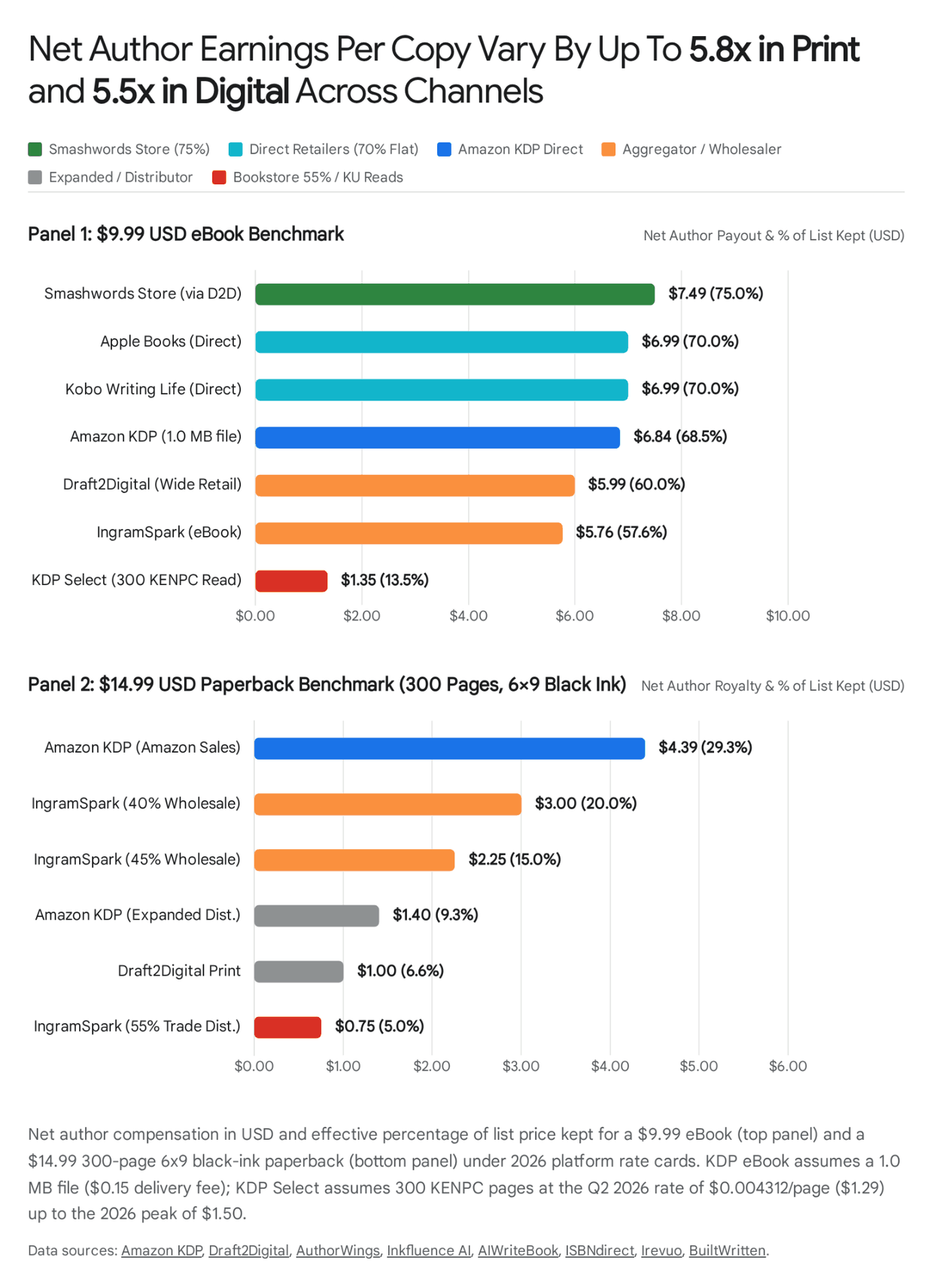
3.1 Benchmark 1: $9.99 USD eBook Royalty Math Across Platforms
On July 7, 2026[20], Amazon KDP expanded its 70% royalty price band on Amazon.com from $2.99–$9.99 to $2.99–$12.99. Consequently, a $9.99 eBook qualifies for the 70% tier across all direct retail platforms[20][26]. However, Amazon KDP deducts a file delivery cost of $0.15 per megabyte on the 70% tier (updated April 21, 2026)[48]. In KDP's contractual formula (Royalty = 70% × (List Price - Delivery Cost)), a 1.0 MB file reduces the taxable base by $0.15 (yielding $6.89 net), whereas standard industry calculators that deduct the full delivery fee directly from the 70% share ((70% × List Price) - Delivery Cost) report $6.84 net for a 1.0 MB file and $6.77 net for a 1.5 MB file[10]. Both figures are documented below.
| Platform & Channel | List Price | Platform / Retailer Cut & Formula | Delivery Fee | Net Royalty to Author | % of List Price Kept | Price Band / Adjustment Notes |
|---|---|---|---|---|---|---|
| Smashwords Store (via D2D) (https://draft2digital.com/blog/royalty-rates/) | $9.99 | 25% combined store & D2D cut (75% royalty tier at ≥$2.99, effective Jan 1, 2026)[22] | $0.00 | $7.49[27] | 75.00%[22] | Drops to 40% ($0.40 on a $0.99 book) if priced below $2.99[22]. |
| Apple Books for Authors (Direct) (https://authors.apple.com) | $9.99 | 30% Apple retail cut (flat 70% royalty across all prices, verified Oct 4, 2026)[10] | $0.00[4] | $6.99 | 70.00%[10] | Pays 70% at $0.99 ($0.69 net) and at $14.99 ($10.49 net)[10]. |
| Kobo Writing Life (Direct Retail) (https://kobowritinglife.zendesk.com) | $9.99 | 30% Kobo retail cut (70% royalty tier at ≥$2.99, verified Oct 12, 2026)[14] | $0.00[14] | $6.99 | 70.00%[14] | No upper price cap (pays 70% at $14.99 = $10.49); drops to 45% below $2.99 ($0.45 at $0.99)[14]. |
| Amazon KDP (Direct, 1.0 MB Novel) (https://kdp.amazon.com/help/topic/G200634560) | $9.99 | 30% Amazon cut (70% tier from $2.99–$12.99, effective Jul 7, 2026)[20] | $0.15 (1 MB × $0.15/MB)[20] | $6.84 (or $6.89 contractual)[20] | 68.47% (68.97%)[30] | Drops to 35% ($0.35 at $0.99; $5.25 at $14.99) outside $2.99–$12.99 band[10]. |
| Amazon KDP (Direct, 10 MB Illustrated) (https://kdp.amazon.com/help?topicId=G200634500) | $9.99 | 30% Amazon cut (70% tier from $2.99–$12.99, effective Jul 7, 2026)[20] | $1.50 (10 MB × $0.15/MB)[20] | $5.49 (or $5.94 contractual)[20] | 54.95% (59.46%)[20] | At 25 MB ($3.75 fee), 70% tier nets $3.24—worse than the 35% tier ($3.50, no delivery fee)[20]. |
| Draft2Digital (at Apple, Kobo, B&N, Tolino) (https://draft2digital.com/blog/royalty-rates/) | $9.99 | 30% retailer cut + ~10% of list D2D cut (~15% of net, verified Oct 13, 2026)[1] | $0.00 | $5.99 (displays $5.94–$5.99)[22] | 60.00% (~59.5–60%)[22] | Flat 60% across all prices at major stores; 55% ($5.49) at Vivlio[1]. |
| IngramSpark (eBook Distribution) (https://www.ingramspark.com) | $9.99 | 30% retailer cut; author receives 85% of net receipts (verified Oct 18, 2026)[17] | $0.00 | $5.94 (or $5.76 if 1.875% fee applies)[17] | 59.50% (57.62%)[17] | Less flexible promotional and pricing controls than D2D or direct[13]. |
| Kobo Writing Life (OverDrive Library) (https://kobowritinglife.zendesk.com) | $19.99 (Library Price) | 50% of library list price (typically set at 2× retail, verified Oct 12, 2026)[14] | $0.00 | $10.00 (or $5.00 at $9.99)[14] | 50.00%[14] | Direct KWL OverDrive opt-in pays 50% vs. D2D's 46% OCOU[22]. |
| Draft2Digital (Library OCOU: OverDrive/BorrowBox) (https://draft2digital.com/library-pricing/) | $19.99 (Library Price) | 46% OCOU royalty on library price ($19.99 recommended for $9.99 retail)[22] | $0.00 | 9.20–9.35 (or $4.60 at $9.99)[22] | 46.00%[22] | CPC (Cost Per Checkout) pays 4.6% at OverDrive ($0.92–$0.93) and 3.8% tiered at Hoopla ($0.49)[22]. |
| KDP Select / Kindle Unlimited (300 KENP Pages) (https://kdp.amazon.com) | $0.00 (Subscription Borrow) | Paid per page from KU Global Fund ($0.004312/p in Q2 2026; $0.0042–$0.00 range)[18][19] | $0.00 | 1.29–1.50 per full read[19] | 12.91%–15.02% (vs. $9.99 list)[19] | Requires 4.6 to 5.3 full 300-page reads to equal one $9.99 retail sale at $6.84[19]. |
Scroll sideways to see all columns →
3.2 Benchmark 2: $14.99 USD 300-Page Black-Ink Paperback & Hardcover Royalty Math
In print-on-demand, every platform calculates the retail or wholesale share against the full list price before subtracting the physical manufacturing cost[31]. Because printing costs are deducted entirely from the author's share, small differences in wholesale discounts or per-page rates create substantial swings in net profit[29].
| Platform, Format & Discount Tier | List Price | Royalty / Wholesale Share Formula | Exact Print Cost & Platform Fee (300 pp, 6"x9" B&W) | Net Royalty to Author | % of List Price Kept | Operational & Channel Context |
|---|---|---|---|---|---|---|
| Amazon KDP Paperback (Amazon Direct Sale) (https://kdp.amazon.com/help/topic/G8BKPU9AGVZSF9QF) | $14.99 | 60% of list price (≥$9.99 cliff; $8.99 gross)[9] minus print cost (effective Jun 10, 2025)[21] | Print: $4.60 ($1.00 + 300 × $0.01)[5][29]. Fee: $0.00[13]. | $4.39 | 29.31% | Highest per-copy paperback payout in retail POD; drops to 50% rate below $9.99[21]. |
| IngramSpark Paperback (40% Online Wholesale Discount) (https://www.ingramspark.com/pricing) | $14.99 | 60% of list retained (after 40% wholesale discount = $8.99)[9] minus print & fee (effective Feb 1, 2026)[29] | Print: $5.71 ($1.33 + 300 × $0.01)[49][29]. 1.875% Fee: $0.28[29]. | $3.00 | 20.03% | Best IngramSpark margin for online-only retailers; physical bookstores rarely order at 40%[17]. |
| IngramSpark Paperback (45% Trade Discount Floor) (https://www.ingramspark.com/pricing) | $14.99 | 55% of list retained (after 45% wholesale discount = $8.24)[10] minus print & fee (reported Sept 2026)[50] | Print: $5.71 ($1.33 + 300 × $0.01)[49][29]. 1.875% Fee: $0.28[29]. | $2.25 | 15.03% | Mid-tier trade discount; beats KDP Expanded Distribution by $0.85/copy. |
| Amazon KDP Paperback (Expanded Distribution) (https://kdp.amazon.com/help/topic/G8BKPU9AGVZSF9QF) | $14.99 | 40% of list price ($5.99 gross)[11] minus print cost[13] | Print: $4.60 ($1.00 + 300 × $0.01)[5][30]. Fee: $0.00[13]. | $1.40 | 9.31% | Reaches Ingram wholesale feed without returnability; do not check if using IngramSpark directly[25]. |
| Draft2Digital Print Paperback (All Stores) (https://draft2digital.com/knowledge-base/) | $14.99 | 45% of list price ($6.74 gross)[11] minus print cost (updated Jan 6, 2026)[16] | Print: $5.75 ($1.34 + 300 × $0.01)[34][27]. Fee: $0.00[51]. | $1.00 | 6.64% | Convenient single-dashboard add-on, but pays $3.39 less per copy than KDP Direct[27]. |
| IngramSpark Paperback (55% Full Bookstore Discount) (https://www.ingramspark.com/pricing) | $14.99 | 45% of list retained (after 55% trade discount = $6.74)[11] minus print & fee (effective Feb 1, 2026)[29] | Print: $5.71 ($1.33 + 300 × $0.01)[49][29]. 1.875% Fee: $0.28[29]. | $0.75 | 5.03% | Required discount for physical bookstore shelf placement; raise list price to $16.99 to net $1.62[29]. |
| Amazon KDP Hardcover (Case Laminate, 300 pp) (https://kdp.amazon.com) | $24.99 (Adjusted) | 60% of list price ($14.99 gross)[9] minus hardcover print cost[30] | Print: $9.25 ($5.65 + 300 × $0.01)[5][30]. Fee: $0.00[13]. | $5.74[30] | 22.99%[30] | At $14.99 list, print cost ($9.25) exceeds 60% share ($8.99), making $15.42 the absolute zero-profit floor[30]. |
| IngramSpark Hardcover (Case Laminate, 300 pp, 55% Disc.) (https://www.ingramspark.com) | $24.99 (Adjusted) | 45% of list retained ($11.24)[11] minus hardcover print & fee (effective Feb 1, 2026)[29] | Print: $9.27 ($5.31 + 300 × $0.01)[30][29]. 1.875% Fee: $0.47[29]. | $1.51 (or $5.25 at 40% disc.)[29] | 6.03% (21.02%)[29] | Dust-jacketed hardcover costs $12.17 to print ($7.76 + 300 × $0.01)[34], requiring a ≥$29.99 list price at 55% discount[29]. |
Scroll sideways to see all columns →
3.3 Three-Year Access Model Cost & Break-Even Analysis
Grouping platforms by their access model reveals the exact sales volume and revenue thresholds at which one distribution path outperforms its adjacent alternative over a standard three-year book lifecycle:
| Access Model & Platforms | Upfront & Fixed Fees Over 3 Years | Per-Sale Variable Commission / Margin Deduction | 3-Year Total Platform Cost (Low Earner: <$100/yr Wide) | 3-Year Total Platform Cost (Active Earner: $1,500/yr Wide List Sales) | Break-Even Threshold vs. Adjacent Model |
|---|---|---|---|---|---|
| Model 1: No-Fee Direct Retailers (Amazon KDP, Kobo Writing Life, Apple Books, B&N Press) | $0.00 (Setup, revisions, and account maintenance are permanently free)[1]. | 0% aggregator fee (Author keeps full 70% retail share; KDP deducts $0.15/MB delivery)[10]. | $0.00[1] | $0.00[1] | Baseline winner on margin. Keeps $1.00 more per $9.99 eBook ($0.50 more per $4.99 eBook) than Draft2Digital[11]. |
| Model 2: Aggregator With Fees (Draft2Digital — including Smashwords Store) (https://draft2digital.com/faq/) | $20 one-time activation (covers Year 1, Apr 14, 2026) + $12/yr in Years 2 & 3 only if net royalties <$100/yr (May 14, 2026)[1]. | ~10% of retail list price (~15% of net retail payout) on distributed sales[1]. | $44.00 fixed ($20 Year 1 + $12 Year 2 + $12 Year 3) + 10% of list sales[1]. | $20.00 fixed ($12 fee waived at ≥$100/yr net) + $450.00 commission (10% of $4,500 3-yr sales) = $470.00[1]. | Requires $166.67/yr in gross retail sales (~34 sales/yr at $4.99 or 17 sales/yr at $9.99) to clear the $100 net threshold and waive the $12 fee[19]. |
| Model 3A: Trade Wholesaler (Verified Live Rate Card) (IngramSpark — post-Feb 1, 2026 rules) (https://www.ingramspark.com/pricing) | $0.00 setup + $0.00 revisions (unlimited free file updates since Feb 1, 2026) + $125 single Bowker ISBN (or £93 UK Nielsen)[5]. | 1.875% of list price market access fee ($0.28 on $14.99 book) + $1.11 higher print cost vs. KDP + trade discount[29]. | $0.00 platform fees (+ $125 ISBN if not already owned)[29]. | $84.38 in 1.875% fees (on 300 copies sold at $14.99 = $4,497 gross)[29]. | At $0 setup and 40% online discount ($3.00 net/copy), [1] copy sold beats KDP Expanded Distribution ($1.40/copy) and D2D Print ($1.00/copy). To recoup a $125 ISBN vs. KDP Expanded (+$1.60/copy gain), break-even is [33] copies. |
| Model 3B: Trade Wholesaler (Reported Legacy/Discrepancy Fees) (IngramSpark — if $49 setup & $49 revision apply) | $49 title setup + $49 per file revision (assuming 1 revision over 3 years = $98.00, cited in Sept 2026 guides)[24]. | 1.875% of list price ($0.28/copy at $14.99)[29]. | $98.00 fixed + 1.875% of list sales[52]. | $98.00 fixed + $84.38 variable = $182.38. | To recoup $98.00 in setup/revision fees: requires 131 physical bookstore sales at a 55% discount ($0.75 net/copy), ** sales** at a 45% discount ($2.25 net/copy), or [53] sales at a 40% discount over KDP Expanded (+$1.60/copy). |
| Model 4: Exclusivity Program (KDP Select / Kindle Unlimited) (https://kdp.amazon.com) | $0.00 explicit fee[19]. | Opportunity cost: 100% loss of non-Amazon eBook retail and library revenue during enrollment[10]. | $0.00 out-of-pocket[19]. | Foregone wide net income (e.g., $900–$1,050/yr net on $1,500 gross wide sales)[1]. | Requires 5.28 complete 300-page KU reads (at $0.004312/page = $1.2936/read) to equal [1] direct $9.99 sale on KDP ($6.84) or 5.40 reads to equal 1 direct Apple/Kobo sale ($6.99)[10]. |
Scroll sideways to see all columns →
Direct Answer: Is Draft2Digital Worth the 10% Fee Versus Uploading Directly to Kobo and Apple?
Mathematically, the total three-year cost of routing Apple Books and
Kobo Writing Life sales through Draft2Digital rather than uploading
directly is governed by the equation:
Total 3-Year D2D Cost = $20activation + $12 × Ylow
+ 0.10 × Rlist
where Rlist represents cumulative retail list-price revenue
at Apple and Kobo, and Ylow ∈ {0, 1, 2} represents the number
of post-activation years in which net royalties fall below $1001.
Uploading directly and maintaining metadata, promotional pricing, and
tax forms across Apple Books and Kobo Writing Life requires roughly 2.5
to 3 hours of administrative labor over a three-year cycle (valued at
approximately
$100)[1].
For a new Draft2Digital account paying the $20 activation fee, the 10%
commission plus the $20 activation fee reaches $100 when cumulative
Apple and Kobo list-price revenue hits $800 over three
years (~$267/year, or ** copies of a $9.99 eBook** /
160 copies of a $4.99
eBook)[54][1].
Conversely, below $320 in three-year wide list sales
(~11 copies/year at $9.99), a low-volume author on Draft2Digital pays
$44 in fixed activation and maintenance fees plus up to $32 in
commissions ($76 total), making free direct uploads to Apple and Kobo
cheaper from the very first
copy[1].
Because Draft2Digital nets the author 60% of the retail list price at
major stores, clearing the $100/year net royalty
threshold to avoid the $12 annual maintenance fee requires
exactly $100/0.60 = $166.67 in gross retail sales per year, which equals
[23]
copies/year of a $9.99 eBook ($5.99 net/copy) or
[28]
copies/year of a $4.99 eBook ($2.99
net/copy)[1].
Furthermore, if an author compares aggregators directly, Draft2Digital's
10% commission beats PublishDrive's flat subscription ($168/year billed
annually) up to 140–170/month
in wide retail sales ($1,680–$2,040/year), above which a flat
software subscription saves
money[1].
However, in a 2026 empirical simulation of an author selling 72 wide
copies per month at $4.99, routing all wide sales through Draft2Digital
nets $1,075.80, going direct to Apple, Kobo, and
B&N alone nets $1,005.98 (because smaller stores
and libraries are missed), and going direct to Apple, Kobo, and
B&N while using Draft2Digital strictly for Smashwords, Tolino,
Vivlio, and libraries nets
$1,219.52[1].
Therefore, any author generating more than $300/year on
Apple and Kobo should upload directly to Kobo Writing Life and Apple
Books (retaining 70%) while keeping a Draft2Digital account active
solely for Smashwords (75%), smaller international retailers (55%–60%),
and library networks (46%
OCOU)[1].
4. The Exclusivity Decision: KDP Select vs. Wide Distribution
Whether to enroll an eBook in KDP Select or distribute it wide is the central strategic choice for independent authors because it dictates not only where the book is sold, but how Amazon's recommendation algorithm weights the title and how an author's backlist compounds over time[10].
4.1 Contractual Requirements vs. Strategic Rewards
Enrolling in KDP
Select[55]
commits the digital (eBook) edition of a title
exclusively to Amazon for a 90-day period that
automatically renews for subsequent 90-day terms unless the author
manually unchecks the renewal option in their KDP Bookshelf before the
term
expires[10].
Throughout the 90-day enrollment term, the eBook—and any excerpt
exceeding 10% of its total length—cannot be sold, distributed for free
as a reader magnet, or offered via subscription on Apple Books, Kobo,
Barnes & Noble, Google Play, Smashwords, library lending platforms
(OverDrive, BorrowBox, Hoopla), or the author's personal
website[10].
Crucially, KDP Select exclusivity applies strictly to the eBook
format: paperback, hardcover, and audiobook editions remain
entirely non-exclusive and may be sold simultaneously through
IngramSpark, Draft2Digital Print, brick-and-mortar bookstores, and
public
libraries[10].
In exchange for digital exclusivity, enrolled authors receive placement
in Kindle Unlimited (KU), earning a per-page royalty
from the monthly KU Global Fund (which reached
$62.2 million in January 2026) whenever a subscriber
reads pages of the book for the first time, measured by the Kindle
Edition Normalized Page Count
(KENPC)[19].
Across 2025 and 2026, the KENPC payout rate has ranged between
$0.00[46]
and
$0.00[18]
per page—averaging $0.00445 in 2025, sitting at $0.004202 in
January 2026, reaching $0.00482 in April 2026, and declining slightly in
Q2 2026 to $0.004312 (down from $0.004601 in July
2025)[19].
At these rates, a complete read of a 300-page novel pays $1.29
to $1.50, while a shorter 50,000-word novel (~200 KENP pages)
pays $0.84 to
$1.00[19].
Beyond page-read royalties, every KU borrow immediately counts as a
transaction toward Amazon's Best Seller Rank (BSR) and recommendation
algorithms, accelerating
visibility[10].
Enrolled titles also unlock Kindle Countdown Deals
(allowing time-limited discounts down to $0.99 on Amazon.com and
Amazon.co.uk while retaining the 70% royalty rate), up
to
[10]
Free Book Promotion days per 90-day period, Kindle Owners'
Lending Library (KOLL) / Kindle+ inclusion, and the 70% eBook
sales royalty rate in Brazil, Japan, Mexico, and India (where
non-Select titles are penalized at
35%)[10].
4.2 The Empirical Landscape: The 38 / 30 / 32 Split, Catalog Scaling, and Direct Sales
Survey data from Written Word Media's 2025 Indie Author Survey (n = 1,346 authors)[56] and the Alliance of Independent Authors (ALLi) 2025 Big Indie Author Data Drop (n > 1,800 authors)[57] demonstrates that the self-publishing market is divided into three nearly equal strategic camps: 38% of surveyed authors are all-in on Amazon (KDP Select) for their entire catalog, 30% distribute fully wide, and 32% operate a hybrid strategy with some titles in Select and others wide[37]. Across the entire respondent pool, 83% of indie authors identify Amazon as their top revenue source[58].
| Monthly Book Income Bracket (Written Word Media Survey, n=1,346n = 1,346n=1,346) | Share of Surveyed Indie Authors (%) | Median Published Catalog Size (Books) | Empirical Distribution & Revenue Characteristics |
|---|---|---|---|
| Under $250 / month (44% earn ≤$100/mo) | 41%[37] | [10] books (80% of authors with 1–3 books earn <$100/mo)[37] | Starter phase dominated by single-title or short-catalog writers still building platform mechanics[37]. |
| $250 – $1,000 / month | 22%[37] | [41] books[37] | Transition stage where backlist read-through begins to offset frontlist launch costs[37]. |
| $1,000 – $5,000 / month | 20%[37] | [59] books[37] | Established multi-series catalog; sci-fi series reach ~$2,000+/mo at 4+ books, mystery/thriller series average $2,500–$4,000/mo[37]. |
| $5,000 – $10,000 / month | 11%[37] | [44] books (ALLi 25+ book median is ~$3,000/mo)[37] | High-output series publishers; 5-book romance series average $5,000+/mo combined[37]. |
| $10,000+ / month | 6% (up to 8% in global sample)[37] | 30+ books[37] | Top-tier publishers; roughly 50% sell direct from their own webstores alongside retail channels[37]. |
Scroll sideways to see all columns →
Three second-order empirical insights emerge from the 2025–2026 survey data. First, Written Word Media's 2026 mid-year survey found that among authors whose publishing businesses are actively growing, the exclusive and wide camps sit within a single percentage point of each other, proving that catalog depth, advertising, and email list execution drive growth rather than distribution ideology[60]. Second, ALLi's 2025 income survey revealed that authors who distribute wide passively through aggregators without direct sales infrastructure report some of the lowest earnings in the dataset, whereas authors using the "Creator Model"—generating 50% or more of their income from direct-to-reader sales—cluster near the very top, matching Written Word Media's finding that roughly half of $10,000+/month earners sell direct from their own stores[60]. Third, genre and catalog longevity remain decisive: full-time indie authors earn a median of $12,749–$13,500 annually (rising to $24,000 for veterans publishing consistently since 2018), with romance and romantic suspense authors achieving a median annual book income of $31,725—more than double the all-genre median[37].
4.3 Verdict: Is KDP Select Worth It? (By Genre and Series Status)
| Genre & Catalog Profile | Verdict | Strategic & Mathematical Rationale |
|---|---|---|
| Romance, Fantasy, Thriller, LitRPG, Cozy Mystery (In Series) | Yes — Enroll in KDP Select | Readers in these high-velocity genres consume 3 to 5+ books per month and disproportionately subscribe to Kindle Unlimited to avoid per-book retail costs[37]. Even though a single 300-page borrow pays ~$1.29–$1.50 (less than a $3.34–$6.84 retail sale), KU subscribers read seamlessly through Books 2, 3, 4, and 5 in a series with zero checkout friction, generating higher total monthly revenue than wide retail[10]. |
| Debut Fiction Author (1–2 Books, No Audience) | Yes — Enroll for First 90–180 Days | Without an existing newsletter or ad machine, a debut novel uploaded wide is invisible across five storefronts at once[60]. KDP Select lowers the reader's risk to $0 (via KU borrows) and provides 5 free promo days and Countdown Deals to establish early reviews and sales rank before reassessing at the 90-day mark[10]. |
| Nonfiction, Business, Self-Help, Technical & Biography | No — Go Wide from Day One | Nonfiction readers buy reference books à la carte at higher list prices ($9.99–$19.99) and rarely browse Kindle Unlimited[27]. Additionally, nonfiction readers frequently skim specific chapters rather than reading cover-to-cover, which devastates KENPC page-read payouts while forfeiting lucrative library OCOU sales ($9.35+ per copy via D2D at a $19.99 library price) and Apple/Kobo buyers[27]. |
| Literary Fiction, Up-Market Standalone & Commonwealth-Set Fiction | No — Go Wide (or Hybrid) | Literary and Commonwealth readers index heavily toward Kobo (Canada, UK, ANZ, Europe), Apple Books, independent bookshops (via IngramSpark), and public library apps (BorrowBox, Libby/OverDrive) rather than the KU binge-reading ecosystem[59]. |
| Established Backlist Author (10+ Books with Active Newsletter) | Hybrid Strategy | Launch new series in KDP Select for 1–2 terms to harvest KU binge readers, or keep flagship series in KU while moving completed backlist series wide + direct to capture Kobo Plus, Apple, Smashwords 75% bundles, and library compounding[59]. |
Scroll sideways to see all columns →
5. Formatting and Prepress File Specifications
Print file preparation is the primary operational bottleneck where independent authors lose money to rejected uploads, delayed launches, and formatter rework fees[25]. While digital eBook platforms have converged around standard validated EPUB and clean DOCX uploads (with free automated EPUB conversion offered by KDP's Kindle Create, Draft2Digital, and Kobo Writing Life), print-on-demand specifications diverge sharply between Amazon KDP[34] and IngramSpark[8][1].
5.1 Print Technical Specification Matrix: Amazon KDP vs. IngramSpark
| Technical Requirement | Amazon KDP Print (https://kdp.amazon.com/help/topic/G201953020) | IngramSpark Print (https://www.ingramspark.com) |
|---|---|---|
| PDF Standard | Any well-formed single-page PDF; transparencies must be flattened and all fonts embedded (verified Oct 13, 2026)[34]. | Strict PDF/X-1a:2001 or PDF/X-3:2002 compliance required; all layers and transparencies flattened; all fonts 100% embedded[47]. |
| Colour Space & Ink Density | Accepts RGB or CMYK in submitted files (KDP converts RGB to CMYK automatically during RIP processing)[34]. | CMYK only for covers and color interiors (grayscale for B&W interiors); strict 240% maximum Total Ink Coverage (TAC) cap; zero spot colours (Pantone) or ICC profiles allowed[47]. |
| ISBN Barcode Rules | Optional in file: If the lower-right back cover barcode safe area is left blank, KDP automatically generates and places the ISBN barcode during upload[61]. | Mandatory in the file: Cover PDF must include a properly positioned ISBN barcode (100% pure black [0,0,0,100] on a solid white box) prior to upload; IngramSpark's template generator can insert one[47]. |
| Bleed Requirements | Cover: 0.125" (3.2 mm) on outer edges[34]. Interior (if bleed enabled): 0.125" (3.2 mm) on top, bottom, and outside edges only (no inside gutter bleed)[35]. | Cover: 0.125" (3.2 mm) on all four sides (0.625" wrap for hardcovers)[47]. Interior: 0.125" (3.2 mm) on all four sides / trim edges; single-page spreads required[47]. |
| Spine Text Page Minimum | Minimum [33] pages for a custom PDF cover (** pages** if using KDP's online Cover Creator)[54] (https://kdp.amazon.com/help/topic/G202145060)[34]. Requires 0.0625" (1.6 mm) safe margin on either side of spine text[34]. | Minimum [35] pages for paperbacks (and as low as 18 pages for hardcovers, subject to spine width fitting text)[29]. |
| Paper Thickness & Spine Multipliers (B&W) | White paper: Page Count × 0.002252” (0.0572 mm)[54]. Cream paper: Page Count × 0.0025” (0.0635 mm)[54]. Standard Color: ×0.002252”; Premium Color: ×0.002347”[34]. | Uses 50 lb white/cream paper and 70 lb color stock with Lightning Source's distinct caliper tables; spine width for the exact same page count differs from KDP[29]. |
| Cover Template System | KDP Cover Calculator & Template Generator (https://kdp.amazon.com/cover-calculator) outputs PNG/PDF layout guides[34]. | IngramSpark Cover Template Generator outputs custom InDesign (INDD), PDF, or EPS templates coded to the exact ISBN and paper stock; cover must be built on it[47]. |
| Hardcover Mechanical Compatibility | Board is wider than interior trim; uses KDP-proprietary hinge and spine tables[17]. | Board width sits 0.185" narrower relative to KDP's wrap geometry with incompatible spine fold tables[17]. |
Scroll sideways to see all columns →
5.2 Practical Prepress Implications for Wide Print Authors
The operational implication of these technical differences is
absolute: a cover built for Amazon KDP cannot be reused on
IngramSpark without regenerating the spine, even at the exact same trim
size and page count, and a hardcover file built for one platform is
flatly incompatible with the
other[17].
Because KDP and IngramSpark utilize different paper caliper multipliers,
barcode rules, and color profile checks, uploading a KDP paperback cover
to IngramSpark triggers automated preflight rejection (due to missing
PDF/X-1a headers, RGB color profiles, >240% rich black ink, or
shifted spine fold
lines)[25].
In hardcover, the mechanical geometry diverges even further because
IngramSpark's board width is 0.185" narrower relative to KDP's wrap
structure and uses a completely different spine table (for example, a 6"
x 9" hardcover cover measures 14.5675" x 10.5" on IngramSpark compared
to a 13.0" x 9.25"
paperback)[17].
Consequently, the standard wide-distribution print setup requires
two separate wraparound cover PDF files (one built on
KDP's template, one built on IngramSpark's Template Generator), although
a single PDF/X-1a:2001 interior file formatted with KDP's gutter margins
and no spot colors will pass inspection on both
platforms[28].
Furthermore, dual-platform print distribution requires the author to
purchase their own independent ISBN from their national
agency—Bowker[62]
in the United States ($125 for a single ISBN; $295 for a 10-pack) or
Nielsen[63]
in the United Kingdom (£93 for a single ISBN; £174 for a 10-pack,
verified September 2,
2026)[42].
Free ISBNs provided by KDP (Independently published), Draft2Digital, or
IngramSpark (Indy Pub) are locked to the issuing platform and cannot
travel to another
printer[11].
When using the same author-owned ISBN on both KDP Print (for Amazon
orders) and IngramSpark (for bookstores and libraries), the author must
leave KDP Expanded Distribution unchecked and either
upload to IngramSpark 3 to 5 business days before KDP or set up both
simultaneously prior to release to avoid catalog
conflicts[28].
6. "Where to Publish What" Decision Framework
Because distribution economics vary by reader consumption habits, format mix, and existing marketing assets, the optimal publishing stack is determined by the author's specific profile[37].
| Author Scenario / Profile | Recommended Primary & Secondary Platforms | Exclusivity Stance | Format & Pricing Strategy | Operational Rationale & Next-Step Trigger |
|---|---|---|---|---|
| [1]. Genre Fiction Author in Series (Romance, Fantasy, Thriller, LitRPG, Cozy Mystery) | eBook: Amazon KDP (enrolled in KDP Select)[37]. Print: KDP Print + IngramSpark (optional for libraries/fans)[59]. | Exclusive (KDP Select) for at least the first 2–3 terms (180–270 days)[10]. | Price Book 1 at $2.99–$4.99; price sequels at $4.99–$5.99; use Kindle Countdown Deals ($0.99 at 70% royalty) on Book 1 to drive series read-through in KU[10]. | Voracious genre readers live inside Kindle Unlimited; series read-through multiplies page-read payouts[37]. Pivot trigger: Go wide (or hybrid) only if KU income plateaus after 4–5 books or readers request non-Amazon formats[59]. |
| [5]. Nonfiction Author With a Platform (Business, Self-Help, Technical, Academic, How-To) | eBook: Amazon KDP (non-Select) + Apple Books Direct + Kobo Writing Life Direct + Draft2Digital (B&N, Smashwords, Libraries)[1]. Print: KDP Print + IngramSpark[28]. | Fully Wide from Day One (Skip KDP Select)[27]. | Price eBook at 9.99–12.99 (earning 70% across KDP, Apple, Kobo, and 75% on Smashwords); set library price at 19.99–29.99 on D2D/KWL; price paperback at 16.99–21.99[20]. | Nonfiction buyers purchase outright rather than borrowing via KU, and KDP's July 7, 2026 band expansion allows 70% royalties up to $12.99[10]. Library OCOU purchases ($9.35+ net per copy at $19.99) and bulk speaking copies drive major margin[29]. |
| [14]. Literary Fiction Author | eBook: KDP (non-Select) + Apple Books Direct + Kobo Writing Life Direct + D2D (Libraries, Bookshop.org, Fable)[1]. Print: IngramSpark + KDP Print[13]. | Fully Wide[37]. | Price eBook at 7.99–11.99; price paperback at 15.99–17.99 and hardcover at 24.99–28.99; register for Public Lending Right (PLR) in UK/CA/AU[59]. | Literary readers over-index on Kobo, Apple Books, Bookshop.org, independent bookstores, and library apps (Libby/BorrowBox)[59]. IngramSpark provides publisher-of-record imprint credibility for award submissions and review venues[59]. |
| [9]. Print-First Author (Bookstore Events, Library Talks, Regional History, Children's) | Print: IngramSpark (for trade distribution & unmarked proofs) + KDP Print (for Amazon sales & cheap event stock)[29]. eBook: KDP + D2D27. | Wide (Print is never subject to KDP Select exclusivity regardless)[10]. | Buy independent ISBNs (Bowker/Nielsen); generate two cover files; set IngramSpark wholesale discount to 55% and Returnable-Destroy only when actively pitching bookstores; order event stock via KDP author copies[29]. | Accepting the two-cover-file prepress burden lets the author earn 60% minus $4.60 on Amazon while giving physical bookstores the 55% returnable terms they require in Ingram's catalog[29]. |
| [10]. International Author (Non-US) (UK, Canada, Europe, Australia, New Zealand, India) | eBook: KDP Global + Kobo Writing Life Direct (mandatory for CA/UK/EU/ANZ) + Apple Books Direct + D2D (Tolino, Vivlio, BorrowBox)[26]. Print: KDP + IngramSpark (local UK/EU/AU/IN printing)[64]. | Wide (Unless writing pure US-targeted KU genre romance/LitRPG; note Brazil/JP/MX/IN 70% Select rule)[10]. | Set native regional prices manually in KWL (£1.99+ GBP, $2.99+ CAD/AUD, €1.99+ EUR for 70%) and KDP (£1.77–£12.99 GBP for 70% eBook; ≥£7.99 GBP for 60% print)[14]. | Amazon's market share is less monopolistic outside the US/UK: Kobo + Tolino + Vivlio + BorrowBox represent a substantial share of Commonwealth and European digital reading[59]. |
| [11]. Author With an Existing Audience (Established Newsletter, Podcast, YouTube, Substack) | Primary: Direct Webstore (Payhip, Gumroad, Fourthwall, or WooCommerce + BookFunnel delivery)[60]. Secondary: Wide retail via KDP, Apple, Kobo, D2D, and IngramSpark[60]. | Fully Wide / Creator Model[60]. | Sell early-access eBooks, bundles, and signed print directly to fans first (retaining 90%–97% after Stripe/PayPal processing), then release wide on retail platforms 2–4 weeks later[60]. | Sending existing warm traffic to Amazon hands 30%–40% of gross revenue to a retailer that did not acquire the customer[60]. ALLi's 2025 survey shows direct-first "Creator Model" authors earn the highest median incomes in self-publishing[60]. |
| [19]. Debut Author With No Audience | eBook: Amazon KDP enrolled in KDP Select[37]. Print: KDP Print paperback (using free KDP ISBN initially if budget is near $0, or owned ISBN if planning IngramSpark later)[28]. | Exclusive (KDP Select) for the initial 90-day term[10]. | Total platform setup cost = $0.00[13]. Price eBook at 2.99–4.99 and paperback at 12.99–14.99; include a back-matter call-to-action linking to a newsletter signup[37]. | Eliminates all upfront platform fees ($20 D2D fee, $125 ISBN) and uses Kindle Unlimited borrows plus 5 free promo days to validate reader demand[1]. Re-evaluate after 90 days before auto-renewal triggers[10]. |
Scroll sideways to see all columns →
7. "Best for X" Verdict-First Angles
Best Platform for Amazon Sales (eBook and Print)
Amazon KDP is the undisputed winner for Amazon sales, capturing 70% royalties on eBooks priced $2.99–$12.99 (minus $0.15/MB delivery) and 60% minus print costs on paperbacks and hardcovers at $9.99+, with zero setup fees and guaranteed in-stock Prime availability[13]. Runner-up: IngramSpark, which serves as a backup wholesale print feed to Amazon at lower margins[13].
Best Platform for Wide eBook Distribution (Apple, Kobo, B&N in One Upload)
Draft2Digital is the best platform for single-upload wide eBook distribution, delivering manuscripts to Apple Books, Kobo, Barnes & Noble, Smashwords (at 75%), Tolino, Vivlio, Fable, and four library networks while retaining 60% of list price at major stores after a $20 activation fee[1]. Runner-up: PublishDrive, which beats Draft2Digital's 10% cut once wide sales exceed $170/month[1].
Best Platform for Print Distribution to Bookstores and Libraries
IngramSpark is the premier platform for physical bookstore and library print distribution, connecting directly to 45,000+ retailers, independent bookshops, and library wholesalers via the Ingram catalog with configurable trade discounts (40%–55%), returnability options, and $0 setup or revision fees as of February 2026[5]. Runner-up: Amazon KDP Expanded Distribution, which lacks returnability for physical bookshops[42].
Best Platform for Highest Royalty Per eBook Sale
The Smashwords Store (via Draft2Digital) pays the highest retail eBook royalty at 75% of list price ($7.49 on a $9.99 book) for titles priced at $2.99 and above with zero delivery fees[22]. Runner-up: Apple Books for Authors, which pays a flat 70% of list price across every price point—including $0.99 where Smashwords drops to 40%—with zero delivery fees[10].
Best Platform for Library Reach
Draft2Digital is the best comprehensive platform for digital library reach, distributing simultaneously to OverDrive, BorrowBox, cloudLibrary (at 46% One-Copy/One-User royalty), and Hoopla (Cost-Per-Checkout) from a single dashboard, even allowing library-only distribution for KDP Select authors[12]. Runner-up: Kobo Writing Life, which pays a higher 50% royalty directly on OverDrive library purchases alongside IngramSpark for print libraries[59].
Best Platform for International Sales
Kobo Writing Life is the strongest direct platform for international non-Amazon eBook sales, operating local storefronts in 190+ countries with deep market share in Canada, Europe (via FNAC, Bol.com, and Tolino), Australia, and New Zealand at a 70% uncapped royalty rate above $2.99[14]. Runner-up: Amazon KDP, which reaches 13+ global Kindle and print marketplaces directly[20].
Best Platform for Authors Who Want to Avoid Exclusivity
Apple Books for Authors and Kobo Writing Life (tied as direct retail portals) are the best platforms for non-exclusive authors, offering 70% royalties with zero delivery fees, zero setup costs, and zero contractual lock-in[10]. Runner-up: Draft2Digital, which aggregates non-exclusive distribution across 15+ retail and library channels while allowing instant delisting at any time[27].
Best Free / Low-Cost Setup for a Debut Author
Amazon KDP is the best zero-cost launchpad for a debut author, charging $0 for account creation, $0 for eBook and print uploads, $0 for unlimited file revisions, and $0 for a platform-assigned ISBN while providing free formatting via Kindle Create[13]. Runner-up: Kobo Writing Life and Apple Books for Authors, both 100% free for direct wide eBooks[1].
Best Print Quality (Paper, Binding, Colour Reproduction)
IngramSpark delivers the best trade print-on-demand quality, utilizing Lightning Source facilities to produce offset-caliber bindings, consistent 50 lb white/cream and 70 lb color paper stocks, sharper text, and superior CMYK color fidelity[29]. Runner-up: Lulu, which excels at specialty coil-bound and premium color formats ahead of KDP Print's facility-dependent variance[17].
Best Platform for Hardcover Production
IngramSpark is the best platform for hardcover production, offering both case-laminate and traditional dust-jacketed hardcovers (cloth/textured boards under a printed jacket) across 18 to 840 pages with full bookstore distribution[29]. Runner-up: Amazon KDP Hardcover, which pays higher per-copy royalties (~$5.00+ on Amazon) but is limited to case-laminate boards without dust jackets across 75–550 pages[30].
Best Aggregator Overall (Draft2Digital vs. IngramSpark by Use Case)
Draft2Digital is the best overall aggregator for digital eBooks, combining automated Word-to-EPUB conversion, 60% retail pass-through, 75% Smashwords sales, and four library networks for a $20 activation fee[1]. Runner-up: IngramSpark, which is the superior wholesaler strictly for physical print books targeting bookstores and libraries, whereas its 85%-of-net eBook distribution arm lacks promotional agility[17].
Best Platform for Authors Who Hate Formatting
Draft2Digital is the best platform for authors who hate formatting: its free browser-based conversion engine ingests a raw Microsoft Word (.docx) file and automatically builds a validated, styled EPUB with customizable chapter headers—and converts that eBook plus a front cover image into a wraparound print book in seconds[11]. Runner-up: Amazon KDP via its free Kindle Create app[49].
8. Search Engine and AI Answer Engine Query Map
| Query Cluster / Topic | Exact Search Phrasings & AI Prompts | Target Dossier Module |
|---|---|---|
| Platform Pairings (eBook & Aggregators) | "KDP vs Draft2Digital which is better", "Draft2Digital vs Smashwords", "Kobo Writing Life vs Apple Books", "is Draft2Digital worth the 10% fee", "how to publish on Smashwords in 2026", "going direct vs aggregator self publishing" | Section 2.1, Section 2.4, Section 2.6, Section 2.9, Section 3.3 |
| Platform Pairings (Print & Hardcover) | "KDP vs IngramSpark print quality", "Best self-publishing platform for print books", "Draft2Digital Print vs IngramSpark", "Draft2Digital Print vs KDP Print", "IngramSpark vs KDP hardcover", "how to use KDP and IngramSpark together" | Section 2.2, Section 2.3, Section 2.7, Section 2.8, Section 5.2 |
| Exclusivity & KDP Select Strategy | "Is KDP Select worth it in 2026", "KDP Select vs wide romance", "Wide vs exclusive publishing 2026", "how much does Kindle Unlimited pay per page in 2026", "can I publish paperback on IngramSpark if in KDP Select", "KDP Select 90 day exclusivity rules" | Section 1, Section 2.5, Section 4.1, Section 4.3, Section 9.1 |
| Royalty Rates & Per-Copy Earnings Math | "How much do I earn per book on KDP", "KDP 70% royalty price band 2026", "KDP paperback royalty calculator", "Kobo Writing Life royalty rates", "Apple Books royalty rate 2026", "Smashwords royalty rates 2026", "KDP $9.99 paperback royalty cliff 50% vs 60%" | Section 1, Section 3.1, Section 3.2, Section 10.1, Section 10.3 |
| Platform Fees & 2026 Pricing Changes | "Draft2Digital fees 2026", "IngramSpark setup fee 2026", "Is IngramSpark worth it for self-publishers", "Draft2Digital $20 activation fee and $12 maintenance fee", "did IngramSpark remove revision fees February 2026", "IngramSpark 1.875% market access fee" | Section 1, Section 3.3, Section 9.2, Section 9.3, Section 10.2, Section 10.4 |
| Prepress Formatting & Cover Compatibility | "Can I use KDP cover on IngramSpark", "How to publish a book on Apple Books", "KDP vs IngramSpark spine width difference", "minimum pages for spine text KDP vs IngramSpark", "IngramSpark PDF/X-1a 240% ink limit error" | Section 1, Section 2.4, Section 2.8, Section 5.1, Section 5.2 |
Scroll sideways to see all columns →
9. "Is X Worth It?" Decision Case Studies
9.1 Is KDP Select Worth It in 2026?
Verdict: KDP Select is worth it for debut novelists and series
authors in romance, fantasy, thriller, LitRPG, and cozy mystery, but it
is a financial drag for nonfiction authors and established multi-channel
publishers[19].
Enrolling in KDP
Select[2]
trades 100% of non-Amazon eBook retail and library access for 90 days in
exchange for placement in Kindle Unlimited (KU), where authors earn from
the $62.2 million monthly Global Fund per page
read[10].
At 2026 KENPC rates ($0.00 to $0.00 per page, sitting at $0.004312 in Q2
2026)[46][18],
a complete read of a 300-page novel yields $1.29 to
$1.50[19].
By comparison, a single retail sale of a $9.99 eBook at 70% nets
$6.84 on KDP (or $3.34 on a $4.99
novel)[30].
Consequently, a $9.99 book must be read cover-to-cover 4.6 to
5.3 times in KU (and a $4.99 novel 2.2 to 2.6
times) to equal the profit of a single retail
purchase[19].
KDP Select overcomes this per-unit deficit only in rapid-consumption
fiction genres where KU subscribers borrow freely without price
friction, propelling the book up Amazon's Best Seller Rank and
generating compounding read-through across a 4+ book
series[10].
In addition, KDP Select preserves the 70% royalty rate on $0.99 Kindle
Countdown Deals and unlocks 70% royalties in Brazil, Japan, Mexico, and
India[10].
Authors writing standalone nonfiction or literary fiction rarely
generate the binge page-read velocity required to beat wide retail and
library sales, and should remain
wide[27].
9.2 Is Draft2Digital Worth It After the 2026 Fee Changes?
Verdict: Draft2Digital is worth the $20 activation fee for every wide
author to access Smashwords (at 75%), secondary international stores,
and libraries, but authors earning over $320 across three years on Apple
and Kobo should upload to those two stores directly to avoid the 10%
commission[1].
On April 14,
2026[41],
Draft2Digital introduced a non-refundable $20 one-time
activation fee for new accounts (covering the first year) and a
$12 annual maintenance fee (effective May 14, 2026)
charged only to active accounts netting less than $100 over the prior 12
months[1].
Existing accounts opened prior to April 14, 2026 do not pay the $20
activation fee, and all accounts can use D2D's automated Word-to-EPUB
formatting tools for free without activating
distribution[1].
For distribution, D2D retains approximately 10% of the retail list price
(~15% of net retail payouts), leaving the author with 60% of
list price ($5.99 on a $9.99 eBook) at Apple, Kobo, and Barnes
& Noble compared to 70% ($6.99) when uploading
directly[1].
If an author sells fewer than 34 copies/year of a $4.99 eBook (or 17
copies/year of a $9.99 eBook) through D2D, their net earnings stay below
$100 and trigger the $12 annual maintenance
fee[1].
Conversely, if an author sells hundreds of copies per year on Apple and
Kobo, the $1.00-per-copy commission loss at $9.99 quickly exceeds the
few hours required to manage direct accounts
at[4]
and Kobo Writing
Life[1].
The mathematically optimal strategy is to pay the one-time $20 fee to
use D2D strictly for channels that cannot be reached directly—OverDrive,
BorrowBox, cloudLibrary, Hoopla, Tolino, Vivlio, Fable, and the
Smashwords Store—while uploading directly to Amazon, Apple, and
Kobo[1].
9.3 Is IngramSpark Worth It for Self-Publishers?
Verdict: IngramSpark is worth it for every print author who owns an
ISBN because its setup and revision fees are $0 as of February 2026,
making it a risk-free wholesale channel when paired with KDP
Print—provided the author avoids enabling returnable 55% discounts
unless physical bookstores have committed to
ordering[5].
Historically, IngramSpark's $49 title setup fee and $25 post-60-day
revision fee made the platform a costly gamble for authors without
guaranteed bookstore
placement[28].
However, IngramSpark eliminated its title setup fee in May 2023 and
removed its $25 revision fee effective February 1,
2026[43],
replacing upfront charges with a 1.875% market access
fee deducted only when a distributed copy
sells[5].
(Even under the legacy/discrepancy scenario of $49 setup and $49
revision cited in some mid-2026 guides, an author recoups $98 after
selling 62 copies at a 40% wholesale discount over KDP Expanded
Distribution)[52].
The true financial trap on IngramSpark is not account fees, but the
wholesale discount and returnability
settings[29].
On a $14.99 300-page paperback ($5.71 print cost + $0.28 fee), setting a
55% trade discount to court physical bookstores leaves
the author just $0.75 per copy—and if a bookstore
returns an unsold copy under "Returnable-Destroy" terms, IngramSpark
claws back the full wholesale price (e.g., $7.65 on a $16.99 book),
wiping out the profit from five to ten previous
sales[29].
Therefore, authors who are not actively pitching brick-and-mortar
bookshops should set their IngramSpark US discount to 40% or 45%
and Non-Returnable (earning $3.00 or $2.25 per
copy, far ahead of D2D Print's $1.00 and KDP Expanded
Distribution's $1.40) while using KDP Print ($4.39 per copy) for all
direct Amazon
orders[29].
9.4 Is the Smashwords Store (via Draft2Digital) Worth Opting Into?
Verdict: Opting into the Smashwords Store via Draft2Digital is an
automatic yes for every wide author pricing eBooks at $2.99 or above to
capture its industry-high 75% royalty rate, though sub-$2.99 titles earn
only 40% after the January 2026
restructure[23].
Following Draft2Digital's acquisition of Smashwords and the completion
of the account migration, authors no longer maintain a separate
Smashwords publishing dashboard; the Smashwords Store is simply a retail
distribution target toggled on inside Draft2Digital at zero extra
cost[12].
Effective January 1,
2026[22],
Draft2Digital simplified Smashwords' royalty structure into two flat
bands: 75% of the list price for eBooks priced at $2.99 and
above, and 40% of the list price for eBooks priced
below
$2.99[12].
While this reduced the historic ~80% net payout slightly and sharply cut
royalties on $0.99–$2.49 short reads from ~60%–80% down to 40%, the
75% tier at $2.99+ still pays
[10]
percentage points more than direct uploads to Amazon KDP, Apple Books,
or Kobo Writing Life (70%) and
[59]
percentage points more than D2D's standard 60%
pass-through[22].
On a $9.99 eBook or box set, a Smashwords Store sale nets
$7.49 compared to $6.99 on Apple/Kobo and $6.84 on
KDP[27].
Because Smashwords hosts high-traffic seasonal merchandising events
(such as the July Summer/Winter Sale and the December End of Year Sale)
where indie romance, erotica, sci-fi, fantasy, and multi-book bundles
see strong direct reader volume, leaving the Smashwords checkbox
unchecked forfeits the highest-margin retail storefront in wide
publishing[23].
10. 2025–2026 Regulatory, Fee, and Royalty Shifts (Freshness Signals & Discrepancy Resolution)
Between June 2025 and October 2026, every major self-publishing platform enacted structural adjustments to royalty bands, upfront fees, or wholesale terms[17]. Because third-party blogs frequently lag behind official rate cards or conflate legacy policies with current updates, this section documents the exact timeline and resolves conflicting industry reports with primary source verification.
10.1 Amazon KDP: The July 7, 2026 eBook Band Expansion ($12.99) and June 10, 2025 Print Cliff ($9.99)
Effective July 7, 2026[20], Amazon KDP raised the upper ceiling of its 70% eBook royalty tier on Amazon.com for the first time since 2007, expanding the band from $2.99–$9.99 to $2.99–$12.99 USD (with corresponding regional bands of £1.77–£12.99 GBP on Amazon.co.uk, C$2.99–C$12.99 CAD on Amazon.ca, R$5.99–R$31.99 BRL on Amazon.com.br, and ₹99–₹599 INR on Amazon.in)[10]. Existing eBooks priced between $10.00 and $12.99 that were previously set to the 35% royalty option do not switch to 70% automatically; authors must manually open their KDP Bookshelf, select "Edit eBook Pricing," change the royalty selection to 70%, and click Publish[13]. In addition, KDP enforces the requirement (updated April 21, 2026)[65] that any eBook on the 70% tier must be priced at least 20% below the Amazon list price of its physical edition, meaning a $12.99 eBook requires its corresponding paperback to be listed at $16.24 or higher[10]. As shown in the cross-platform price-point matrix below, KDP's expansion to $12.99 eliminates the historic $10.00–$12.99 penalty, but creates a severe new cliff at $13.00+: pricing a KDP eBook at $14.99 (where it drops to 35% and nets $5.25) earns $3.69 less per copy than pricing the exact same book at $12.99 (where it earns 70% and nets $8.94)[10].
| eBook List Price (USD) | Amazon KDP Net Royalty (1.0 MB file, $0.15 delivery on 70% tier) (https://kdp.amazon.com/help/topic/G200634560) | Apple Books Net Royalty (Flat 70%, $0 delivery) (https://authors.apple.com) | Kobo Writing Life Net Royalty (45% <$2.99; 70% ≥$2.99) (https://kobowritinglife.zendesk.com) | Smashwords Store Net Royalty (40% <$2.99; 75% ≥$2.99) (https://draft2digital.com/blog/royalty-rates/) | Strategic Pricing Implication Across Storefronts |
|---|---|---|---|---|---|
| $0.99 | $0.35 (35% tier; $0.69 if KDP Select Countdown Deal)[10] | $0.69 (70%)[10] | $0.45 (45%)[14] | $0.40 (40%)[22] | Apple Books pays nearly double KDP ($0.69 vs. $0.35) on regular $0.99 loss-leaders[10]. |
| $2.99 | $1.94 (70% minus $0.15)[30] | $2.09 (70%)[10] | $2.09 (70%)[14] | $2.24 (75%)[22] | Entry floor for 70% tier on KDP/Kobo and 75% tier on Smashwords[14]. |
| $4.99 | $3.34 (70% minus $0.15; $3.28 at 2 MB)[10] | $3.49 (70%)[10] | $3.49 (70%)[14] | $3.74 (75%)[22] | Standard indie genre fiction price point[1]. |
| $9.99 | $6.84 (70% minus $0.15)[30] | $6.99 (70%) | $6.99 (70%) | $7.49 (75%)[27] | Legacy KDP 70% ceiling (2007–July 6, 2026)[20]. |
| $11.99 | $8.24 (70% minus $0.15; $7.87 at 5 MB)[10] | $8.39 (70%)[10] | $8.39 (70%)[14] | $8.99 (75%)[22] | Newly unlocked 70% KDP zone (effective July 7, 2026)[10]. |
| $12.99 | $8.94 (70% minus $0.15)[20] | $9.09 (70%)[10] | $9.09 (70%)[14] | $9.74 (75%)[22] | New KDP 70% upper ceiling (requires print list price ≥$16.24)[20]. |
| $14.99 | $5.25 (Drops to 35% tier; no delivery fee)[10] | $10.49 (70%)[10] | $10.49 (70%)[14] | $11.24 (75%)[22] | Severe KDP cliff: KDP pays $3.69 less at $14.99 than at $12.99, while Apple/Kobo/Smashwords scale linearly[10]. |
Scroll sideways to see all columns →
In print, effective June 10, 2025[36], Amazon KDP introduced a discrete royalty cliff for paperbacks and hardcovers: titles priced at $9.99 USD and above (£7.99+ GBP in the UK) earn the 60% royalty rate minus printing costs, whereas titles priced at $9.98 USD and below (£7.98 and below in the UK) dropped from 60% to 50% minus printing costs[42]. Expanded Distribution remained a flat 40% minus printing costs across all prices[13].
10.2 Draft2Digital: The April / May 2026 Activation and Maintenance Fees
On April 14–15, 2026[41][66], Draft2Digital CEO Kris Austin announced two account-level fees to combat a massive influx of AI-generated spam and single-use content-farm accounts (following a 32.5% surge in US ISBN registrations to over 4 million titles in 2025 and months where over 70% of automated submissions were rejected)[41]. First, new accounts created on or after April 14, 2026 must pay a non-refundable $20 USD one-time activation fee before turning on retail distribution, which covers the account's first year of maintenance[1]. Accounts opened prior to April 14, 2026 are exempt, and D2D confirmed plans to waive the activation fee for members of vetted author organizations such as ALLi[1]. All formatting, conversion, and previewing tools remain free without activating distribution[12]. Second, effective May 14, 2026, Draft2Digital introduced a $12 USD annual maintenance fee billed on the account's anniversary date only if the account has active titles in distribution and earned less than $100 USD in net royalties over the preceding 12 months[1]. The $12 fee is deducted from owed royalties first, and authors can avoid the charge completely by unpublishing their titles from distribution while retaining free access to their account and formatting tools[1].
10.3 Smashwords: The January 1, 2026 Royalty Restructure (75% / 40%)
Effective January 1, 2026[22], following the completed technical consolidation of Smashwords into Draft2Digital (which acquired Smashwords in March 2022), D2D replaced the legacy Smashwords store royalty formula (~80% net after PayPal micro-transaction fees) with a simplified two-tier structure: 75% of list price for eBooks priced at $2.99 and above, and 40% of list price for eBooks priced below $2.99[12].
10.4 IngramSpark: Resolving the February 2026 vs. September 2026 Fee Discrepancy
Across 2026 self-publishing literature, a sharp contradiction exists
between primary rate cards and secondary comparison blogs regarding
IngramSpark's setup fees, revision fees, and wholesale discount
floors[5].
Primary-source verification against IngramSpark's live pricing page
(captured September 19–22, 2026 and October 13–18,
2026)[43]
and IngramSpark Support's official bulletin "Changes in Print Cost,
Market Access Fee, and More" confirms Timeline A (Verified
Live Rate Card): IngramSpark dropped its $49 (£49) title setup
fee in May 2023 ("FREE title setup. Upload your books for
FREE"), eliminated its $25 file revision fee effective
February 1, 2026 ("Revisions are FREE. We removed
revision fees for all books effective February 1, 2026"), and
raised its global distribution / market access fee from 1.5% to
1.875% of the local list price on the same
date[5].
On the live US dashboard, the configurable wholesale discount spans
40% to 55% (35% to 55% internationally), though the
interface warns that physical bookstores rarely order below
53%–55%[17].
Conversely, Timeline B (Secondary Source & Legacy User Guide
Discrepancy) explains why several June–September 2026 articles
and prompts cite a reinstated $49 title setup fee, a
$25 or $49 file revision fee, and a 45%
wholesale discount
floor[50].
Specifically, IngramSpark's downloadable PDF User Guide Version
3.3 (effective August 24, 2026, accessed September 4, 2026
via)[52]
retained un-updated boilerplate referencing a $25 fee applying after
e-proof approval, while third-party blogs and service calculators
published in June–September 2026 continued quoting legacy $49 setup
fees, conflated third-party $49 service/translation charges with
IngramSpark's native rates, or cited 45% as the effective minimum
wholesale discount floor for expanded retail
ordering[50].
Working authors opening a direct IngramSpark account in late 2026 pay
$0 setup and $0 revision fees alongside the
1.875% market access fee, and should model both the
40%–45% online wholesale discount and the 55% bookstore discount in
Section 3.22.
10.5 KDP Select: 2025–2026 Page-Read Rate Trajectory
While the monthly KU Global Fund expanded to $62.2 million in January 2026 (/ KDP Global Fund tracker)[56], total subscriber page reads grew slightly faster than the fund pool in mid-2026, causing the per-page KENPC payout rate to move from $0.004601 in July 2025 to $0.004202 in January 2026, rebound to $0.004820 in April 2026, and settle at $0.004312 in Q2 2026[37]. Authors modeling 2026 KU income should use $0.00[64] to $0.00[32] per KENP page (~$1.30–$1.35 per 300-page read) as their conservative baseline[19].
11. Consolidated Data Verification Log
| Platform / Claim Category | Specific Royalty, Fee, or Technical Claim | Effective Date of Policy | Primary Source / Verification Reference & URL | Last Verified Date |
|---|---|---|---|---|
| Amazon KDP (eBook Band) | 70% eBook royalty price band expanded from $2.99–$9.99 to $2.99–$12.99 USD (£1.77–£12.99 GBP; C$2.99–C$12.99 CAD); 35% outside band[20]. | July 7, 2026 | Amazon KDP Help Center — eBook List Price Requirements (https://kdp.amazon.com/help/topic/G200634560)[20] | October 18, 2026[17] |
| Amazon KDP (Delivery Fee & 20% Rule) | $0.15/MB delivery cost on 70% option in US (£0.10/MB UK, €0.12/MB EU); eBook list price must be ≥20% below physical list price[20]. | April 21, 2026 (Last Help Update) | Amazon KDP Help Center — Digital Book Pricing Page (https://kdp.amazon.com/help?topicId=G200634500 & https://kdp.amazon.com/help?topicId=A29FL26OKE7R7B)[20] | October 18, 2026[10] |
| Amazon KDP (Print Royalty Cliff) | Paperback and hardcover royalty is 60% minus print cost at ≥$9.99 USD (≥£7.99 GBP) and 50% minus print cost at ≤$9.98 USD; Expanded Distribution is 40%[13]. | June 10, 2025 | Amazon KDP Help Center — Paperback and Hardcover Royalty (https://kdp.amazon.com/help/topic/G8BKPU9AGVZSF9QF)[21] | September 30, 2026[27] |
| Amazon KDP (Print Cost & Spine Specs) | US B&W paperback (110–828 pp): $1.00 + $0.012/page ($4.60 for 300 pp); Hardcover: $5.65 + $0.012/page ($9.25 for 300 pp); Spine text min [33] pages (80 Cover Creator)[30]. | Current 2026 Rate Card | Amazon KDP Help Center — Create a Paperback Cover & Print Options (https://kdp.amazon.com/help/topic/G201953020 & https://kdp.amazon.com/help/topic/G202145060)[30] | October 18, 2026[17] |
| Draft2Digital (Account Fees) | $20 USD one-time activation fee for new accounts (covers Year 1); $12 USD/year maintenance fee only if active account nets <$100/year[1]. | Announced April 14, 2026; Effective May 14, 2026 | Draft2Digital Official FAQ & Blog Announcement (https://draft2digital.com/faq/ & https://draft2digital.com/blog/understanding-d2ds-activation-and-maintenance-fees/)[41] | October 13, 2026[1] |
| Draft2Digital (Retail & Library Royalties) | 60% of list price at Apple, Kobo, B&N, Tolino, Fable, Gardners; 55% at Vivlio; 46% OCOU at OverDrive, BorrowBox, cloudLibrary; 4.6% / 3.8% CPC at OverDrive/Hoopla[22]. | Current 2026 Schedule | Draft2Digital Official Royalty Rates & Library Pricing (https://draft2digital.com/blog/royalty-rates/ & https://draft2digital.com/library-pricing/)[22] | September 30, 2026[22] |
| Draft2Digital Print (POD Formula) | 45% of list price minus printing cost ($1.34 + $0.0147/page for 6x B&W = $5.75 for 300 pp)[29]; 1 free revision token per 90 days[16]. | January 6, 2026 (Rate Update) | Draft2Digital Knowledge Base & Print Calculator (https://draft2digital.com/knowledge-base/)[16] | September 30, 2026[16] |
| Smashwords Store (via D2D) | 75% of list price for eBooks priced at ≥$2.99 USD, and 40% of list price for eBooks priced <$2.99 USD; integrated as D2D storefront[22]. | January 1, 2026 | Draft2Digital Royalty Rates Page (https://draft2digital.com/blog/royalty-rates/)[22] | October 13, 2026[1] |
| IngramSpark (Live Fee Structure & Discrepancy) | Live Rate Card: $0 title setup (since May 2023), $0 file revisions (since Feb 1, 2026), 1.875% market access fee on distributed sales[5]. (Discrepancy: User Guide v3.3 Aug 24, 2026 & third-party blogs cite $25–$49 revision / $49 setup)[24]. | February 1, 2026 (Live Rate Card) / August 24, 2026 (v3.3 Guide) | IngramSpark Pricing & Support (https://www.ingramspark.com/pricing & Support Article "Changes in Print Cost, Market Access Fee, and More"; User Guide v3.3 via https://authoraz.com/publishing-database/ingramspark)[5] | October 18, 2026[5] |
| IngramSpark (Print Cost & Wholesale Terms) | US 6x[29] B&W (50 lb): $1.33 + $0.0146/page ($5.71 for 300 pp); Case-laminate hardcover: $5.31 + $0.0132/page; Wholesale discount 40%–55% US (45%–55% trade norm); PDF/X-1a & 240% CMYK ink cap; 48-page spine min[29]. | February 1, 2026 | IngramSpark Rate Card & File Setup Guide (https://www.ingramspark.com via verified calculators at https://www.inkfluenceai.com/ingramspark-cost-calculator & https://authorwings.com/guides/kdp-vs-ingramspark/)[29] | October 18, 2026[29] |
| Kobo Writing Life (Royalties & Library) | 70% of list price at ≥$2.99 USD (£1.99 GBP, $2.99 CAD/AUD, €1.99 EUR) with no upper cap; 45% below $2.99; 50% of library price on OverDrive; 0 delivery fees[14]. | Current 2026 Schedule | Kobo Writing Life Help Center (https://kobowritinglife.zendesk.com/hc/en-us/articles/360058976032-What-will-my-earnings-be)[14] | October 12, 2026[14] |
| Apple Books for Authors | Flat 70% of list price at all price points ($0.99 to max) and all territories; 0 delivery fees; web publishing at authors.apple.com (no Mac needed); Digital Narration audio[10]. | Current 2026 Schedule | Apple Books for Authors Official Portal (https://authors.apple.com/)[10] | October 4, 2026[10] |
| KDP Select / Kindle Unlimited & Survey Data | 90-day eBook-only exclusivity; KU Global Fund $62.2M (Jan 2026); KENP rate $0.004312 (Q2 2026) / 0.0042–0.0050 range; Written Word Media 2025 survey (n = 1,346): 38% Select, 30% Wide, 32% Hybrid[19]. | 2025 – Q2 2026 | Written Word Media Indie Author Survey & KDP Global Fund Tracker (https://www.writtenwordmedia.com / https://neucitepress.com/kdp-income-in-2026-what-self-published-authors-actually-make/ & ALLi 2025 Data Drop)[37] | October 18, 2026[37] |
Scroll sideways to see all columns →
Sources and references
- Draft2Digital Review 2026: Fees, Stores, AI Rules - Inkfluence AI. inkfluenceai.com. ↩
- kdp.amazon.com. kdp.amazon.com. ↩
- kobo.com. kobo.com. ↩
- Apple Books for Authors: Self-publish an ebook. authors.apple.com. ↩
- KDP vs IngramSpark for UK Authors: Which One, or Both?. publishing.co.uk. ↩
- draft2digital.com. draft2digital.com. ↩
- smashwords.com. smashwords.com. ↩
- ingramspark.com. ingramspark.com. ↩
- Where Should You Publish Your Book: 9 Great Self-Publishing. publishpagesservices.com. ↩
- KDP vs Apple Books: Wide vs Exclusive in 2026 - AIWriteBook. aiwritebook.com. ↩
- How to Publish on Draft2Digital in 2026 - AIWriteBook. aiwritebook.com. ↩
- What the Draft2Digital Fee Changes Mean for You in 2026. selfpublishingadvice.org. ↩
- KDP vs IngramSpark 2026: Which Should You Choose?. primebookauthors.com. ↩
- What will my earnings be? - Kobo Writing Life Help Centre. kobowritinglife.zendesk.com. ↩
- Best Audiobook Distributors: Top Platforms for Self-Publishing. danieljtortora.com. ↩
- Knowledge Base - Draft2Digital. draft2digital.com. ↩
- Amazon KDP vs IngramSpark: Royalties, Costs and Which to Use. authorwings.com. ↩
- Where to Sell Your AI Audiobook in 2026: Platform Guide - TomeVox. tomevox.com. ↩
- Draft2Digital Fees Explained: What Indie Authors Need to Know. writepublishsell.com. ↩
- eBook List Price Requirements - Amazon KDP. kdp.amazon.com. ↩
- KDP $9.99 royalty cliff: 50% vs 60% explained [2026]. bookillustrationai.com. ↩
- Ebook Royalty Rates - Draft2Digital. draft2digital.com. ↩
- Draft2Digital Review: Fees, Royalties and When to Use It. authorwings.com. ↩
- What Is IngramSpark? A Simple Guide for Self-Published Authors in. ensuite9.com. ↩
- How to Set Up KDP Expanded Distribution: A UK Author's Guide. publishing.co.uk. ↩
- Best Self-Publishing Platforms Compared (2026 Guide) - AuthorWings. authorwings.com. ↩
- Draft2Digital Review and How It Compares With KDP Select. builtwritten.com. ↩
- Why Indie Authors Use IngramSpark to Sell Paperbacks and. scribecount.com. ↩
- IngramSpark Cost Calculator 2026: Print Cost, Author Copies, Fees. inkfluenceai.com. ↩
- How to Price Your Self-Published Book So the Royalty Maths Works. isbndirect.com. ↩
- IngramSpark Alternatives for UK Authors (2026). publishing.co.uk. ↩
- Best AIWriteBook Alternative: Write Without a Credit Meter. inkfluenceai.com. ↩
- KDP Trim Sizes 2026: Chart, Page Limits and Print Cost - Inkfluence AI. inkfluenceai.com. ↩
- Create a Paperback Cover - Amazon KDP. kdp.amazon.com. ↩
- Save Your Manuscript File - Amazon KDP. kdp.amazon.com. ↩
- Print Book Pricing Page - Amazon KDP. kdp.amazon.com. ↩
- KDP Income in 2026: What Self-Published Authors Actually Make. neucitepress.com. ↩
- FAQ | SelfPublishing.pro. selfpublishing.pro. ↩
- Global Self-Publishing with Kobo Writing Life. kobo.com. ↩
- Top Self-Publishing Platforms in 2026 for Writers and Authors. fliphtml5.com. ↩
- Understanding D2D's Activation and Maintenance Fees - Draft2Digital. draft2digital.com. ↩
- KDP vs IngramSpark vs BookBaby vs Lulu 2026 (UK). publishing.co.uk. ↩
- ingramspark.com. ingramspark.com. ↩
- ACX Alternatives for Audiobook Publishing in 2026 - Narratory. narratory.co. ↩
- Tons of ebooks free and discounted on Smashwords. freeliteracy.jcink.net. ↩
- How Authors Use KDP Print and IngramSpark Together. selfpublishingadvice.org. ↩
- How to Publish on IngramSpark in 2026: Full Title Setup Walkthrough. aiwritebook.com. ↩
- kdp.amazon.com. kdp.amazon.com. ↩
- Book Writing Software & Self-Publishing Tools (2026) - AuthorAZ. authoraz.com. ↩
- Adventures in the Heart of Children's Book Authors Podcast. kaboosetherockymountainbear.com. ↩
- The Indie Advantage Issue #1 - Draft2Digital | Blog. draft2digital.com. ↩
- IngramSpark | Publishing Database - AuthorAZ. authoraz.com. ↩
- Amazon KDP Royalties 2026: Maximize Earnings With Smart Pricing. nespola.io. ↩
- Paperback Submission Guidelines - Amazon KDP. kdp.amazon.com. ↩
- kdp.amazon.com. kdp.amazon.com. ↩
- writtenwordmedia.com. writtenwordmedia.com. ↩
- allianceindependentauthors.org. allianceindependentauthors.org. ↩
- PublishDrive Market Intelligence Report 2026. publishdrive.com. ↩
- Library Distribution for Indie Authors: BorrowBox, Libby, OverDrive. publishing.co.uk. ↩
- KDP Select or Wide: The Decision Tree Nobody Gives You - irevuo. irevuo.net. ↩
- Apple Books Review (2026): Pricing, Features & Score - BookBird. bookbird.io. ↩
- myidentifiers.com. myidentifiers.com. ↩
- nielsenisbnstore.com. nielsenisbnstore.com. ↩
- Print on Demand Books UK (2026): Costs, KDP vs IngramSpark vs. publishing.co.uk. ↩
- kdp.amazon.com. kdp.amazon.com. ↩
- FAQ - Draft2Digital. draft2digital.com. ↩
- Kobo Writing Life: The Indie Author Guide (2026). publishing.co.uk.
- How to Publish on Apple Books (2026): Steps, Royalties, AI. inkfluenceai.com.
- Draft2Digital is going to implement fees - Good e-Reader. goodereader.com.
- Self-Publishing vs Traditional Publishing UK: Pros and Cons. publishing.co.uk.
- KDP paperback print specs collected into one table, can anyone. reddit.com.
- 9 Best Blurb Alternatives in 2026 (Honest Picks). blog.chapter.pub.
- Where Can I Sell Ebooks? 12 Best Platforms for 2025 - Zanfia. zanfia.com.
- Smashwords new royalty rates will punish authors for using coupons. reddit.com.
- How to Create a Hardcover Book on KDP - publishing.co.uk. publishing.co.uk.
- Amazon KDP Royalty Changes 2026: New $12.99 Ebook Ceiling. builtwritten.com.
- The 9 Best Book Printing Services for Authors (2026) - Reedsy. reedsy.com.
- Draft2Digital Print Prices Are Going Up | Self-Publishing ... - YouTube. youtube.com.
- Sapphic fiction reader survey (Part 1) - Jae. jae-fiction.com.
- Draft2Digital review: How does this ebook distribution platform work?. whop.com.
- Where to Publish and Buy Books in 2026: Options for Indie Authors. tc-mill.medium.com.
- Book Cover the Wrong Size? Why Canva Can't Measure Your Wrap. bookdesigner.ai.
- KDP Royalties Guide (2026): 35% vs 70%, Worked Examples. bestwriting.com.
- Amazon KDP vs. Other Publishing Platforms: Which Should You. the-couvent-collective.ghost.io.
- Draft2Digital is now charging a $12 maintenance fee for authors. reddit.com.
- Amazon KDP Paperback Pricing and Royalties : r/selfpublish - Reddit. reddit.com.
- How Much Does It Cost to Self-Publish a Book? | 2026 Guide. thepulphousepublishing.com.
- KU vs Wide: What the Data Actu... - The Written Word Podcast. podcasts.apple.com.
- Big Indie Author Data Drop. allianceindependentauthors.org.
- Self-Publishing Income, Costs & Platforms: The Honest Truth. wetherid.com.
- How Much Do Self-Published Authors Make? | PublishFlow. publishflow.ai.
- The Making of A Six Figure Author: How Authors Evolve With Their. writtenwordmedia.com.
- How to Self-Publish a Biography: The Complete Guide. sgwashere.com.
- Important Update: New Draft2Digital Fee Structure (2026) - MYeBook. myebook.online.
- Self-Publishing Tips That Actually Move the Needle in 2026. aeropublishing.com.
- Free KDP Royalty Calculator: What You Earn Per Book Sold. builtwritten.com.
Generated by Gemini 4 Argon, Deep Research


