

1. Structured Directory of Editorial Tools, Platforms, and Services
A. Track-Changes and Review Tools (The File-Format Layer)
The file-format layer governs how an author's draft transitions from an isolated composition workspace into a collaborative review environment without corrupting markup or losing version control[1]. Professional editors operate almost exclusively inside Microsoft Word's .docx standard (verified October 2026)[2] because its revision engine tracks granular character, style, and formatting modifications independently while permitting document-level locking and native change-list printing[3]. Authors who draft in modular binder applications like Scrivener (verified October 2026)[4] or unified formatting suites like Atticus (verified October 2026)[5] must execute a deliberate file conversion before hiring a professional editor, as neither drafting environment supports a bidirectional .docx Track Changes round-trip[1].
| Tool / Platform | Pricing Model (2026) | Primary Editorial Pass & Function | Functional Boundary (What It Does Not Do) | Best For (Author Profile) | Native & Export File Formats | Turnaround & Pipeline Bottleneck Risk | Primary Source URL & Last Verified Date |
|---|---|---|---|---|---|---|---|
| Microsoft Word | Subscription: $69.99/yr (Personal) to $99.99/yr (Family) via Microsoft 365; standalone desktop license ~$159.99 one-time | Track Changes & Review Layer: Industry-default redlining, inline margin comments, version compare/combine, style-sheet tagging for InDesign import, and host environment for PerfectIt and ProWritingAid[3]. | Does not provide non-linear scene corkboards, chapter binder reorganization, or automated KDP print/EPUB layout formatting. | Every author entering professional developmental, line, or copyediting passes; non-negotiable for working with human freelancers[1]. | Native .docx; exports .pdf, .rtf, .txt, .odt | Real-time execution; handles 300,000+ words and hundreds of tracked edits without lag on modern hardware. No software bottleneck. | https://www.microsoft.com/en-us/microsoft-365/word (Verified Oct 2026) |
| Google Docs | Free ($0 consumer tier); Google Workspace Business Starter $6–$7.20/user/mo | Collaborative Beta & Early Co-Authoring Layer: Real-time browser-based Suggesting mode, threaded margin comments, and cloud version history[6]. | Cannot lock tracked changes at the document level, tracks formatting coarsely, cannot print a native change report, and degrades well before its ~1,024,000-character (~150K–180K word) hard ceiling. | Zero-budget authors running small beta cohorts (3–5 readers) on chapter splits, or co-authors drafting simultaneously in the cloud. | Cloud-native web format; imports/exports .docx, .pdf, .epub, .odt | Real-time initially; becomes a major performance bottleneck when a full novel accumulates hundreds of Suggesting threads, forcing editors to split files. | https://docs.google.com (Verified Oct 2026) |
| Scrivener (Literature & Latte) | $59.99 one-time (macOS or Windows); $23.99(iOS);~$121.93 3-platform bundle. 30-day free trial[6]. | Drafting & Structural Reorganization Layer: Binder-based scene management, corkboard plotting, side-by-side split view, inline notes, margin comments, and file Snapshots for version rollback[6]. | Cannot import or render Microsoft Word's Track Changes markup[1]. Imports Word comments as margin notes, but flattens or strips tracked insertions and deletions upon re-import. | Novelists and research-heavy nonfiction authors drafting and structurally rearranging long-form manuscripts prior to external editing[6]. | Native .scriv project package; compiles to .docx, .pdf, .epub, .md, .rtf | Instant local compilation, but creates a severe manual round-trip bottleneck: edited .docx files must be accepted in Word and pasted back into Scrivener scene by scene[1]. | https://www.literatureandlatte.com (Verified Oct 2026) |
| Atticus | $147 one-time purchase (lifetime updates included; 30-day money-back guarantee; no recurring tiers)[6]. | Drafting & Book Formatting Layer: Cross-platform Progressive Web App (Windows, Mac, Linux, Chromebook, iOS, Android) combining chapter drafting, revision history, and professional print PDF / EPUB typesetting[7]. | Does not contain a full redline Track Changes engine for heavy multi-pass editor collaboration, has no generative AI, and offers less bespoke layout control than Adobe InDesign[6]. | Self-publishing authors producing text-led fiction or nonfiction who want one-time software to draft and generate KDP-ready print and eBook files[6]. | Cloud/local database; imports .docx, exports .docx, print-ready .pdf, and validated .epub[7] | Instant export; however, importing a heavily redlined .docx after an external edit requires resolving tracked changes in Word first to prevent formatting glitches. | https://www.atticus.io/ (Verified Oct 2026) |
| LibreOffice Writer | Free ($0 open-source under MPLv license)[3] | Free Desktop Track-Changes Layer: Full offline record/show/manage Track Changes functionality, margin comments, document protection locking, and styles management. | Lacks native real-time cloud co-authoring and cannot run Windows-dependent Word COM add-ins like PerfectIt Desktop or certain macro suites[8]. | Zero-budget solo authors who need a genuine desktop .docx Track Changes processor to review an editor's redlines without buying Microsoft 365. | Native .odt; full read/write compatibility with .docx, .doc, .rtf, and .pdf export | Real-time local processing on large manuscripts; minor formatting translation checks required when exchanging complex .docx style sheets with Word users. | https://www.libreoffice.org (Verified Oct 2026) |
| Marked 3 (and Marked 2 / CriticMarkup Tools) | Marked 2: $9.99–$13.99 one-time (Mac App Store / direct) or via Setapp; Marked 3 releasing in 2026 with enhanced .docx/PDF export[9]. | Markdown & Scrivener Preview/Conversion Layer: Live rendering of .scriv folders and Markdown files, CriticMarkup syntax tracking (insertions, deletions, comments in plain text), keyword/repetition/passive-voice highlighting, and custom .docx/PDF export[9]. | Does not edit files directly (operates as a live previewer/processor alongside Scrivener, Ulysses, or Obsidian) and cannot process binary Word redlines natively without conversion[10]. | Mac-based Scrivener and Markdown authors who want automated visual proofing previews and clean one-way compilation to .docx or PDF[1]. | Reads .scriv, .md, .txt; exports .docx, .pdf, .html[9] | Real-time live preview refreshes on save; Mellel 5.0+ and Word open Marked-generated .docx files cleanly, though final editor redlines remain in Word[1]. | https://brettterpstra.com / https://marked2app.com (Verified Apr 2026) |
Scroll sideways to see all columns →
B. Beta Reader Platforms and ARC Delivery Services
The pre-publication reader ecosystem divides into three distinct operational categories that authors frequently conflate: beta management software (which organizes feedback from readers the author recruits independently, such as betabooks.co, betareader.io, and heybeta.com, verified May–October 2026)[11][12][13], paid beta reading services (which supply vetted human readers for a project fee, such as bookabetareader.com and thenichereader.com, verified May 2026)[14][15], and ARC delivery platforms (which distribute finished Advance Reader Copies to generate launch reviews rather than developmental craft notes, led by bookfunnel.com and storyoriginapp.com, verified May 2026)[16][17][18].
| Platform / Service | Pricing Model (2026) | Primary Editorial Pass & Function | Functional Boundary (What It Does Not Do) | Best For (Author Profile) | File Format & Delivery Mechanism | Turnaround & Pipeline Bottleneck Risk | Primary Source URL & Last Verified Date |
|---|---|---|---|---|---|---|---|
| BetaBooks | Free: $0 (1 book, up to 3 readers, all core features) Standard: $14.99/mo (unlimited books, 20 readers, reader directory access) Pro: $34.99/mo (unlimited books, unlimited readers, collaborator/view-only roles, images). Annual billing gives 2 months free[19]. | Beta Reader Management (Pre-Edit / Post-Self-Edit): Browser-only chapter-gated delivery, inline highlighter commenting, custom end-of-chapter questionnaires, progress tracking, and a secondary reader directory on paid tiers[19]. | Primarily a bring-your-own-reader platform; does not guarantee reader recruitment and prevents readers from downloading files for offline e-reader use[20]. | Established indie authors with an existing street team of 10–50+ beta readers who need centralized feedback triage and anti-groupthink controls[19]. | Browser-only web reader (author uploads text/chapters; no reader downloads)[20] | Platform setup takes minutes; human beta reading takes 2–6 weeks, creating a schedule bottleneck if readers ghost without chapter reminders[19]. | https://www.betabooks.co/ (Verified May 2026) |
| BetaReader.io | Free: $0 (1 active manuscript, 3 beta readers, 30 days' reading history) Premium: $9.99/mo (5 to unlimited manuscripts, 20 to unlimited readers, 90 days' history) Publisher: $49.99/mo (20 books, 500 betas each, 1-yr history)[18]. | Beta Reader Management & Reading Analytics: Inline commenting, emoji reactions, custom reader surveys, real-time progress tracking, and granular reading analytics pinpointing where readers slow down or abandon the draft[20]. | Bring-your-own-reader software; does not supply a built-in pool of beta readers or perform automated grammar/prose editing[20]. | Data-oriented fiction and nonfiction authors wanting enterprise-grade reader drop-off analytics and mobile app support (iOS/Android) at ~$10/mo[19]. | Cloud web app plus native Android and iOS mobile apps (imports .docx / text)[21] | Instant manuscript deployment; reader feedback cycle typically runs 2–4 weeks. | https://betareader.io/ (Verified Aug–Oct 2026) |
| CritiqueMatch | Free Tier: $0 (basic profile and matchmaking) Pro: $10/mo or $8.33/mo billed annually ($100/yr)[19]. | Beta & Critique Partner Matchmaking: Searchable directory matching writers by genre, sub-genre, language, experience level, and favorite authors, paired with a public critique rating system and cloud workspace[19]. | Does not guarantee completion on free peer swaps; requires mutual relationship building unless hiring paid reviewers on the network[19]. | Genre novelists who lack a writing network and want to filter for compatible 1-on-1 critique partners before exchanging chapters[19]. | Web-based editor and .docx attachment exchange | Partner matching takes 3–10 days; full manuscript swap takes 3–8 weeks. | https://www.critiquematch.com (Verified May 2026) |
| Heybeta | Free: $0 (limited to author signup and content upload only; cannot invite readers) Basic Paid: $7/mo($70/yr) for 2 pen names, 25 readers/book, unlimited books Pro Paid: $14/mo($140/yr) for 10 pen names, 100 readers/book, unlimited books Publisher: Custom[13]. | Piracy-Protected Beta Management: Secure on-site reading (no downloads, no link sharing, instant access revocation), reader progress tracking, single-click reminders, and chapter/book summary feedback forms[13]. | Does not support inline commenting (feedback is restricted to chapter or book summaries), offers nothing usable on the free tier, and does not supply readers[19]. | Privacy- and piracy-sensitive authors writing under multiple pen names (especially romance and adult fiction with plot) who bring their own reader lists[13]. | Strict on-site browser reading only (zero file downloads permitted)[13] | Fastest onboarding among beta tools; reader turnaround runs 1–4 weeks[19]. | https://www.heybeta.com/ (Verified May 2026) |
| BookFunnel | Restructured Feb 2026 (Annual Only): First-Time Author: $30/yr (1 pen name, 500 downloads/mo) Mid-List Author: $200/yr (up to 4 pen names, 5,000 downloads/mo) Bestseller: $300/yr (unlimited downloads) (Legacy $20/$100/$250 plans retired)[18]. | ARC, Reader Magnet & Direct Sales Delivery (Post-Edit): Watermarked ARC distribution via Certified Mail, automated e-reader side-loading, group promotions, newsletter integration, and full reader technical support[20]. | Not a beta reading tool (no inline comments, no chapter gating, no developmental questionnaires) and does not supply a built-in reviewer directory for ARCs[20]. | Every indie author distributing ARCs, reader magnets, or direct store purchases who wants anti-piracy watermarking and zero reader tech-support burden[20]. | Delivers .epub, .pdf, .mobi, and audiobook files directly to Kindle, Kobo, Apple Books, and apps[20] | Instant automated file delivery; ARC reading window typically set to 2–4 weeks prior to launch. | https://bookfunnel.com/ (Verified May 2026) |
| StoryOrigin | Free Tier: $0 (basic file and link delivery) Standard: $10/mo or $100/yr[18]. | All-in-One Beta, ARC & Marketing Toolkit: Combines chapter-by-chapter beta feedback coordination, ARC reviewer management and verification, newsletter swaps, group promos, and direct sales[18]. | Lacks individual invisible file watermarking on the free plan and offers a less specialized beta analytics dashboard than BetaReader.io[18]. | Budget-conscious indie authors seeking a single $10/mo subscription to handle beta coordination, ARC tracking, and email list growth[18]. | Web browser for beta chapters; .epub and .pdf for ARC downloads | Instant setup; beta and ARC campaigns typically run 2–6 weeks. | https://storyoriginapp.com (Verified May 2026) |
| The Niche Reader | $250–$535 per campaign (flat project fee scaled by reader count and package)[20]. | Boutique Managed Beta Reading & ARC Service: Hand-picks 6–20 genre-matched readers per manuscript, applies digital watermarking, administers a 15-question developmental feedback framework, and runs an ARC review program targeting Amazon and Goodreads[20]. | Does not provide professional developmental editing letters or sentence-level line editing. | Mid-budget genre authors who want guaranteed, vetted reader feedback and launch review momentum without recruiting or managing volunteers[20]. | Watermarked .docx, .epub, and .pdf handled by the agency[20] | Fixed campaign window of 2–4 weeks; eliminates the volunteer ghosting bottleneck. | https://thenichereader.com (Verified May 2026) |
| Beta Reader Bookings | $130–$185 per project (flat fee per manuscript)[20]. | Vetted Paid Beta Reading Agency: Matches manuscripts with vetted, US-based genre-appropriate readers who deliver structured developmental feedback reports; authors and readers never interact directly[20]. | No direct follow-up dialogue between author and reader; does not perform line editing or proofreading[20]. | Authors seeking fast, objective, drama-free genre reader diagnostics on a predictable project budget before hiring an editor[20]. | .docx or .pdf submitted via agency portal | Guaranteed turnaround of 1–3 weeks; removes peer-swap delays entirely. | https://bookabetareader.com (Verified May 2026) |
Scroll sideways to see all columns →
C. Critique Swap Communities
Critique swap communities operate on sweat-equity economies: an author pays with time and analytical labor by critiquing peers' chapters before earning the currency required to post their own work on platforms such as Scribophile (verified May 2026)[22], Critique Circle (verified October 2026)[23], or Absolute Write (verified May 2026)[24][20]. While financially free or low-cost, these platforms introduce significant calendar bottlenecks when applied to an entire 80,000-word manuscript[25].
| Community Platform | Pricing Model (2026) | Primary Editorial Pass & Mechanism | Functional Boundary (What It Does Not Do) | Best For (Author Profile) | File Format & Submission Limit | Turnaround & Pipeline Bottleneck Risk | Primary Source URL & Last Verified Date |
|---|---|---|---|---|---|---|---|
| Scribophile | Free Tier: $0 (capped at 2 active works posted at a time) Premium: $15/mo; vendor page promotes annual billing with "two months free" (~$150/yr at $15/mo base, though third-party audits cite legacy $65–$89/yr rates—verify at checkout)[25]. | Karma-Based Peer Critique & Beta Directory: Writers earn karma by writing detailed critiques of others' work and spend karma to post chapters (~3,000-word soft limit); the Spotlight queue guarantees at least 3 critiques per post. Includes a Beta Reader Directory and Writing Academy[20]. | Free tier restricts active works, forcing constant deletion/re-uploading; does not provide fast whole-novel reads unless an author recruits a private partner from the Beta Directory[20]. | Craft-focused writers seeking detailed, inline paragraph-by-paragraph peer feedback and community accountability[20]. | Browser text editor with inline critique markup (3,000-word chapter limit per post) | 2–7 days per chapter, meaning a 27-chapter novel takes 2–4 months to cycle through the public queue—a major pipeline bottleneck. | https://www.scribophile.com (Verified May 2026) |
| Critique Circle | Free Tier: $0 Premium: $11/mo(~$5/mo billed annually) Gold: $18/mo(~$8/mo billed annually)[25]. | Credit-Based Weekly Queue Swap (Launched 2003): Submitting a story/chapter costs 3 credits; critiquing others earns 0.5–2 credits based on length and effort. Public submissions enter a Wednesday-to-Wednesday 7-day genre queue. Paid tiers unlock private queues and a Beta Reading queue[26]. | Platform has experienced feature stagnation since 2022–2023 and declining active users (down from 110+ to ~60–70), reflected in lukewarm consumer ratings (Trustpilot 2.8/5 to 3.2/5; Sitejabber 3.1/5)[27]. | Genre fiction writers (Fantasy, Sci-Fi, Mystery) who thrive on a rigid weekly chapter deadline and structured credit math[27]. | Browser form paste (inline and template-based critique tools) | Strict 7-day public queue window per submission; cycling a full novel chapter-by-chapter requires months unless upgraded to the paid Beta Queue[27]. | https://www.critiquecircle.com (Verified May–Oct 2026) |
| Absolute Write | 100% Free ($0) (volunteer-moderated vBulletin/XenForo community)[25]. | Forum Workshop ("Share Your Work" & "Query Letter Hell"): High-rigor peer and industry-veteran feedback on opening chapters, synopses, and query letters (password vista), plus a "Beta Readers, Mentors, and Writing Buddies" matchmaking subforum[28]. | Enforces a strict 50-post participation threshold before a member can start a critique thread in Share Your Work; does not host full-manuscript uploads on the public boards[28]. | Authors polishing query packages, synopses, and first 1,000–3,000 words, or networking for serious full-manuscript swap partners[28]. | Forum BBCode text paste for excerpts; private .docx email exchange for full beta swaps[28] | 1–5 days for excerpt/query dissection once the 50-post requirement is cleared; zero monetary cost but requires thick skin[29]. | https://absolutewrite.com/forums/ (Verified May 2026) |
| r/BetaReaders (Reddit) | 100% Free ($0) | Open Peer Matchmaking Marketplace: Public Reddit board with mandatory genre flair, word count, content warnings, blurb, and swap availability, plus a recurring First Page Critique thread. | Zero platform vetting, no karma/credit escrow, and no accountability mechanisms—resulting in high ghosting rates (often 50%+) on unvetted full-manuscript swaps. | Zero-budget indie authors who have a finished draft ready now and want to arrange 3–5 full-manuscript swaps without grinding chapter credits first. | Author-defined (typically Google Docs chapter links or .docx via email/Discord) | 1–3 days to find matches (faster for Romance/Fantasy, slower for Literary); 2–6 weeks for full read completion. | https://www.reddit.com/r/BetaReaders (Verified May 2026) |
Scroll sideways to see all columns →
D. Manuscript Evaluation and Professional Editorial Services
Human editorial rates in 2026 are anchored by two primary industry benchmarks: the Editorial Freelancers Association (EFA) in the United States (verified May 2026)[30]—whose 2025/2026 rate estimator and 2024 survey chart (based on 1,000 member respondents across 250-word standard manuscript pages) establish median per-word and hourly pricing—and the Chartered Institute of Editing and Proofreading (CIEP) in the United Kingdom (verified June 2026)[31], which publishes annual suggested minimum hourly rates[30]. Marketplace platforms such as Reedsy (verified May 2026)[32] sit at or above EFA medians due to strict freelancer vetting (requiring traditional publishing or top-tier indie credentials) and platform commissions[32].
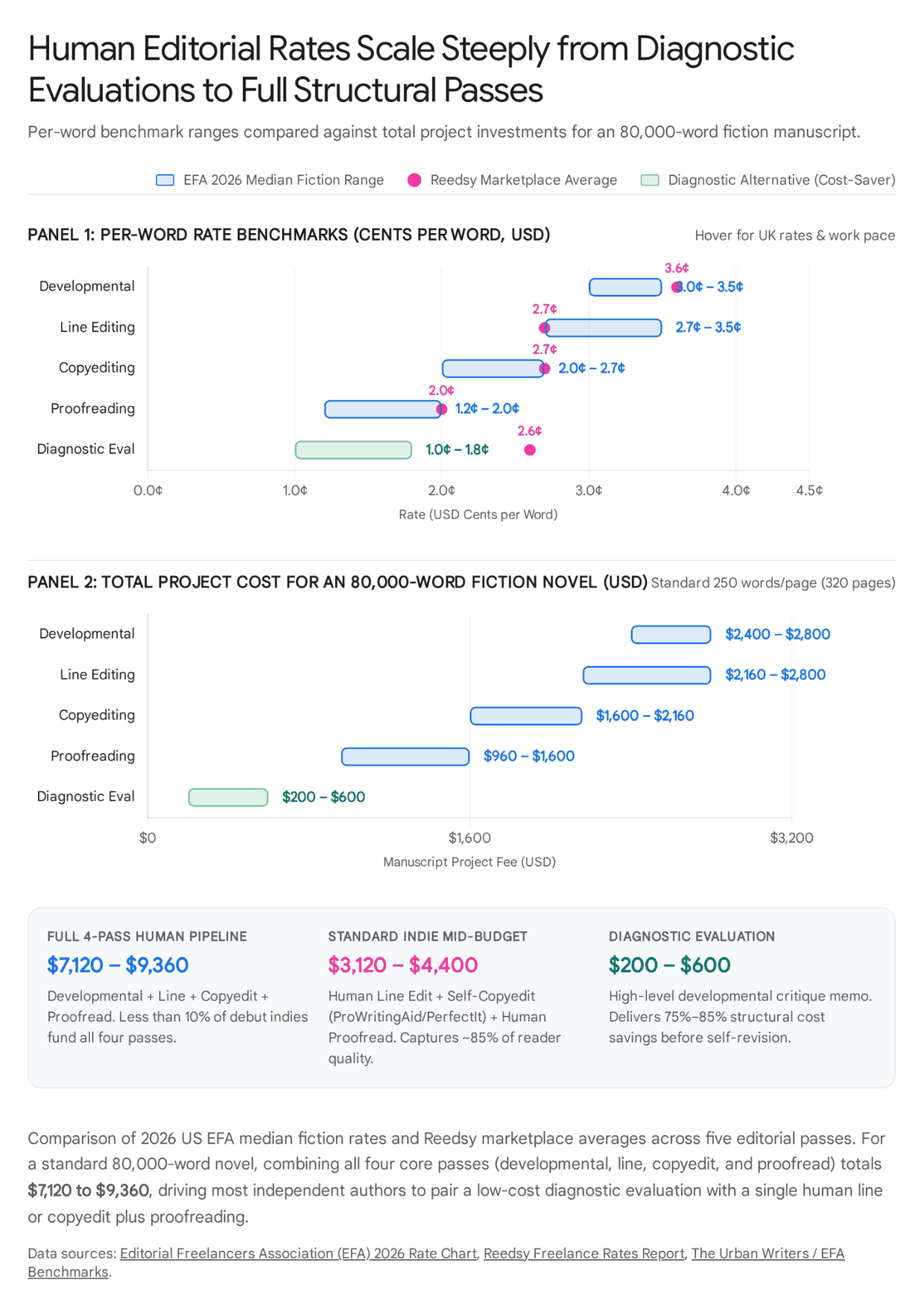
The empirical rate structure across the US and UK markets demonstrates a clear division between diagnostic services, structural/stylistic interventions, and mechanical verification[30]. While US freelancers predominantly quote per word or flat project fees calculated from a standard 250-word page (verified May 2026)[30], UK editors frequently anchor to CIEP suggested minimum hourly rates (verified June 2026)[31]—which rose on 1 March 2026 to £31.92/hour for proofreading (up from £30.75 in 2025 and £29.85 in 2024), alongside 2025/2026 tiers of £35.75+ for copyediting and £41.10–£44.50+ for substantial/developmental editing[33].
| Editorial Service / Directory | Pricing Model & 2026 Benchmarks (US & UK) | Specific Pass & Core Deliverable | Functional Boundary (What It Does Not Do) | Best For (Author Profile) | File Format | Turnaround & Pipeline Bottleneck Risk | Primary Source URL & Last Verified Date |
|---|---|---|---|---|---|---|---|
| Manuscript Evaluation / Editorial Assessment | US Freelance: $200–$500 for 50K words (~1.0–1.8¢/word); EFA median project fee $600 (mean $856); broad US novel range $600–$2,000. Reedsy Avg: 2.5–2.6¢/word ($0.026/word)[32]. UK Novel Range: £560–£970. Litro FastTrack: £45 ($59 USD) <4K words; Full Assessment £99 ($129 USD); Revision Check £35 ($45 USD)[34]. NAWE (UK): £80 (<10K words), £140 (10K–50K words), £215 (50K–110K words)[35]. | Big-Picture Structural Diagnostic (Pre-Edit): A holistic read of the manuscript resulting in a standalone 5–15 page editorial letter diagnosing plot holes, pacing lag, character motivation, stakes, and market readiness[34]. | Zero line edits, zero Track Changes, and zero (or minimal) inline margin comments inside the manuscript file[36]. | Budget-constrained authors and debut novelists who need professional verification of whether the story works before paying $2,000+ for line or developmental edits[34]. | .docx or .pdf[36] | [37] business days (Litro FastTrack) to 2–3 weeks (freelance)[34]; much faster than a full developmental edit. | https://www.the-efa.org/rates/ https://www.litromagazine.com/fast-track/ https://www.nawe.co.uk/ (Verified May–Oct 2026) |
| Developmental Editing | US EFA 2026 Median Fiction: 3.0–3.5¢/word ($0.030–$0.035/word; 2024 chart 3.0–4.0¢/word; $50–$60/hr; 5–10 pgs/hr). 80K novel: $2,400–$2,800[30]. Reedsy Fiction: 2.6–5.3¢/word (avg $0.027–$0.036/word)[32]. UK 2026 Rate: £0.020–£0.036/word (£1,800–£3,240 for 90K words). | Pass 1 — Structural Overhaul: Deep analysis of plot architecture, scene-by-scene pacing, subplots, character arcs, and narrative tension. Deliverable: a 10–25 page editorial letter plus extensive inline margin comments throughout the manuscript[38]. | Does not rewrite sentences, fix grammar, or apply Track Changes to prose; requires the author to execute major rewrites afterward[38]. | Funded authors ($2,400+ budget) tackling complex multi-POV plots, series openers, or structurally troubled drafts[39]. | .docx (margin comments + separate editorial report) | 3–6 weeks for the editor, plus 4–12 weeks for the author's structural rewrite—the single largest calendar bottleneck in publishing. | https://www.the-efa.org/rates/ (Verified May 2026) |
| Line Editing | US EFA 2026 Median Fiction: 2.7–3.5¢/word ($0.027–$0.035/word; 2024 chart 2.5–4.0¢/word; $45–$60/hr; 5–8 pgs/hr). 80K novel: $2,160–$2,800[30]. UK 2026 Rate: £0.020–£0.040/word (£1,800–£3,600 for 90K words). | Pass 2 — Stylistic & Prose Polish: Paragraph- and sentence-level editing for rhythm, voice consistency, word choice, emotional punch, dialogue naturalism, and elimination of filtering/redundancy via heavy Track Changes[33]. | Does not fix foundational plot holes and does not replace a final mechanical copyedit/proofread (unless contracted as a combined line/copy pass)[39]. | Indie authors funding one professional human pass—line editing directly shapes reader immersion and page-to-page prose quality[39]. | .docx with heavy Track Changes and margin queries | 2–4 weeks editor turnaround, plus 1–2 weeks for the author to accept/reject redlines and resolve queries. | https://www.the-efa.org/rates/ (Verified May 2026) |
| Copyediting | US EFA 2026 Median Fiction: 2.0–2.7¢/word ($0.020–$0.027/word; 2024 chart 2.0–3.0¢/word; $40–$50/hr; 5–10 pgs/hr). 80K novel: $1,600–$2,160[30]. Reedsy Avg: 2.5–2.8¢/word ($0.027/word avg)[32]. UK 2026 Rate: £0.014–£0.030/word (£1,260–£2,700 for 90K words; CIEP min £35.75+/hr)[40]. | Pass 3 — Mechanical & Continuity Certification: Grammar, punctuation, spelling, syntax, internal timeline/character trait consistency, and strict compliance with Chicago Manual of Style (US) or New Hart's Rules (UK), plus a formal Style Sheet[38]. | Does not restructure chapters or elevate flat artistic prose if the underlying sentences are grammatically valid[38]. | Authors with locked story structure and confident prose who need technical accuracy and continuity protection across a standalone or series[38]. | .docx with Track Changes + standalone Style Sheet .docx[38] | 2–3 weeks editor turnaround; low author revision friction (mostly accepting mechanical corrections). | https://www.the-efa.org/rates/ https://www.ciep.uk/knowledge-hub/suggested-minimum-rates.html (Verified May–Jun 2026) |
| Proofreading | US EFA 2026 Median Fiction: 1.2–2.0¢/word ($0.012–$0.020/word; $35–$45/hr; 7–10 pgs/hr). 80K novel: $960–$1,600[30]. Reedsy Avg: 2.0¢/word ($0.020/word; $30–$45/hr)[32]. UK 2026 Rate: £0.006–£0.017/word (CIEP min £31.92/hr effective 1 March 2026)[41]. | Pass 4 — Final Quality-Control Sweep: Catching the last 1–2% of surface errors: surviving typos, duplicated/dropped words, homophones, punctuation slips, and typesetting/layout defects (widows, orphans, bad hyphenation, TOC mismatches)[33]. | Does not rewrite sentences, question story logic, or fix stylistic awkwardness; altering prose at this stage corrupts pagination. | Every author on every budget. Proofreading is the cheapest human pass and the one whose absence immediately triggers 1- and 2-star Amazon reviews. | .docx (pre-layout) or formatted .pdf / .epub proofs | 1–2 weeks; fast, non-disruptive final checkpoint immediately prior to KDP/IngramSpark upload. | https://www.the-efa.org/rates/ https://www.ciep.uk/knowledge-hub/suggested-minimum-rates.html (Verified Mar–Jun 2026) |
| Reedsy Marketplace | Free to browse and request up to 5 quotes; 10% client fee + 10% freelancer commission built into quotes. Avg rates: Assessment 2.5–2.6¢/word, Developmental 2.6–5.3¢/word ($0.03 avg)[42], Copyediting 2.5–2.8¢/word ($0.02 avg)[13], Proofreading 2.0¢/word[32]. | Vetted Freelancer Marketplace: Connects authors with strictly vetted traditional-publishing editors (requiring 5+ years experience and strong credits), handling contracts, milestones, and escrow payments[32]. | Does not allow unvetted budget freelancers, making it roughly 20–50% more expensive than hiring entry-to-mid-level editors directly via EFA job boards or Upwork[43]. | Mid-to-high-budget authors who prioritize vetted Big-5 editorial pedigrees and platform payment security over bargain hunting[32]. | .docx / .pdf via platform workspace | 1–3 days to receive quotes; top Reedsy editors often book 1–3 months in advance. | https://reedsy.com/freelancer/how-to-set-your-freelance-editing-rates/ (Verified May 2026) |
| EFA (US) & CIEP (UK) Directories | Free ($0) for authors to search member directories or post job listings (the-efa.org/hiring/); direct freelancer rates without marketplace commission markups[30]. | Direct Professional Hiring Directories: Public databases and job boards connecting authors directly with independent US and UK editorial professionals[30]. | Does not provide built-in escrow payment processing; note that EFA membership is open to paying freelancers, whereas CIEP Professional/Advanced grades require formal assessment/experience verification[40]. | Authors who want to avoid Reedsy's ~20% combined platform fee and negotiate sample edits and payment plans directly with freelancers[43]. | .docx / .pdf | Job board posts on the EFA regularly yield 15–40 editor applications within 48 hours, often including editors willing to work below median rates or on payment plans[43]. | https://www.the-efa.org/hiring/ https://www.ciep.uk/ (Verified May–Jun 2026) |
Scroll sideways to see all columns →
E. AI-Assisted Editing and Proofreading Software
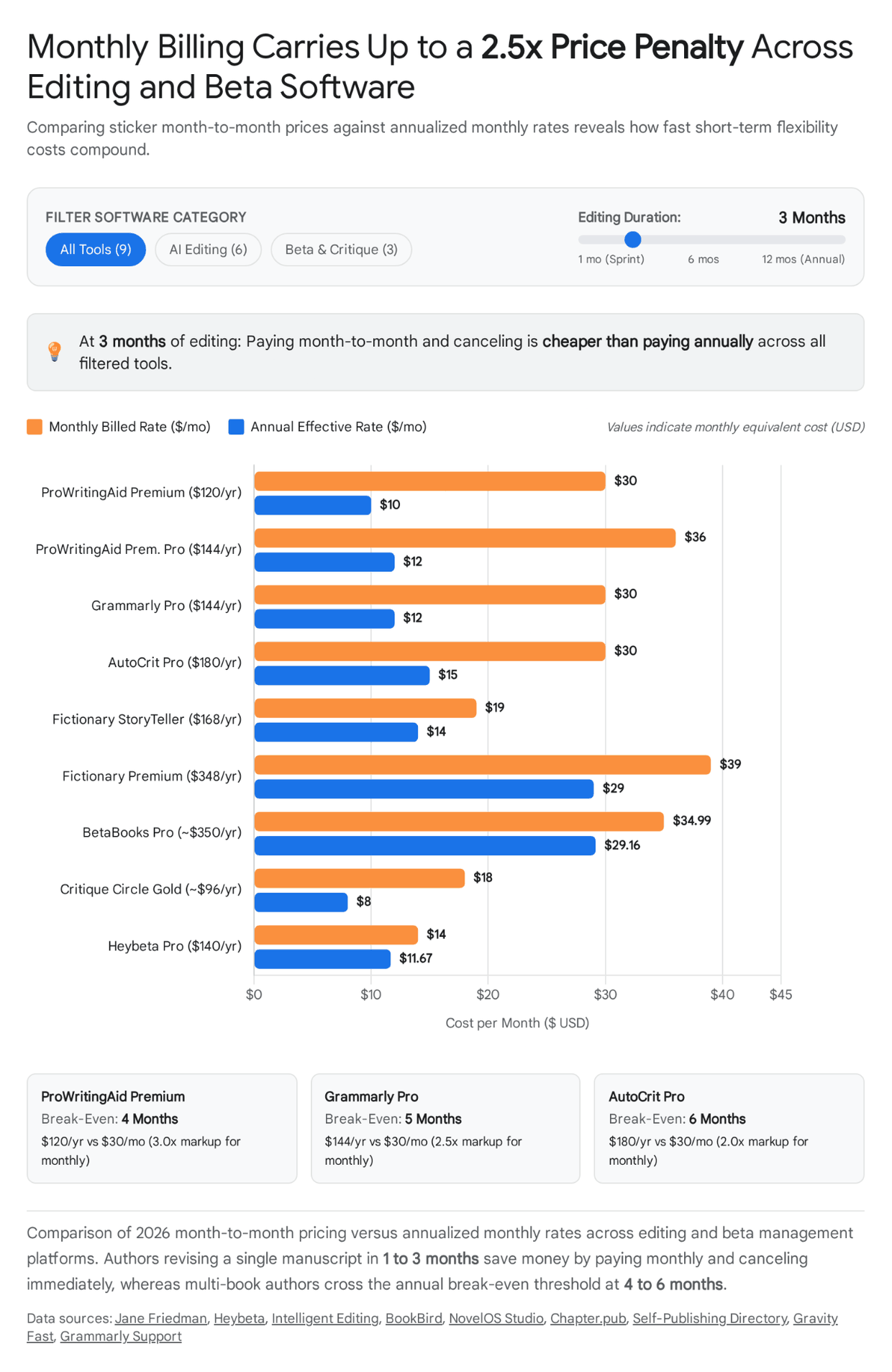
The 2026 software landscape separates into rule-based consistency checkers (PerfectIt, verified October 2026)[8], prose-level style and grammar analyzers (ProWritingAid, Grammarly, and AutoCrit, verified September–October 2026)[44][45][46], scene-level structural mapping tools (Fictionary, verified October 2026)[47], and whole-manuscript LLM developmental utilities (Wordsmith and novelmint.ai/compare, verified October 2026)[25][48][6]. Across all tools in this category, a fundamental technical boundary persists: software excels at pattern detection, syntax verification, consistency, and statistical benchmarking against genre corpora, but it cannot evaluate whether a narrative premise is emotionally resonant, whether a character's motivation is earned, or whether a plot twist lands with human subtext[6].
| Software Tool | Pricing Model & Tiers (2026) | Primary Editorial Pass & Core Capabilities | Functional Boundary (What It Does Not Do) | Best For (Author Profile) | File Format & Integrations | Turnaround & Workflow Speed | Primary Source URL & Last Verified Date |
|---|---|---|---|---|---|---|---|
| ProWritingAid | Free: $0 (500-word check cap, 3 Sparks/day) Premium: $30/mo, $120/yr ($10/mo), or $399 lifetime (unlimited words, 1 Chapter Critique/day) Premium Pro: $36/mo, $144/yr ($12/mo), or $699 lifetime (50 Sparks/day, 3 Chapter Critiques/day) Story Credits: $17.50–$25 per full Manuscript Analysis[6]. | Self-Line Edit & Copyedit Assist: 25+ prose reports (sticky sentences, pacing, echoes/repetition, clichés, sensory balance, dialogue tags, sentence length variety), Sparks AI rephrasing, and AI Chapter Critique[6]. | Cannot validate multi-chapter plot logic, character arc payoff, or emotional authenticity; full-manuscript AI critique requires extra paid Story Credits ($17.50–$25 each)[49]. | Fiction and nonfiction authors who want deep sentence-level style diagnostics directly inside Scrivener, Atticus, or Word, or who want a one-time lifetime license[6]. | Native integrations for Scrivener (.scriv), Atticus, MS Word (.docx), Google Docs, browser extension, and web app (requires internet connection)[6] | Seconds per chapter; running and manually revising across 25+ reports on an 80K novel takes 1–2 weeks of author labor. | https://prowritingaid.com (Verified Sept–Oct 2026) |
| AutoCrit | Free Forever: $0 (no manuscript word limit, basic reports) AutoCrit Pro: $30/mo or $180/yr ($15/mo billed annually); promotional lifetime tier $698. (Note: A Sept 2026 audit flagged a display discrepancy showing "$500 billed annually" alongside "$15/mo / 6 months free" on its pricing page)[6]. | Genre-Benchmarked Line Edit & Story Analysis: 25+ interactive reports benchmarking prose statistics (adverbs, passive indicators, dialogue ratio, pacing) against published bestsellers in specific fiction and 8 nonfiction genres, plus Story Analyzer+ (plot, characters, beat sheets) and AI reader personas with unlimited re-runs[6]. | Browser-only workspace (no native plugin inside Scrivener or Word); statistical matching to bestsellers can homogenize unique literary voice if followed blindly[49]. | Commercial genre novelists (Thriller, Romance, Fantasy, Mystery) who want empirical bestseller prose comparisons and unlimited AI structural re-runs during revision[6]. | Web browser workspace (imports and exports .docx, .rtf, .txt)[49] | Prose reports run in seconds; Story Analyzer+ delivers full-manuscript beat/character reports in minutes[50]. | https://www.autocrit.com (Verified Sept–Oct 2026) |
| Fictionary | Free Community: $0 (classes/groups; no permanent free software tier; 7-day free trial with no card) StoryTeller: $19/mo or $168/yr ($14/mo; 3 manuscripts) StoryTeller Premium: $39/mo or $348/yr ($29/mo; 10 manuscripts, track changes, series support, 8 courses) StoryCoach (Editors): $49/mo or $396/yr ($33/mo; 20 clients)[51]. | AI-Assisted Structural / Developmental Self-Edit: Breaks a finished draft into scenes and evaluates [52] Story Elements across Character, Plot, and Setting; visualizes the Story Arc against genre templates; provides immediate AI scene evaluation and POV/pacing insights[6]. | Performs zero grammar, spelling, punctuation, or line-level copyediting; useless during early drafting because it requires a completed manuscript to analyze[49]. | Novelists with a completed first draft who cannot afford a $2,400+ developmental editor and want a structured 1-to-2-month ($19–$38) scene-level structural audit[6]. | Desktop web browser app (imports and exports .docx mapped by chapter/scene breaks)[49] | Automated arc mapping takes minutes; working through all 38 elements across ~60 scenes takes 2–8 weeks of author revision[51]. | https://fictionary.co/pricing/ (Verified Oct 2026) |
| Grammarly | Free: $0 (spelling, grammar, basic tone, 100 AI prompts/mo) Grammarly Pro (replaced legacy Premium & Business in 2026; 1–149 seats): $30/member/mo monthly, $60/quarter ($20/mo), or $144/yr ($12/mo annual; 2,000 AI prompts/mo) Superhuman Business Suite: ~$33–$40/member/mo Enterprise: Custom quote[53]. | Surface Copyediting & Proofreading Layer: Real-time grammar, spelling, punctuation, conciseness, full-sentence rewrites, tone adjustment, style guides, and plagiarism detection across virtually every desktop and web app[6]. | Not built for fiction craft: lacks pacing, dialogue, or story structure tools, and aggressively flags intentional fiction fragments, dialect, and narrative voice as grammatical errors[6]. | Nonfiction, memoir, and business authors, or fiction writers running a fast surface typo/punctuation sweep and polishing query letters and blurbs[6]. | Browser extension, desktop overlay, MS Word (.docx), Google Docs, mobile keyboards[6] | Real-time inline checking; processes manuscript chapters in minutes (must be checked in chapter chunks rather than a single 80K dump)[54]. | https://www.grammarly.com/pro https://support.grammarly.com/hc/en-us/articles/115000090011-How-much-does-Grammarly-Pro-cost (Verified Sept–Oct 2026) |
| PerfectIt (Intelligent Editing) | 14-day free trial Cloud / Standard (1–10 users): $70/yr billed annually ($10/mo option) Professional (1–3 users): $115/yr (adds Chicago Manual of Style integration; requires CMOS Online subscription) Elite (1–3 users): $145/yr (adds PowerPoint) Team (3–100 users): $155/yr Enterprise: $7,000/yr[8]. | Deterministic Copyediting Consistency & Style-Guide Checker: Scans entire .docx manuscripts for hyphenation inconsistencies, capitalization drift, spelling variants (US/UK/CA/AU), number formatting, acronym definitions, and custom house style sheets[42]. | Does not check general syntax/grammar, does not rewrite prose, does not use generative AI, and cannot run outside Microsoft Word[8]. | Self-copyediting indie authors, series writers enforcing multi-book worldbuilding spelling/capitalization rules, and professional freelance copyeditors[42]. | Native Microsoft Word (.docx) add-in (Windows desktop supports secure offline working; Mac/Web via Word Cloud add-in)[8] | 1–3 minutes to scan an 80,000-word .docx file and step through grouped consistency fixes[8]. | https://intelligentediting.com/buy-now/?display=cloudonly (Verified May–Oct 2026) |
| Wordsmith | $50/month or $50/manuscript (independent publishing editorial utility co-founded by Euwyn Goh, distinct from Wordsmith.ai legal contract AI)[25]. | Whole-Manuscript AI Developmental & Line Editor: Reads the full manuscript in context, diagnoses where structural pacing or chapter arcs break, performs style checks, and evaluates when a chapter is structurally finished alongside publishing/export tools[25]. | Cannot replace human reader empathy, cultural nuance, or a human developmental editor's market intuition on high-stakes commercial releases. | Budget-constrained solo authors wanting an all-at-once AI structural and line read without piecing together chapter-by-chapter LLM prompts[25]. | Web workspace accepting .docx uploads and exporting KDP-ready files[48] | Minutes to hours per full manuscript evaluation pass, bypassing the 4-week human developmental wait time. | https://publishingmap.com/reference/ https://novelmint.ai/compare (Verified May–Oct 2026) |
Scroll sideways to see all columns →
2. Core Pairing Matrix: Head-to-Head Comparisons
1. Microsoft Word vs. Google Docs for Manuscript Editing
Microsoft Word ($69.99–$99.99/year, verified October 2026)[2] wins decisively for every author entering the professional editing stage with a full-length manuscript because its revision engine handles 300,000+ words and granular formatting redlines without lag, whereas Google Docs ($0 free tier, verified October 2026)[55] is viable only for short-form drafting, co-authoring, or small beta-reader chapter splits[3].
| Comparison Dimension | Microsoft Word (.docx) | Google Docs (Cloud Web Doc) |
|---|---|---|
| Pass Depth & Redline Granularity | Tracks text insertions, deletions, paragraph moves, style definitions, table changes, and granular formatting as individually acceptable items[3]. | Suggesting mode tracks text edits and coarse formatting, but lacks style-level redline separation and native change-list printing. |
| File Compatibility & Size Ceiling | Publishing's universal .docx standard; effortlessly opens 300,000-word manuscripts containing thousands of tracked edits and margin comments[3]. | Hard limit of ~1,024,000 characters (~150K–180K words), with severe browser lag emerging once a 70K–80K novel accumulates heavy comment threads. |
| Locking, Enforcement & Add-Ins | Supports password-protected "Lock Tracked Changes" enforcement and hosts professional editorial plugins (PerfectIt, ProWritingAid, Wordsmith)[42]. | Per-user Suggesting toggle with no document-level lock preventing accidental direct overwrites; cannot run PerfectIt[8]. |
| Price & Turnaround Impact | **69.99–**99.99/yr (Microsoft 365); zero file-splitting rework during professional editing. | $0 (Free); forces freelance editors to split full novels into 3–5 separate files, fracturing the change record and adding manual reassembly time. |
Scroll sideways to see all columns →
Choose Microsoft Word if the manuscript is ready for a human developmental, line, or copyeditor, exceeds 40,000 words with heavy markup, requires PerfectIt consistency checks, or needs clean paragraph styles for InDesign or Atticus import[38]. Choose Google Docs if two co-authors are drafting scenes simultaneously in real time or a solo author is sharing three to five chapters with a small group of free beta readers who lack Microsoft Office[13]. Regarding 2025–2026 market changes, while Google Docs expanded Gemini AI writing prompts across Workspace tiers in 2025–2026, its underlying browser DOM rendering ceiling for heavily commented long-form documents remains unchanged, keeping .docx in Microsoft Word the non-negotiable requirement for professional book editors[38].
2. Scrivener vs. Microsoft Word for the Editing Stage
Scrivener ($59.99 one-time license, verified October 2026)[4] wins as a modular drafting and structural reorganization studio for first drafts, but Microsoft Word ($69.99/year) wins unconditionally for the editing stage because Scrivener cannot import or display Word's Track Changes markup[1].
| Comparison Dimension | Scrivener (Drafting Environment) | Microsoft Word (Review Environment) |
|---|---|---|
| Primary Pipeline Stage | First-draft composition, research storage, corkboard plotting, and post-beta structural chapter reordering[6]. | External developmental, line, copyediting, and proofreading review passes[1]. |
| Track Changes Interoperability | Zero native Track Changes view. Imports Word margin comments, but flattens all tracked insertions/deletions upon .docx import[1]. | Full bidirectional .docx Track Changes review, compare/combine, and redline acceptance/rejection[1]. |
| Version Control Mechanism | Document-level Snapshots (manual or compile-triggered point-in-time backups of individual binder scenes) with visual diff comparison. | Linear inline redlines and Version History / Compare Documents across whole manuscript files[3]. |
| Price & Round-Trip Friction | $59.99 one-time license (macOS/Windows)[6]; high friction during external edits due to manual scene-by-scene paste-backs[1]. | $69.99/yr subscription; zero round-trip friction when exchanging files with editors and proofreaders[1]. |
Scroll sideways to see all columns →
Choose Scrivener if drafting a novel from scratch, managing a complex series bible, or rearranging dozens of scenes on a visual corkboard after receiving a high-level developmental editorial letter[6]. Choose Microsoft Word if compiling the manuscript to send to a human editor and permanently transitioning the project out of Scrivener once line editing and copyediting begin[1]. In 2025–2026, Scrivener remains a $59.99 one-time non-AI desktop powerhouse[6], while macOS power users increasingly pair it with Marked 3 (verified April 2026)[56] for live Markdown and Scrivener previewing and clean .docx or PDF compilation[9]. However, the core architectural barrier—Scrivener's inability to parse Word Track Changes—remains unaltered[1].
3. Scribophile vs. Critique Circle
Scribophile (Free to $15/month, verified May 2026)[22] wins for authors prioritizing guaranteed, high-effort inline prose critiques and an active community with a built-in beta reader directory, whereas Critique Circle (Free to $11–$18/month, verified October 2026)[23] wins for genre writers who prefer a rigid 7-day weekly chapter queue and lower annual subscription pricing (~$60–$96/year vs. Scribophile's ~$150/year standard framing)[25].
| Comparison Dimension | Scribophile | Critique Circle |
|---|---|---|
| Exchange Economy & Queue Logic | Karma system: Critiquing others earns karma; posting costs karma. Works remain in the "Main Spotlight" until they receive at least 3 guaranteed critiques[20]. | Credit system: Posting costs 3 credits; critiques earn 0.5–2 credits. Submissions sit in a public genre queue for a strict 1-week window regardless of critique count[27]. |
| Community Culture & Vetting | Strictly moderated against destructive behavior; readers rate critique helpfulness, incentivizing long, inline line-by-line critiques[20]. | Long-running (launched 2003) with strong genre niches, but suffers from declining active user concurrency (~60–70 online vs 110+ previously)[27]. |
| Price Structure (2026) | Free tier (2 works limit); Premium $15/mo (annual framed as "two months free" ~$150/yr, though legacy/third-party sources cite $65–$89/yr)[25]. | Free tier; Premium $11/mo (~$5/mo annual); Gold $18/mo (~$8/mo annual)[27]. |
| Turnaround & What It Misses | 2–7 days per 3,000-word chapter; both platforms miss whole-book structural pacing unless the author recruits a full-manuscript beta reader off-queue[20]. | Fixed 7-day Wednesday queue cycle; free queue misses full-book continuity unless upgraded to Premium/Gold Beta Queues[27]. |
Scroll sideways to see all columns →
Choose Scribophile if the goal is guaranteed feedback volume on individual chapters, detailed inline prose-level peer critique, or access to a large, active Beta Reader Directory[20]. Choose Critique Circle if writing commercial genre fiction (especially Fantasy or Sci-Fi), preferring a predictable weekly submission cadence, or seeking lower-cost annual access to private and beta queues (~$5–$8/month billed annually)[27]. Between 2022–2023 and 2026, Critique Circle has experienced notable feature stagnation alongside a drop in active concurrent users (from 110+ to 60–70) and low third-party review scores (Trustpilot 2.8/5 from 41 reviews on directory audits and 3.2/5 on regional pages; Sitejabber 3.1/5 from 12 reviews)[27], tilting momentum toward Scribophile despite Scribophile's higher monthly sticker price[20].
4. BetaBooks vs. BetaReader.io
BetaReader.io (Free to $9.99/month, verified October 2026)[12] wins for budget-conscious, data-driven indie authors because it provides granular reader drop-off analytics and native mobile apps (iOS and Android), whereas BetaBooks (Free to $14.99–$34.99/month, verified May 2026)[11] wins only for authors who want a paid-tier beta reader directory or team collaborator roles[19].
| Comparison Dimension | BetaBooks (betabooks.co) | BetaReader.io (betareader.io) |
|---|---|---|
| Pass Depth & Analytics | Chapter-gated progress tracking, inline highlighter feedback, custom questionnaires, and anti-groupthink comment isolation[19]. | Inline comments, reactions, chapter surveys, real-time progress tracking, plus drop-off and reading speed analytics showing exactly where readers stall[19]. |
| Platform & File Compatibility | Browser-only manuscript delivery; no native mobile apps and no offline downloads[20]. | Cloud web application plus dedicated Android and iOS mobile apps; imports .docx/text seamlessly[19]. |
| Price Structure (2026) | Free (1 book, 3 readers); $14.99/mo (20 readers + directory); $34.99/mo Pro (unlimited readers + collaborator roles)[19]. | Free (1 book, 3 readers, 30-day history); $9.99/mo Premium (5 to unlimited books, 20 to unlimited readers, 90-day history); $49.99/mo Publisher[18]. |
| What It Misses | High price ceiling ($34.99/mo) for unlimited readers; directory does not guarantee high-quality completions[19]. | Zero built-in reader directory—the author must recruit 100% of beta readers externally[20]. |
Scroll sideways to see all columns →
Choose BetaBooks if the workflow requires its built-in Reader Directory to supplement an existing beta team or co-author/editor collaborator roles on the $34.99/month Pro plan[19]. Choose BetaReader.io if an author already has a list of beta readers and wants the richest reading-pace and drop-off analytics at a flat $9.99/month[19]. In 2025–2026, both platforms maintained stable pricing (verified May–October 2026), while new challenger BetaManuscript (verified October 2026)[57] entered the market at an identical Free to $9.99/month price point with passage annotations and revision dashboards, further pressuring BetaBooks' $34.99/month Pro tier[20].
5. BookFunnel vs. StoryOrigin for ARC Delivery
BookFunnel ($30–$300/year, verified May 2026)[16] wins for frictionless, watermarked ARC delivery and white-glove reader technical support, while StoryOrigin (Free to $10/month or $100/year, verified May 2026)[17] wins for authors seeking a unified all-in-one dashboard that combines beta reader chapter coordination, ARC review tracking, and newsletter swaps[18].
| Comparison Dimension | BookFunnel (bookfunnel.com) | StoryOrigin (storyoriginapp.com) |
|---|---|---|
| Core Functional Scope | Pure digital delivery engine: watermarked ARCs (Certified Mail), reader magnets, direct sales delivery, group promos, and reader tech support[20]. | All-in-one marketing and editorial coordinator: beta reading module, ARC reviewer application/tracking, newsletter swaps, and direct sales[18]. |
| Beta Reading Capability | None. Delivers finished .epub/.pdf files only; no inline commenting or chapter feedback forms[20]. | Built-in beta reader chapter distribution and structured feedback collection forms[18]. |
| Price Structure (2026) | Restructured Feb 2026: $30/yr (1 pen name, 500 downloads/mo), $200/yr (4 pen names, 5,000 downloads/mo), $300/yr (unlimited)[20]. | Free tier (basic link/file delivery); Standard $10/mo or $100/yr (full ARC, beta, and swap suite)[18]. |
| What It Misses | Does not track whether ARC readers actually post their reviews on Goodreads/Amazon as granularly as dedicated ARC trackers without Certified Mail upgrades ($200/yr tier), and supplies no built-in ARC readers[20]. | Does not match BookFunnel's industry-leading direct-to-Kindle app integration or dedicated human tech support for confused readers[18]. |
Scroll sideways to see all columns →
Choose BookFunnel if the priority is the industry standard for delivering reader magnets and watermarked ARCs with zero technical support emails from readers struggling to side-load EPUBs[20]. Choose StoryOrigin if seeking one $100/year subscription that handles both pre-edit beta reader chapter feedback and post-edit ARC campaign tracking alongside newsletter cross-promotions[18]. BookFunnel's February 2026 pricing restructure eliminated its legacy $20/$100/$250 tiers, raising the entry First-Time Author plan to $30/year (500 downloads/month) and doubling the Mid-List plan from $100/year to $200/year (up to 4 pen names, 5,000 downloads/month)[18]. That $200/year jump makes StoryOrigin ($100/year) exactly half the price for mid-list authors who need multi-pen-name ARC management[18].
6. ProWritingAid vs. AutoCrit
ProWritingAid ($30/month, $120/year, or $399 lifetime, verified October 2026)[44] wins for versatile line-level style editing because it integrates directly inside Scrivener, Atticus, Word, and Google Docs, whereas AutoCrit ($30/month or $180/year, verified October 2026)[46] wins for commercial genre novelists who want their prose empirically benchmarked against bestselling titles in their specific genre and want unlimited AI story-analyzer runs[6].
| Comparison Dimension | ProWritingAid | AutoCrit |
|---|---|---|
| Pass Depth & Benchmarking | 25+ deep style reports (sticky sentences, echoes, pacing, sensory words, clichés), Sparks AI rewrites, and daily Chapter Critiques[6]. | 25+ prose reports benchmarked against genre-specific bestseller corpora, plus Story Analyzer+ (beat sheets, character arcs) and AI reader personas[6]. |
| Workflow & File Compatibility | Native plugins for Scrivener, Atticus, MS Word, Google Docs, browser extension, and desktop app (internet required)[6]. | Browser-only workspace; requires uploading .docx/.rtf files to AutoCrit's web app and exporting back out[49]. |
| Price & Credit Economics (2026) | Free (500 words); Premium $30/mo, $120/yr, $399 lifetime; Premium Pro $36/mo, $144/yr, $699 lifetime; full Manuscript Analysis costs 17.50–[58] per Story Credit[49]. | Free Forever (no word cap, limited reports); Pro $30/mo or $180/yr($15/mo); occasional $698 lifetime promo. Unlimited Story Analyzer+ re-runs included in Pro[59]. |
| What It Misses | Iterative developmental re-runs become expensive due to $17.50–$25 per-credit fees for whole-manuscript reports[59]. | Lacks native integrations with external writing software and carries a non-refundable $30 monthly fee[49]. |
Scroll sideways to see all columns →
Choose ProWritingAid if editing directly inside Scrivener, Atticus, or Word, preferring a lower annual rate ($120/year vs. $180/year), or investing in a $399 one-time lifetime license[6]. Choose AutoCrit if writing commercial genre fiction (Thriller, Romance, Fantasy) and comparing dialogue-to-narrative ratios, adverb counts, and pacing against genre bestsellers while running unlimited Story Analyzer+ developmental checks[6]. In 2025–2026, ProWritingAid raised its standard annual price from $79/year to $120/year ($144/year for Premium Pro) while maintaining its $399/$699 lifetime tiers and adding per-manuscript Story Credits ($17.50–$25)[6]. AutoCrit countered by bundling unlimited Story Analyzer+ runs into its $30/month($180/year) Pro tier without per-run credit surcharges[59].
7. ProWritingAid vs. Grammarly
ProWritingAid ($120/year, verified October 2026)[44] wins for fiction and long-form book authors because its 25+ reports analyze pacing, dialogue, repetition, and rhythm without flattening creative voice, while Grammarly ($144/year for Pro, verified October 2026)[45] wins for nonfiction and business writers and fast surface-level typo and punctuation cleanup across everyday applications[6].
| Comparison Dimension | ProWritingAid | Grammarly |
|---|---|---|
| Editorial Pass Focus | Line Editing & Style Diagnostics: Pacing, sentence variety, overused words, echoes, dialogue tags, sensory detail, and chapter-level fiction critique[6]. | Copyediting & Surface Proofreading: Grammar, spelling, punctuation, conciseness, business tone detection, and plagiarism checking[6]. |
| Fiction Voice Preservation | Built specifically for novelists; configurable for fiction style rules and integrates with Scrivener and Atticus[6]. | Tuned for corporate and academic clarity; routinely attempts to rewrite intentional stylistic fragments, colloquial dialogue, and literary rhythm[6]. |
| Price & Billing Options (2026) | Free (500-word cap); Premium $30/mo, $120/yr ($10/mo), or $399 lifetime[49]. | Free (unlimited basic grammar + 100 AI prompts/mo); Pro $30/mo, $60/quarter, or $144/yr ($12/mo; 2,000 AI prompts/mo). No lifetime option[53]. |
| What It Misses | Slightly slower real-time popup responsiveness than Grammarly on casual web forms/emails[6]. | Zero fiction craft reports (no pacing, dialogue balance, or chapter critique)[6]. |
Scroll sideways to see all columns →
Choose ProWritingAid if editing a novel, memoir, or narrative nonfiction manuscript where prose rhythm, dialogue, and repetition control are primary concerns[6]. Choose Grammarly if writing nonfiction business books, academic prose, emails, and query letters, or using Grammarly Free ($0) solely as a final surface typo catcher after a ProWritingAid pass[6]. In 2026, Grammarly retired its standalone Premium and Business tiers, consolidating into Grammarly Pro ($30/month, $60/quarter, $144/year) under the broader Superhuman AI suite (alongside Coda/Superhuman Docs and Superhuman Mail)[60]. Despite ProWritingAid's jump to $120/year, ProWritingAid remains $24/year cheaper than Grammarly Pro ($144/year) and is the only one of the two offering a lifetime purchase ($399)[53].
8. AutoCrit vs. Fictionary
Fictionary ($19/month or $168/year for StoryTeller, verified October 2026)[47] wins for dedicated scene-by-scene developmental editing across 38 structural story elements, whereas AutoCrit ($30/month or $180/year, verified October 2026)[46] wins for authors who want line-level prose benchmarking against genre bestsellers combined with automated beat-sheet summaries in a single subscription[6].
| Comparison Dimension | AutoCrit | Fictionary (StoryTeller) |
|---|---|---|
| Primary Editorial Pass | Line Editing + Automated Story Diagnosis: Sentence-level prose reports benchmarked against genre fiction plus Story Analyzer+ beat/character reports[6]. | Pure Developmental / Structural Editing: Visual Story Arc mapping and scene-by-scene audit across [52] Story Elements (Plot, Character, Setting)[6]. |
| Line & Copyediting Capability | Full suite of 25+ prose, pacing, repetition, dialogue, and grammar reports[49]. | None. Does not check grammar, spelling, word repetition, or sentence syntax[49]. |
| Price & Trial Structure (2026) | Free Forever tier (no word cap); Pro $30/mo or $180/yr($15/mo)[6]. | No permanent free tier (7-day free trial, no card); StoryTeller $19/mo or $168/yr($14/mo); Premium $39/mo or $348/yr[51]. |
| Turnaround & Author Effort | Story Analyzer+ generates diagnostic reports in minutes[50]. | Imports and plots the Story Arc in minutes, but requires 2–8 weeks of hands-on scene grading by the author ($19–$38 for a 1–2 month pass)[51]. |
Scroll sideways to see all columns →
Choose AutoCrit if seeking one tool that handles both genre-benchmarked line editing and fast AI structural and beat-sheet diagnostics[6]. Choose Fictionary if holding a completed first draft with suspected structural or pacing flaws and wanting a disciplined, visual scene-by-scene developmental framework for $19–$38 over one to two months before touching line-level prose[6]. In 2025–2026, Fictionary's addition of immediate AI-powered scene evaluation inside its $19/month StoryTeller tier bridged the gap between manual scene tagging and automated critique, while keeping its monthly entry price $11/month lower than AutoCrit Pro ($30/month) for short 1–2 month structural revision sprints[51].
9. PerfectIt vs. ProWritingAid
PerfectIt ($70/year Standard or $115/year Professional, verified October 2026)[8] wins for deterministic manuscript-wide consistency and Chicago Manual of Style copyediting enforcement inside Microsoft Word, while ProWritingAid ($120/year, verified October 2026)[44] wins for creative style, readability, pacing, and sentence-level line editing[6].
| Comparison Dimension | PerfectIt (Intelligent Editing) | ProWritingAid |
|---|---|---|
| Editorial Pass Specialization | Pass 3 — Technical Copyediting Consistency: Enforces uniform hyphenation, capitalization, spelling variants, numbers, acronyms, and custom house style sheets across a whole book[42]. | Pass 2 & 3 — Line Editing & General Grammar: Evaluates prose rhythm, sticky sentences, pacing, dialogue tags, clichés, and grammar/spelling[6]. |
| Algorithmic Mechanism | Deterministic rule-based comparison engine + Chicago Manual of Style database; zero generative AI hallucination risk[8]. | Statistical NLP + generative LLM (Sparks AI / Chapter Critique)[6]. |
| File & Offline Compatibility | Runs exclusively as a Microsoft Word (.docx) add-in; Windows desktop version supports 100% secure offline operation[8]. | Works across Scrivener, Atticus, Word, Google Docs, and browsers, but requires an active internet connection for all integrations[49]. |
| Price Structure (2026) | $70/yr Standard/Cloud; $115/yr Professional (with CMOS integration; requires separate CMOS Online subscription); $145/yr Elite[8]. | Free (500 words); $30/mo, $120/yr, or $399 lifetime[49]. |
Scroll sideways to see all columns →
Choose PerfectIt if performing the final copyediting pass in Microsoft Word to ensure a character's title, fantasy terminology, or compound words (cyber-attack vs. cyberattack) never drift between Chapter 1 and Chapter 306. Choose ProWritingAid if revising sentence structure, eliminating repetitive word echoes within paragraphs, and tightening prose during the line-editing phase[6]. In 2025–2026, professional copyeditors and high-output indie series authors routinely stack both tools sequentially—running ProWritingAid during the line edit in Scrivener or Atticus, then exporting to .docx and running PerfectIt ($70/year) in Word as the final consistency gate before proofreading[42].
10. Manuscript Evaluation vs. Developmental Editing
Manuscript evaluation ($200–$600 US or £99–£215 UK and nawe.co.uk, verified May–October 2026)[30][36][61] wins for budget-constrained authors and unvetted first drafts because it delivers 80% of the macro-structural diagnosis at 15–25% of the cost, whereas full developmental editing ($2,400–$2,800 for 80K words at EFA medians) wins only when an author has the capital to pay for scene-by-scene inline margin coaching alongside a comprehensive editorial letter[30].
| Comparison Dimension | Manuscript Evaluation / Editorial Assessment | Full Developmental Editing |
|---|---|---|
| Deliverable Depth | A standalone 5–15 page editorial letter diagnosing overarching plot, pacing, character arc, and market-fit issues, with priority revisions ranked by impact[34]. | A 10–25 page editorial letter PLUS hundreds of inline margin comments anchored to specific paragraphs and scenes throughout the .docx file[38]. |
| 2026 Cost (80,000-Word Novel) | $200–$500 (50K benchmark) / $600 EFA median project fee (mean $856); Reedsy ~2.5¢/word (~$2,000); UK £99 (Litro Full Assessment) to £215 (NAWE) to £560–£970 (UK commercial)[32]. | US EFA Median: $2,400–$2,800 (3.0–3.5¢/word); Reedsy 2.6–5.3¢/word ($2,080–$4,240); UK £1,800–£3,240 (90K words at £0.020–£0.036/word)[30]. |
| Turnaround Time | [37] business days (Litro) to 2–3 weeks (freelance)[34]. | 3–6 weeks for the editor's pass, often booked 1–2 months ahead. |
| What It Misses | Does not hold the author's hand scene-by-scene in the margins; the author must locate and execute the structural fixes independently[39]. | Consumes $2,400+ of budget before a single sentence is line-edited, copyedited, or proofread[33]. |
Scroll sideways to see all columns →
Choose a Manuscript Evaluation if the total editorial budget is under $4,000, the draft has not yet been stress-tested by beta readers, or the author needs a prioritized roadmap of what to fix first before investing in line editing[34]. Choose Developmental Editing if the author has a $5,000–$9,000 total budget, or the manuscript has already been through self-revision and beta readers yet still suffers from complex structural tangles that require margin-level dissection[33]. In 2025–2026, the availability of ultra-accessible institutional assessments—such as Litro FastTrack (£45 / $59 USD for <4,000 words; £99 / $129 USD for Full Manuscript Assessment; £35 / $45 USD for a follow-up Revision Check) and NAWE (£215 for up to 110,000 words)—alongside $19/month AI structural tools like Fictionary has made the $600–$2,800 developmental decision the primary area where savvy indies reallocate budget toward line editing[34].
11. Free Critique Swap vs. Paid Beta Reader
Paid beta services (Beta Reader Bookings at $130–$185/project or The Niche Reader at $250–$535/campaign, verified May 2026)[14][15] win for authors on a publishing schedule who need guaranteed, vetted genre feedback within 2–3 weeks, whereas free critique swaps (Scribophile, Critique Circle, and reddit.com/r/BetaReaders, verified May 2026)[63] win for zero-budget debut authors who have 2–4 months of spare time to critique other writers' manuscripts[25].
| Comparison Dimension | Free Critique Swap (r/BetaReaders, Scribophile, Critique Circle) | Paid Beta Reader Service (Beta Reader Bookings, The Niche Reader, Reedsy/Fiverr) |
|---|---|---|
| Direct Financial Cost | $0 (or $5–$15/mo optional community upgrade)[25]. | 130–185/project (Beta Reader Bookings); 250–535/campaign (The Niche Reader for 6–20 readers); 50–150/reader on Fiverr/Reedsy[20]. |
| Time & Labor Cost | High: Requires reading and critiquing 80,000+ words of peers' drafts (30–60 hours of labor) to earn swap reciprocity or platform karma/credits[20]. | Zero swap labor: The author submits the .docx/.epub and receives structured reports without reading anyone else's book[20]. |
| Reliability & Ghosting Risk | High ghosting rate on open forums (r/BetaReaders); slow chapter-by-chapter bottlenecks on credit/karma sites[27]. | Near-zero ghosting: Readers are financially compensated and managed by the agency against strict deadlines[20]. |
| Perspective Quality | Skews toward other writers analyzing craft mechanics rather than pure consumer genre expectations[26]. | Skews toward voracious genre consumers evaluating pacing, tropes, and reader satisfaction (paying buys reliability and speed, not superior literary taste)[20]. |
Scroll sideways to see all columns →
Choose a Free Critique Swap if operating on a zero-dollar debut budget, seeking to sharpen personal editing instincts by diagnosing peers' mistakes, and facing no hard launch pre-order deadline[25]. Choose a Paid Beta Reader Service if working against a locked publication calendar, valuing 40 hours of writing time at more than $150, or wanting 6–20 coordinated genre readers via The Niche Reader that transition into launch ARC reviews[20]. In 2025–2026, structured agency intermediaries like Beta Reader Bookings ($130–$185) and The Niche Reader ($250–$535) formalized paid beta reading by removing direct author-reader friction and embedding anti-piracy watermarking and standardized 15-question frameworks[20].
12. AI Editing Software vs. Human Editing
AI editing software ($70–$180/year across PerfectIt, ProWritingAid, Fictionary, Grammarly, and AutoCrit, verified October 2026) can effectively replace a standalone human copyedit on a tight budget and heavily accelerate self-line editing, but human editing ($960–$2,800 per pass, verified May 2026)[30] wins unconditionally for developmental story logic, emotional voice preservation, and the final pre-publication proofread[6].
| Comparison Dimension | AI Editing Software (ProWritingAid, AutoCrit, Fictionary, Grammarly, PerfectIt) | Human Professional Editor (Developmental, Line, Copy, Proofreader) |
|---|---|---|
| What It Catches Reliably | Grammar, spelling, punctuation, hyphenation/capitalization consistency (PerfectIt), word echoes, adverb density, passive voice, pacing slowdowns, and scene element checklists (Fictionary)[6]. | Plot logic failures, unconvincing character motivations, flat emotional payoffs, subtext, cultural sensitivity, comedic/dramatic timing, intentional stylistic rule-breaking, and subtle homophone/layout errors[38]. |
| What It Misses (The Boundary) | Misses story logic and voice: Cannot tell if a twist is earned, if a protagonist is unintentionally unlikable, or if a grammatically correct sentence ruins the mood of a scene[6]. | Rarely misses macro-logic, though human fatigue can occasionally miss 1–2% of minor hyphenation variants unless the human editor also runs PerfectIt[42]. |
| 2026 Cost (80,000-Word Novel) | $0 to $180/year (or $19–$50 for a single month's pass)[25]. | 960–[1],600 (Proofread) up to 2, 400–[3],800 (Developmental/Line) per pass[33]. |
| Turnaround Speed | Seconds to minutes per automated report; 1–3 weeks of author self-revision[51]. | [3] to 6 weeks per human editorial pass, plus booking lead time[39]. |
Scroll sideways to see all columns →
Choose AI Editing Software if cleaning up a draft before sending it to beta readers or a human editor (preventing the human editor from wasting billable hours on basic repetition and typos), or when folding the copyediting pass on a zero-to-mid budget[6]. Choose a Human Editor if funding the highest-leverage creative pass (line editing for prose voice or developmental editing for structure) and for the mandatory final proofread before publication[33]. According to BookBub's May 2025 survey of 1,229 authors[64], 45% of working authors now use generative AI, with 70% of those using it for editing and 50% specifically using ProWritingAid (behind ChatGPT at 85% and Claude at 54%)[65]. Simultaneously, Amazon KDP confirmed in its 2026 policy guidance (verified May 2026)[66] that using AI to edit, refine, or proofread human-written text classifies as AI-assisted and requires zero KDP disclosure[66].
13. Dedicated Author Editing Tool vs. General LLM / Human Editor (When Is Software Enough?)
Dedicated author software (Fictionary, ProWritingAid, AutoCrit, and PerfectIt at $70–$180/year, verified October 2026) is sufficient to carry a manuscript through initial structural self-diagnostics and mechanical consistency cleanup when paired with human beta readers and a human proofreader, whereas a human developmental or line editor ($2,160–$2,800 per pass at EFA medians, verified May 2026) is required whenever an author cannot diagnose why beta readers are disengaging from the story or prose[6].
| Comparison Dimension | Dedicated Author Software Suite | General LLM (Claude Pro / ChatGPT Plus) | Human Specialist Editor |
|---|---|---|---|
| Structural & Prose Framework | Purpose-built guardrails: 38 Story Elements (Fictionary), 25+ prose reports (ProWritingAid/AutoCrit), CMOS style sheets (PerfectIt)[6]. | Large context window (Claude Pro $20/mo handles whole manuscripts) for custom instruction-following and continuity checks[6]. | Holistic craft mastery combining market awareness, reader psychology, and line-by-line artistic judgment[38]. |
| KDP Disclosure Safety | Diagnostic reports and rule checks keep authorship 100% human (AI-assisted, no KDP disclosure required)[6]. | High risk of crossing into AI-generated territory (requiring KDP disclosure) if prompted to rewrite whole scenes or chapters[6]. | 100% human editorial collaboration; zero AI provenance or copyright complications[67]. |
| 2026 Cost Benchmark | $70–$180/year (or $14–$39/month)[6]. | $20/month ($17/mo annual for Claude Pro; $20/mo ChatGPT Plus)[6]. | 960–[25],360 depending on number of passes purchased[33]. |
Scroll sideways to see all columns →
Choose Dedicated Software + Beta Readers if an experienced indie author has validated story structure with 3–5 genre beta readers, runs Fictionary, ProWritingAid, and PerfectIt to execute a disciplined self-edit, and hires a human proofreader ($960–$1,600) for the final pass[6]. Choose a Human Editor if writing a debut novel or flagship series starter, encountering beta feedback that reveals deep pacing or voice confusion the author cannot solve alone, or submitting a manuscript that has never been reviewed by a professional eye[38]. With US self-published book output surging 38.7% to over 3.5 million titles in 2025 (per Bowker data cited by Publishers Weekly)[6], reader intolerance for unedited prose has intensified[6]. The winning 2026 indie workflow uses dedicated software to elevate the baseline manuscript before human eyes touch it, maximizing the return on human editorial spend[6].
3. Editing Pipeline Order and Budget Skip Logic
The Four Sequential Passes
The editorial pipeline follows a strict, irreversible macro-to-micro
sequence: Developmental Editing first, Line Editing second,
Copyediting third, and Proofreading fourth (verified May
2026)[30][38].
Violating this sequence is the single most expensive financial error in
self-publishing. If an author pays $1,600–$2,160 for a copyedit or
$2,160–$2,800 for a line edit first, and subsequently discovers through
beta readers or a developmental pass that Chapters 4, 9, and 17 must be
cut and rewritten to fix the plot, the money spent polishing those
deleted chapters is completely
destroyed[33].
Furthermore, inserting new rewritten scenes into a previously copyedited
manuscript invalidates the copyeditor's continuity certification and
introduces fresh grammatical errors, forcing the author to pay for
copyediting a second
time[38].
Pass 1: Developmental Editing (Structural Architecture)
asks whether the book works as a
story[38].
The editor evaluates narrative stakes, inciting incident placement, act
structure, scene-by-scene pacing, subplot integration, character agency
and arcs, point-of-view choice, and genre market
expectations[38].
The deliverable is a 5–25 page macro editorial letter paired with inline
margin comments flagging structural weak points; no sentence-level Track
Changes are
applied[39].
Following this pass, the author executes major structural
revisions—cutting dead scenes, merging redundant characters, and
drafting new bridging chapters. At 2026 EFA median fiction rates
(verified May
2026)[30],
developmental editing costs 3.0–3.5¢/word (2, 400–,800 for an
80,000-word US
novel)[3],
while UK 2026 rates run £0.020–£0.036/word
(£1,800–£3,240 for a 90,000-word
novel)[30].
Pass 2: Line Editing (Stylistic Voice & Prose
Rhythm) asks whether every paragraph
sings[39].
Operating at the paragraph and sentence level once scene order is
locked, the line editor targets prose rhythm, sentence length variety,
word choice, metaphor precision, emotional immediacy (eliminating filter
words like she felt or he noticed), dialogue subtext,
and transition
flow[39].
Line editing is about artistic style and reader immersion, not technical
grammar
rules[39].
The deliverable is a heavily redlined .docx file via Microsoft Word
Track Changes plus margin queries questioning unclear phrasing or tonal
shifts, which the author reviews to accept or reject sentence-level
rewrites[39].
At 2026 EFA median fiction rates, line editing costs
2.7–3.5¢/word (2, 160–,800 for an
80,000-word US
novel)[3],
while UK 2026 rates run £0.020–£0.040/word
(£1,800–£3,600 for a 90,000-word
novel)[30].
Pass 3: Copyediting (Mechanical Accuracy, Continuity & Style
Guide) asks whether the manuscript is technically correct and
internally
consistent[38].
The copyeditor enforces objective rules of grammar, syntax, punctuation,
spelling, capitalization, hyphenation, and number usage according to
The Chicago Manual of Style (US) or New Hart's Rules
(UK), while auditing internal story continuity to verify that a
character's eye color, a spaceship's layout, or a seven-day timeline
never contradicts
itself[38].
The deliverable is a tracked .docx file containing mechanical
corrections, author queries on factual or timeline discrepancies, and a
formal Style Sheet documenting all custom spelling,
hyphenation, and worldbuilding decisions for the proofreader and future
series
installments[38].
Crucially, the author must not perform heavy creative rewriting after
the copyedit, or the copyedit certification is broken. At 2026 EFA
median fiction rates, copyediting costs 2.0–2.7¢/word
(1, 600–,160 for an
80,000-word US
novel)[3],
while UK 2026 rates run £0.014–£0.030/word
(£1,260–£2,700 for a 90,000-word novel; CIEP minimum
£35.75+/hour, verified June
2026)[31][30].
Pass 4: Proofreading (Final Pre-Publication Quality
Control) asks whether the formatted book is free of surviving
typos and layout
defects[33].
Executed on the formatted interior files (or locked final .docx
immediately prior to conversion), proofreading catches the remaining
1–2% of surface errors: surviving typos, missing quotation marks,
homophone errors (their/there, peek/peak), double
spaces, widow and orphan lines, bad page breaks, and mismatched running
headers or table of
contents[33].
The deliverable consists of marked-up PDF page proofs, a correction
location list, or a lightly tracked .docx checked against the
copyeditor's Style
Sheet[33].
At 2026 EFA median fiction rates, proofreading costs
1.2–2.0¢/word (960–,600 for an 80,000-word
US
novel)[1],
while UK 2026 rates run £0.006–£0.017/word (with the
CIEP suggested minimum hourly rate at £31.92/hour
effective 1 March
2026)[30].
The Budget Skip Logic
Because purchasing all four human passes on an 80,000-word novel costs $7,120 to $9,360 at EFA medians (verified May 2026)[30][30], working independent authors almost never fund all four human tiers on a single book. Instead, disciplined budget allocation applies strict substitution logic to each pass:
| Editorial Pass | Budget Strategy | Operational Execution & Substitution Mechanism | Risk Profile & Trade-Off |
|---|---|---|---|
| [1]. Developmental Edit ($2,400–$2,800) | Replace, Don't Skip | Never skip the structural evaluation. Replace the $2,400+ human pass with a low-cost Manuscript Evaluation ($200–$600 US / £99 Litro / £215 NAWE) or an AI structural diagnostic (Fictionary at $19/mo or AutoCrit Story Analyzer+ at $30/mo) combined with 3–5 genre-matched beta readers[34]. | Requires the author to interpret diagnostic feedback and execute structural rewrites without margin-level hand-holding; saves ~$1,800–$2,60048. |
| [3]. Line Edit ($2,160–$2,800) | Prioritize (Highest-Leverage Human Spend) | The one pass indie readers feel most. When an author can afford exactly one professional-grade editing pass alongside proofreading, working indies allocate that capital to a human line edit (or a combined Line + Copyedit pass at ~2.7–3.5¢/word)[39]. | Elevates page-by-page prose rhythm, voice, and emotional immersion—the primary drivers of read-through rate in Kindle Unlimited and series fiction[39]. |
| [38]. Copyedit ($1,600–$2,160) | Foldable, Carefully | If the author has strong mechanical command of grammar, the standalone copyedit can be folded into a rigorous self-copyedit using ProWritingAid ($120/yr) + PerfectIt ($70/yr) in Word, or bundled into a combined human Line/Copy pass, followed by a human proofread[8]. | Riskier than paying for both a human copyeditor and proofreader; requires the author to build a manual Style Sheet so the proofreader knows custom worldbuilding spellings[38]. |
| [6]. Proofread ($960–$1,600) | Never Skip (Non-Negotiable) | Mandatory human pass on the final file. Even after Grammarly, ProWritingAid, and human line/copy edits, author blindness guarantees surviving typos and formatting glitches. A human proofreader is the cheapest pass and the final firewall before launch[33]. | Skipping a human proofread directly results in reader complaints and 1- to 2-star reviews citing "poorly edited" text on retail product pages. |
Scroll sideways to see all columns →
Plain Verdict — Can an Author Skip Developmental Editing? No, an author cannot skip the structural pass, but an author can and should replace the $2,400–$2,800 human developmental edit with a low-cost manuscript evaluation ($99–$600) or an AI structural diagnostic tool (Fictionary at $19/month) paired with 3–5 genre beta readers, reserving human editorial capital for the line edit and proofread[33].
4. Track-Changes and File-Format Compatibility
File-format incompatibility is a primary source of financial loss and revision delay in self-publishing[1]. When an author drafts in a proprietary environment or a web browser and fails to account for how professional editors apply and lock revision markup, the author is forced into manual text reconstruction or pays hourly editorial surcharges to repair broken formatting[1].
| Technical Capability | Microsoft Word | Google Docs | Scrivener | LibreOffice Writer |
|---|---|---|---|---|
| Track Changes / Suggesting Granularity | Full: Tracks insertions, deletions, paragraph moves, formatting changes, style modifications, and table edits as discrete, individually acceptable items[3]. | Coarse: Suggesting mode tracks text insertions/deletions and basic character formatting, but groups complex layout edits coarsely. | None: No native Track Changes view or redline engine; supports inline annotations, margin comments, and file-level Snapshots only[1]. | Full: Supports recording, showing, filtering, and accepting/rejecting tracked text and formatting changes, plus document compare. |
| Document Size Ceiling | No practical manuscript limit: Handles 300,000+ words and thousands of tracked changes/comments on modern desktop hardware before slowing. | ~1,024,000 characters (~150K–180K words) hard cap: Browser rendering lags severely around 60K–80K words once two passes of markup and comment threads accumulate. | Project-based (unlimited): Stores scenes as separate internal .rtf files inside the .scriv package; handles multi-book series effortlessly[6]. | Large files supported: Desktop memory management handles full-length 100K–250K word novels without browser DOM bottlenecks. |
| Change Report Printing | Native: Prints markup summaries, lists of all tracked changes, and margin comments directly from the Print menu. | No native change list: Can print with comments via browser workarounds or .docx export, but cannot generate a standalone audit list of edits. | No change list: Can compile margin comments as footnotes/endnotes or margin boxes, but has no redline change report[1]. | Supported: Prints document pages with tracked changes and comments displayed in margins or end-of-document lists. |
| Locking & Enforcement | Document-level lock: Editor or author can use Restrict Editing > Tracked Changes with a password so neither party accidentally edits with Track Changes turned off. | Per-user mode only: Any collaborator with Edit permissions can toggle from Suggesting to Editing mode at any time; no document-level lock. | N/A (Single-user local project file; relies on manual/automatic Snapshots before editing a scene). | Supported: Edit > Track Changes > Protect locks recording of tracked changes with a password compatible with .docx protection. |
| Native & Export File Format | .docx — publishing's universal lingua franca[3]. | Native cloud web document; .docx is created only upon download/export conversion. | .scriv package; exports to DOCX via Compile (with comments converted to Word margin notes)[1]. | Native .odt (OpenDocument Text); opens and saves .docx directly. |
| Professional Editor Acceptance | 100% Universal Default: What virtually every freelance editor, copyeditor, and literary agent expects and requires[1]. | Low for full manuscripts: Freelancers who accept Docs links routinely split novels into 3–5 parts to prevent browser crashes, fracturing the change record. | Not an editorial review format: Very few editors work inside .scriv files because they cannot redline sentences via Track Changes[1]. | Acceptable via .docx: Editors accept .docx files saved from LibreOffice, provided custom Word macros/plugins are not corrupted. |
Scroll sideways to see all columns →
Practical Implications for the Author Workflow
The operational reality of these technical boundaries dictates how a
manuscript must move from drafting to publication. Scrivener
cannot import Microsoft Word's Track Changes markup—it imports
comments as margin notes but strips or flattens all tracked insertions
and deletions upon
re-import[1].
Consequently, the review and acceptance of tracked changes must happen
inside Microsoft Word (or LibreOffice Writer), and if an author wishes
to return to Scrivener, the clean text must be pasted back into
Scrivener file by file, with Scrivener Snapshots taken before each
paste[1].
Because pasting 60 individual scenes back into Scrivener is tedious and
prone to version-control errors, most working indies treat the export
from Scrivener ($59.99, verified October
2026)[4]
or Atticus ($147, verified October
2026)[5]
to .docx prior to Line Editing as a permanent one-way migration, keeping
the master file in Word through Line Editing, Copyediting, and
Proofreading before importing the final clean .docx into Atticus or
Vellum for
typesetting[1].
Similarly, while Google Docs (verified October
2026)[55]
is convenient for beta readers and co-authors, a full-length novel with
two passes of markup and a comment thread per page starts lagging well
inside its ~1,024,000-character (~150,000–180,000-word)
ceiling[13].
Freelancers who agree to take Google Docs files routinely split full
manuscripts into three to five separate part files to prevent browser
freezes, which fractures the global change record, prevents
whole-manuscript consistency tools like PerfectIt from running, and
complicates final
reassembly[8].
Microsoft Word is therefore the mandatory default for the editing stage,
even when the initial draft lives in Scrivener or
Atticus[1].
5. Beta Reader and Critique Workflow
Beta readers test reader engagement, pacing, and genre satisfaction before an author spends thousands of dollars on professional line and copyediting[25]. However, an unstructured beta process wastes months on ghosted swaps or buries the author under contradictory amateur rewrite suggestions.
Free Beta and Critique Channels, Ranked by Genre Match
Evaluating free beta channels by genre fidelity rather than raw traffic reveals a sharp divergence between generalist marketplaces and targeted communities. Genre Discord servers and Goodreads groups rank highest for genre match: although quieter than public boards, a dedicated romance Discord or LitRPG group tells an author whether a third-act breakup or progression system lands against sub-genre expectations in a way a generalist reader never could. Critique Circle[23] and Scribophile[22] rank second because their swap economies require an author to earn credits or karma by critiquing peers first, which filters for serious participants and sharpens the author's own revision instincts before applying them to their own manuscript[25]. r/BetaReaders[63] ranks as the most active general marketplace where authors post genre flair, word count, content warnings, and swap availability for immediate full-manuscript trades, though unvetted matches carry a high ghosting rate unless gated by a three-chapter sample swap. Finally, the author's own mailing list provides enthusiastic readers who already chose the author's voice and excel at catching series continuity slips, but existing fans are often too kind to deliver blunt structural criticism.
| Free Beta / Critique Channel | Genre Match Fidelity | Entry Requirement / Swap Cost | Ghosting Risk | Best Operational Use Case | Source URL & Verified Date |
|---|---|---|---|---|---|
| [1]. Genre Discord Servers & Goodreads Groups | Highest (Sub-genre specific readers) | Community participation / reciprocal swap | Low to Moderate | Validating trope execution, pacing, and sub-genre reader satisfaction. | Community-specific (Verified May 2026) |
| [3]. Critique Circle & Scribophile | High (Genre-filtered queues + Beta Directory) | Must critique peers first (3 credits per post on CC; karma on Scribophile)[20] | Low (enforced by karma/credit escrow)[20] | Polishing opening chapters and recruiting vetted writers for full swaps[20]. | https://www.critiquecircle.com https://www.scribophile.com (Verified May–Oct 2026) |
| [38]. r/BetaReaders (Reddit) | Moderate (General marketplace with genre tags) | Free ($0); post genre, word count, blurb, and swap terms | High (~50%+ without a 3-chapter trial) | Fast recruitment of 3–5 full-manuscript swap partners with zero upfront credit grind. | https://www.reddit.com/r/BetaReaders (Verified May 2026) |
| [6]. Author Mailing List | High for fans, Low for objectivity | Existing newsletter subscriber base ($0) | Moderate | Catching series continuity errors and building early launch excitement. | Author-owned email list (Verified May 2026) |
Scroll sideways to see all columns →
Paid Beta Reading Services
When publication deadlines make a 40-hour reciprocal critique swap impractical, paid beta services provide guaranteed turnaround and structured feedback. Beta Reader Bookings ($130–$185/project, verified May 2026)[14] matches manuscripts with vetted, US-based genre readers who deliver structured developmental reports with zero direct author-reader interaction, eliminating interpersonal friction[20]. The Niche Reader ($250–$535/campaign, verified May 2026)[15] hand-picks 6 to 20 genre-matched readers per campaign, applies digital anti-piracy watermarking, administers a standardized 15-question developmental framework, and offers an integrated ARC review program targeting Amazon and Goodreads[20]. Alternatively, hiring individual freelance beta readers on Fiverr or Reedsy ($50–$200 per reader, verified May 2026) buys schedule reliability and commitment to a hard deadline rather than inherently superior literary taste[43].
Beta Reading Etiquette, Feedback Design, and Platform Verdicts
Running an effective beta round requires disciplined feedback design.
Authors should recruit three to five genre-matched readers
rather than fifteen, as a tight group of matched genre readers
reveals clear consensus patterns whereas a crowd of fifteen mismatched
readers generates contradictory
noise[68].
Always send a clean draft free of distracting surface typos, accompanied
by a concise question list and a firm two-to-four-week deadline, since
vague requests invariably yield vague
feedback[13].
Frame the questionnaire around specific sections, potential pacing lags,
character believability, and what the reader enjoyed most alongside what
failed to land. When reports return, never argue with or defend against
feedback in the moment; thank the reader warmly, log the notes in a
master revision document, and let the feedback marinate for several days
before deciding which changes serve the book.
Finally, authors must distinguish between management software, community
pools, and delivery tools. BetaBooks ($0–$34.99/month,
verified May
2026)[11]
and BetaReader.io ($0–$9.99/month, verified October
2026)[12]
are built for authors who already have readers and need software to
manage them; they mostly do not supply
readers[19].
Scribophile and Critique Circle supply
people rather than management software, making them the right choice
when finding readers is the
bottleneck[25].
BookFunnel ($30–$300/year, verified May
2026)[16]
is not a beta reading tool at all, but an ARC and ebook delivery engine,
while ProWritingAid's "beta reader" / Chapter Critique
and AutoCrit's AI personas are automated LLM
evaluations rather than human
readers[6].
6. AI-Assisted Editing: Capabilities, Boundaries, and 2026 KDP Disclosure Rules
What AI Editing Software Catches vs. What It Misses
In 2026, AI-assisted editing software plays a high-efficiency diagnostic and mechanical role in the indie author pipeline, provided the author respects the boundary between statistical pattern recognition and human narrative judgment[6]. AI editing tools are highly reliable at catching grammar, spelling, punctuation, manuscript-wide hyphenation and capitalization consistency (via PerfectIt, verified October 2026)[8], word repetition and echoes, pacing flags, dialogue tag density, adverb overuse, readability metrics, style-guide compliance (ProWritingAid and AutoCrit, verified October 2026)[44][46], and scene-level structural checklists across 38 story elements (Fictionary, verified October 2026)[47][6]. Conversely, AI software is fundamentally incapable of evaluating story logic, subtext, authentic voice, whether a scene emotionally earns its place in the novel, whether a character's arc feels satisfying to a human reader, or whether the book is genuinely compelling[6]. AI catches grammar and statistical patterns, but misses story logic and voice[6].
| Dimension | What AI Editing Software Excels At (High Reliability) | What AI Editing Software Misses (The Human Boundary) |
|---|---|---|
| Mechanics & Consistency | Catching grammar, spelling, punctuation, homophones, tense shifts, capitalization drift, hyphenation inconsistencies, and Chicago Manual of Style compliance (via PerfectIt, Grammarly, ProWritingAid)[6]. | Recognizing when a grammatical "error"—such as a sentence fragment during an action sequence or regional dialect in dialogue—is an intentional artistic choice that should be preserved[6]. |
| Prose Style & Pacing Metrics | Quantifying word echoes within a 200-word window, adverb density, passive voice, sticky (glue-word heavy) sentences, dialogue tag ratios, readability scores, and statistical deviation from genre bestsellers (ProWritingAid, AutoCrit)[6]. | Evaluating voice, subtext, and comedic or dramatic timing. AI cannot tell when a statistically "simple" sentence carries devastating emotional weight or when an AI-suggested rewrite strips the author's unique cadence into generic prose[6]. |
| Scene & Structural Diagnostics | Mapping scene word counts, POV distribution, inciting incident placement, and flagging missing scene goals, entry/exit hooks, or sensory anchors across 38 Story Elements (Fictionary, Wordsmith)[6]. | Judging story logic, thematic resonance, and whether a scene earns its place. AI cannot truly feel whether a romance couple has chemistry, whether a mystery clue is too obvious to a human reader, or whether a book is genuinely compelling[6]. |
Scroll sideways to see all columns →
Plain Verdict — Can AI Edit a Novel? It can replace a copyedit and assist a proofread and a line edit on a tight budget, but it cannot replace a developmental edit or a human line edit on a book that matters—and a final human proofread remains the safest last check before launch[6].
The 2026 Amazon KDP AI Disclosure Policy and Industry Survey Data
Amazon Kindle Direct Publishing (KDP)—which first introduced its AI
content rules and a 3-title-per-day upload cap in September 2023
following an influx of bot-written spam—enforces a strict, mechanical
distinction in 2026 between AI-generated content and
AI-assisted content
(builtwritten.com/blog/disclose-ai-in-your-book-kdp-policy-2026,
verified May
2026)[66][69][66].
KDP defines content as AI-generated whenever an AI tool
creates the actual text, images (including Midjourney or DALL-E cover
art and interior illustrations), or translations that remain in the
published
book[66].
Under KDP's 2026 policy, even if an author prompts ChatGPT, Claude, or
Sudowrite to generate a draft chapter and subsequently edits that output
heavily by hand, the creative origin remains the AI model and
mandatory disclosure is required via the private
metadata checkbox in the KDP publishing
workflow[6].
That KDP disclosure goes internally to Amazon only and never places a
public label on the book's retail product page, nor does it require an
in-book printed disclaimer, but Amazon aggressively pulls titles caught
with undisclosed AI-generated
content[69].
Conversely, KDP defines content as AI-assisted when the
human author creates the material themselves and uses AI tools solely to
brainstorm, outline, research, edit, refine, or proofread that
human-written
text[66].
Using ProWritingAid, AutoCrit, Fictionary, Grammarly, PerfectIt,
or an LLM to edit, critique, or proofread a manuscript written by the
author is 100% AI-assisted and requires NO disclosure to Amazon
KDP[66].
Furthermore, human-written manuscripts refined with AI-assisted editing
retain full U.S. copyright protection (Form TX registration fee ~$45–$65
in 2026), whereas purely AI-generated text lacks human authorship and
enters the public domain
immediately[69].
Industry survey data underscores how widespread AI assistance has become
alongside persistent disclosure anxiety. A May 2025 BookBub
survey of 1,229 authors (verified May 2026; 69% self-published,
25% hybrid, 6% traditionally
published)[64]
found that 45% of authors use generative AI in their
workflow (60% frequently, 30% occasionally), yet 74% of those
AI-using authors do not disclose its use to
readers[6].
Among AI-using authors, the top tasks are research (81%), marketing copy
(73%), outlining and plotting (72%), and editing (70%), led by ChatGPT
(85%), Claude (54%), and ProWritingAid
(50%)[6].
Because reader pushback against generative prose remains fierce—as
reflected in a 2026 sapphic fiction survey (verified May
2026)[70]
where 77% of authors rejected AI use entirely and 82% cited ethical
training concerns90—confining software strictly to the
AI-assisted editing tier protects both KDP compliance
and reader
trust[66].
7. Budget Pipeline Scenarios: Worked 80,000-Word Novel Maths
Answering "How much should an author budget for editing?" requires worked scenario modeling rather than a single flat figure, because an independent author's capital allocation depends on backlist revenue and risk tolerance[43]. Below are three worked, line-item editorial pipelines for a standard [71],000-word fiction novel using verified 2026 EFA US median rates (verified May 2026)[30] and current software pricing[30]. To ground the break-even reasoning, each scenario calculates the exact number of $4.99 KDP eBook sales (yielding ~$3.45 net royalty per copy at the 70% royalty tier after delivery fees) required to recoup the editorial spend.
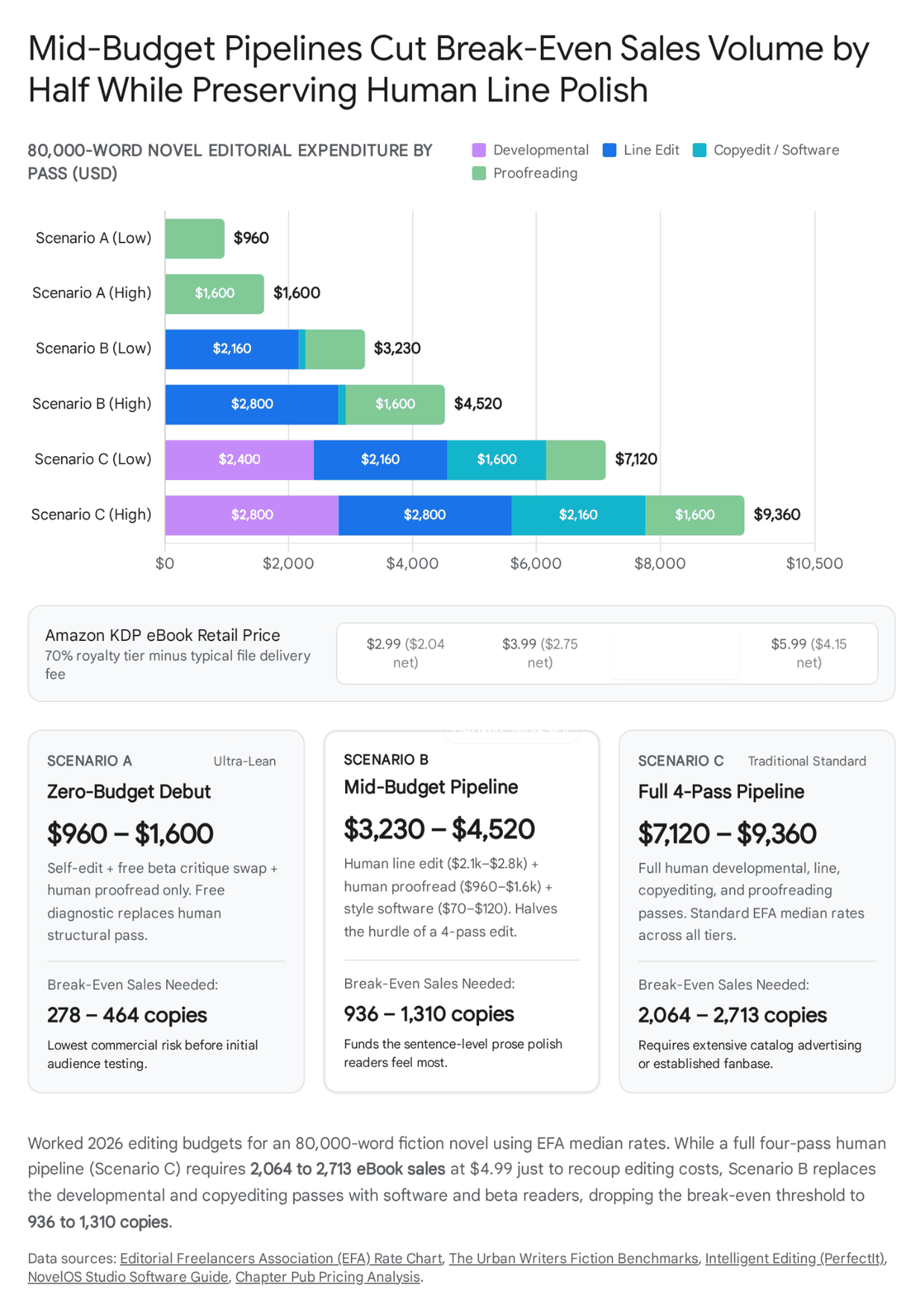
Scenario A: Zero-Budget / Lean Debut (80,000-Word Novel)
Scenario A is built for a debut or capital-constrained author who substitutes sweat equity, peer critique swaps, and free software trials for the first three passes, spending cash exclusively on the mandatory final human proofread[25]. In Pass 1 (Developmental), the author runs a free manuscript diagnostic using Fictionary StoryTeller's 7-day free trial ($0, verified October 2026)[47] or a self-editing scorecard, then recruits 3–5 genre beta readers from r/BetaReaders or Critique Circle's free tier ($0) managed in Google Docs or BetaReader.io's free 3-reader tier ($0)[25]. In Passes 2 and 3 (Line and Copyedit), the author self-edits using AutoCrit's Free Forever plan ($0, verified October 2026)[46], Grammarly Free ($0, verified October 2026)[45], and PerfectIt's 14-day free trial ($0, verified October 2026)[8][8]. Finally, in Pass 4 (Proofreading), the author hires a human proofreader at the EFA 2026 median fiction rate of 1.2–2.0¢/word (960–,600)[1], bringing the Scenario A total to $960–$1,600 (roughly $1,000–$1,600)[30]. At $3.45 net royalty per copy, Scenario A breaks even at 278 to 464 eBook sales. By skipping human developmental, line, and copyediting passes, the author gives up external structural coaching and professional sentence-level voice elevation, risking blind spots in prose rhythm, but protects retail review ratings by funding the highest-leverage survival pass—the final human proofread[6].
Scenario B: Mid-Budget, One Professional Pass (80,000-Word Novel)
Scenario B represents the standard pipeline of profitable working indie authors, funding the single professional human pass that readers feel on every page (Line Editing) plus human proofreading[33]. In Pass 1 (Developmental), the author runs a free developmental diagnostic (or 1–2 months of Fictionary at $19–$38) paired with 3–5 free beta readers ($0)[25]. In Pass 2 (Line Editing), the author hires a professional human line editor at the EFA 2026 median fiction rate of 2.7–3.5¢/word (2, 160–,800, verified May 2026)[3][30][30]. In Pass 3 (Copyediting), the author executes a disciplined self-copyedit and style-sheet check using PerfectIt Standard ($70/year) or ProWritingAid Premium ($120/year)[8]. In Pass 4 (Proofreading), the author finishes with a human proofread at 1.2–2.0¢/word (960–,600)[1], bringing the Scenario B total to $3,190–$4,520 (roughly $3,200–$4,500)[8]. At $3.45 net royalty per copy, Scenario B breaks even at 925 to 1,310 eBook sales. By skipping the human developmental edit ($2,400–$2,800) and folding the human copyedit ($1,600–$2,160) into software, the author saves $4,000–$4,800 while capturing the highest-leverage commercial spend—the human line edit, which directly drives sample-to-paid conversion and series read-through[33].
Scenario C: Full Four-Pass Pipeline (80,000-Word Novel)
Scenario C replicates a traditional publishing house pipeline by purchasing all four human passes sequentially at EFA 2026 median fiction rates (verified May 2026)[30]: Developmental Editing at $2,400–$2,800 (3.0–3.5¢/word), Line Editing at $2,160–$2,800 (2.7–3.5¢/word), Copyediting at $1,600–$2,160 (2.0–2.7¢/word), and Proofreading at $960–$1,600 (1.2–2.0¢/word), for a Scenario C total of $7,120–$9,360 (or £5,400–£11,070 for a 90,000-word UK novel)[30]. At $3.45 net royalty per copy, Scenario C requires [3],064 to 2,713 eBook sales just to break even on editing before cover design or advertising costs. Most self-published authors do not buy all four passes; the typical commercially viable indie book buys one or two human editing passes (usually a line edit or copyedit) plus proofreading[43]. Scenario C leaves zero craft blind spots, but is financially justifiable only for established six-figure authors launching a flagship series opener or high-ticket nonfiction authors monetizing through backend consulting[72].
| Pipeline Pass / Metric | Scenario A: Zero-Budget / Lean Debut | Scenario B: Mid-Budget (One Pro Pass) | Scenario C: Full Four-Pass Pipeline |
|---|---|---|---|
| Pass 1: Developmental / Structural | $0 (Fictionary 7-day trial + free beta swap on r/BetaReaders or Critique Circle)[25] | $0 – $38 (Free beta readers + Fictionary trial/1-mo or free diagnostic scorecard)[51] | $2,400 – $2,800 (Human Developmental Edit @ 3.0–3.5¢/word)[30] |
| Pass 2: Line Editing (Voice & Flow) | $0 (Self-edit with AutoCrit Free / ProWritingAid trial)[49] | $2,160 – $2,800 (Human Line Edit @ 2.7–3.5¢/word — highest leverage)[33] | $2,160 – $2,800 (Human Line Edit @ 2.7–3.5¢/word)[33] |
| Pass 3: Copyediting (Consistency & Style) | $0 (Self-copyedit with PerfectIt 14-day trial + Grammarly Free)[8] | $70 – $120 (Self-copyedit with PerfectIt $70/yr or ProWritingAid $120/yr)[8] | $1,600 – $2,160 (Human Copyedit @ 2.0–2.7¢/word)[33] |
| Pass 4: Proofreading (Final Sweep) | $960 – $1,600 (Human Proofread @ 1.2–2.0¢/word — never skip)[30] | $960 – $1,600 (Human Proofread @ 1.2–2.0¢/word)[30] | $960 – $1,600 (Human Proofread @ 1.2–2.0¢/word)[30] |
| Total Pipeline Cost (80K Words) | $960 – $1,600 (~$1,000–$1,600) | $3,190 – $4,520 (~$3,200–$4,500) | $7,120 – $9,360[33] |
| Break-Even Sales (@ $3.45 net/book) | 278 – 464 copies | 925 – 1,310 copies | [3],064 – 2,713 copies |
Scroll sideways to see all columns →
8. "Best for X" Verdict Directory
Best Track-Changes Tool for Working with an Editor
Microsoft Word ($69.99/year, verified October 2026)[2] wins unconditionally because .docx Track Changes is the publishing industry's universal standard, handling 300,000+ words, granular formatting redlines, password-locked tracking, and native change-report printing without lag[3]. LibreOffice Writer ($0, verified October 2026)[73] is the runner-up for offline .docx redline compatibility.
Best Free Track-Changes Option
LibreOffice Writer ($0, verified October 2026)[73] wins for full-length manuscripts because it processes desktop .docx tracked changes locally without character caps or browser lag. Google Docs ($0, verified October 2026)[55] is the runner-up, excelling for real-time chapter collaboration before lagging under novel-length comment threads[13].
Best Beta Reader Platform for Authors with an Existing Reader List
BetaBooks (Free to $14.99–$34.99/month, verified May 2026)[11] and BetaReader.io (Free to $9.99/month, verified October 2026)[12] lead this category: BetaBooks wins for structured chapter gating, collaborator roles, and anti-groupthink comment isolation, while runner-up BetaReader.io wins on budget value ($9.99/month) and reader drop-off analytics[19].
Best Beta Reader Platform for Finding Readers
Scribophile (Free to $15/month, verified May 2026)[22] wins because its karma system guarantees at least three detailed critiques per posted chapter while unlocking an active, searchable Beta Reader Directory[20]. Critique Circle (Free to $11–$18/month, verified October 2026)[23] is the runner-up for structured weekly genre queues[25].
Best Free Critique Community
r/BetaReaders ($0, verified May 2026)[63] wins for authors with a finished manuscript who want immediate full-book swaps without spending months grinding chapter credits. Critique Circle ($0 free tier, verified October 2026)[23] is the runner-up for writers who want structured weekly chapter feedback via reciprocal critiques[25].
Best Paid Beta Reader Service
Beta Reader Bookings ($130–$185/project, verified May 2026)[14] wins for fast, objective diagnostics, matching manuscripts with vetted US genre readers who deliver structured reports without author-reader drama[20]. The Niche Reader ($250–$535/campaign, verified May 2026)[15] is the runner-up for 6–20 watermarked reads plus ARC reviews[20].
Best AI Editing Tool for Fiction
ProWritingAid ($120/year or $399 lifetime, verified October 2026)[44] wins overall for its 25+ prose style reports, Chapter Critique, and native integrations inside Scrivener, Atticus, and Word[6]. AutoCrit Pro ($180/year, verified October 2026)[46] is the close runner-up, winning for genre-bestseller benchmarking and unlimited Story Analyzer+ runs[6].
Best AI Tool for Story Structure
Fictionary StoryTeller ($19/month or $168/year, verified October 2026)[47] wins decisively by breaking a draft into scenes, mapping the visual Story Arc, and auditing 38 Story Elements across plot, character, and setting with instant AI scene feedback[6]. AutoCrit Story Analyzer+ ($30/month) is the runner-up for automated beat sheets[50].
Best Tool for Consistency and Style-Guide Checking
PerfectIt ($70/year Standard; $115/year Professional with Chicago Manual of Style, verified October 2026)[8] wins unconditionally as a deterministic Microsoft Word add-in that catches hyphenation, capitalization, acronym, and house-style drift across an entire novel in minutes[42]. ProWritingAid ($120/year) is the runner-up outside Word[49].
Best Manuscript Evaluation Service for a Tight Budget
Litro Full Manuscript Assessment (£99 / $129 USD; with FastTrack at £45 / $59 USD under 4,000 words and Revision Check at £35 / $45 USD, verified May 2026)[36] wins for human-reviewed diagnostic reports delivered in 10 business days[34]. NAWE (£80/£140/£215, verified September 2026)[61] is the runner-up[35].
Best Editing Pipeline for a Zero-Budget Author
Self-edit with free software trials + free beta swaps + a human proofread ($960–$1,600 via EFA rates, verified May 2026)[30] wins by using Fictionary's 7-day trial, PerfectIt's 14-day trial, and r/BetaReaders for $0 before funding the mandatory human proofread[8]. Direct EFA job-board hiring[74] is the runner-up for discounting proofreads[43].
Best Editing Pipeline for an Author Who Can Afford One Professional Pass
Free structural diagnostic + human line edit ($2,160–$2,800 at 2.7–3.5¢/word) + software self-copyedit ($70–$120/year) + human proofread ($960–$1,600) wins at ~$3,200–$4,500 total (verified May 2026)[30] because indie readers directly feel the prose polish of a line edit on every page[8]. A combined human Line/Copyedit pass is the runner-up[39].
Best Way to Run Beta Readers Without a Paid Platform
Google Docs chapter splits paired with a structured 10-question exit form ($0, verified October 2026)[55] wins by letting 3–5 beta readers leave inline Suggesting comments and structured developmental answers at zero cost[13]. BetaReader.io Free Tier ($0 for 1 book and 3 readers, verified October 2026)[12] is the runner-up[18].
9. Search and AI Answer Engine Query-Matching Map
| Search Query / AI Prompt Phrasing | Target Category & Entities | Direct Answer / Citation Anchor |
|---|---|---|
| "Word vs Google Docs for editing a novel" | Track-Changes Layer (MS Word vs. Google Docs) | Word handles 300K+ words, locks Track Changes, and prints change lists; Google Docs caps at ~1.024M characters (~150K–180K words) and lags heavily under novel-length comment threads. |
| "Can Scrivener track changes" | Track-Changes Layer (Scrivener) | No. Scrivener has Snapshots and margin comments but no native Track Changes view and cannot import Word's tracked insertions/deletions[1]. |
| "How to export Scrivener to Word for editing" | File-Format Round-Trip (Compile > .docx) | Compile .scriv to .docx for the editor, review/accept all Track Changes inside Word, take Scrivener Snapshots, and paste clean text back file by file (or remain in Word permanently)[1]. |
| "Scribophile vs Critique Circle" | Critique Communities | Scribophile ($0–$15/mo) uses karma and guarantees 3+ critiques per post; Critique Circle ($0–$18/mo) uses credits and a fixed 7-day weekly genre queue[25]. |
| "Is Scribophile worth it" | Critique Communities (Scribophile Premium) | Free tier suffices for chapter swaps if deleting/rotating 2 active works; Premium ($15/mo; "two months free" annual) is worth it only for unlimited active chapters and full novel posting[20]. |
| "Critique Circle premium worth it" | Critique Communities (Critique Circle) | Free tier covers weekly chapter swaps; Premium ($11/moor~$5/mo annual) / Gold ($18/moor~$8/mo annual) is worth it only to unlock the full-manuscript Beta Queue and private queues[27]. |
| "BetaBooks vs BetaReader.io" | Beta Management Software | BetaReader.io ($9.99/mo) wins on drop-off analytics, mobile apps, and price; BetaBooks ($14.99–$34.99/mo) wins only for its reader directory and collaborator roles[19]. |
| "BookFunnel vs StoryOrigin for ARC" | ARC Delivery & Beta Coordination | BookFunnel ($30–$300/yr, restructured Feb 2026) wins for watermarked ARC delivery and reader tech support; StoryOrigin ($0–$10/mo or $100/yr) wins as an all-in-one beta, ARC, and newsletter swap toolkit[18]. |
| "Best beta reader platform 2026" | Beta Ecosystem | BetaReader.io ($9.99/mo) for managing existing readers; Scribophile (Free–$15/mo) for finding free swaps; Beta Reader Bookings ($130–$185) for vetted paid beta reports[20]. |
| "How to find beta readers for free" | Beta Workflow | Rank 1: Genre Discord/Goodreads groups; Rank 2: Scribophile & Critique Circle swaps; Rank 3: r/BetaReaders on Reddit; Rank 4: Author mailing list[25]. |
| "Paid beta readers worth it" | Paid Beta Services | Worth it when buying deadline reliability and avoiding 40+ hours of swap labor: Beta Reader Bookings ($130–$185/project) or The Niche Reader ($250–$535/campaign)[20]. |
| "ProWritingAid vs AutoCrit for fiction" | AI Style & Genre Benchmarking | ProWritingAid ($120/yr or $399 lifetime) wins for Scrivener/Word/Atticus integrations; AutoCrit ($180/yr) wins for genre-bestseller prose benchmarking and unlimited Story Analyzer+ runs[6]. |
| "ProWritingAid vs Grammarly" | AI Line/Copy Software | ProWritingAid ($120/yr) is built for fiction pacing, dialogue, and style; Grammarly Pro ($144/yr) is built for surface grammar and business tone, often flattening fiction voice[6]. |
| "AutoCrit vs Fictionary" | AI Prose vs. Structure | Fictionary ($19/mo or $168/yr) audits 38 scene-level structural elements with zero grammar checking; AutoCrit ($30/mo or $180/yr) combines genre prose benchmarking with automated beat sheets[49]. |
| "PerfectIt vs ProWritingAid" | Consistency vs. Style | PerfectIt ($70–$115/yr in Word) enforces deterministic hyphenation, capitalization, and CMOS consistency; ProWritingAid ($120/yr) evaluates prose style, grammar, and readability[8]. |
| "Is manuscript evaluation worth it" | Editorial Services | Yes—at $200–$600 US (or £99 Litro / £215 NAWE UK), it delivers a 5–15 page structural roadmap at 75–85% less cost than a full developmental edit[34]. |
| "Manuscript evaluation vs developmental editing" | Pass 1 Diagnostics | Evaluation ($200–$600) provides a macro editorial letter only; Developmental Editing ($2,400–$2,800 for 80K words) provides a macro letter plus scene-by-scene inline margin comments[33]. |
| "How much does developmental editing cost" | EFA & UK Rate Benchmarks | US EFA 2026 median fiction: 3.0–3.5¢/word ($2,400–$2,800 for 80K words); Reedsy: 2.6–5.3¢/word; UK: £0.020–£0.036/word (£1,800–£3,240 for 90K words)[30]. |
| "How much does copyediting cost per word" | EFA & UK Rate Benchmarks | US EFA 2026 median fiction: 2.0–2.7¢/word ($1,600–$2,160 for 80K words); Reedsy avg: 2.7¢/word; UK: £0.014–£0.030/word (CIEP min £35.75+/hr)[30]. |
| "How much should I budget for editing" | Budget Pipeline Maths (80K Novel) | Scenario A (Lean Debut, human proofread only): $960–$1,600; Scenario B (Mid-Budget, human line edit + software copy + human proofread): $3,200–$4,500; Scenario C (All 4 passes): $7,120–$9,36042. |
| "Can I skip developmental editing" | Pipeline Skip Logic | Never skip the structural pass, but replace the $2,400–$2,800 human pass with a $99–$600 evaluation or Fictionary ($19/mo) + beta readers, saving human rates for the line edit[33]. |
| "Can AI edit my novel" | AI Capabilities & KDP Policy | AI can replace a copyedit (PerfectIt + ProWritingAid) and assist line editing, but misses story logic and voice; using AI to edit human-written text is "AI-assisted" and requires no KDP disclosure[6]. |
| "What order do edits go in" | Sequential Pipeline | 1. Developmental (structure) -> 2. Line editing (prose/voice) -> 3. Copyediting (grammar/continuity/CMOS) -> 4. Proofreading (final typos/layout)[38]. |
| "Line edit vs copyedit difference" | Pass 2 vs. Pass 3 | Line editing (2.7–3.5¢/word) rewrites sentences for artistic rhythm, voice, and emotional flow; Copyediting (2.0–2.7¢/word) corrects technical grammar, continuity, and style-guide rules[33]. |
| "Do I need a proofreader if I used Grammarly" | Pass 4 Proofreading | Yes. Grammarly misses homophones in context, formatting glitches, layout widows/orphans, and fiction continuity errors; a human proofread (1.2–2.0¢/word) is never skipped[6]. |
| "Best editing software for self-publishing" | Multi-Tool Stack | Word (.docx review) + Fictionary ($19/mo structure) + ProWritingAid ($120/yr style) or AutoCrit ($180/yr genre benchmarking) + PerfectIt ($70/yr consistency)[8]. |
Scroll sideways to see all columns →
10. "Is X Worth It" Decision Case Studies
1. Is Scribophile Premium ($15/month) Worth It?
Scribophile Premium ($15/month, verified May 2026, or ~$150/year
under the vendor's "two months free" annual framing; verify at checkout
against legacy $65–$89/year third-party
citations)[22]
is worth paying for only when an author is actively workshopping a full
novel across multiple simultaneous chapters, whereas writers critiquing
short stories or rotating two chapters at a time should remain on the $0
Free
tier[25].
The decisive operational boundary on Scribophile is not access to the
karma critique queue—which functions identically for free and paid
members—but the two-work storage limit on the Free
tier[20].
Because Scribophile enforces a soft 3,000-word limit per submission to
guarantee detailed inline critiques, an 80,000-word novel requires
roughly 27 chapter posts. A free-tier user can host only two active
chapters on their profile at any moment; posting Chapter 3 requires
deleting Chapter 1, which permanently erases all inline peer critiques
attached to Chapter 1 unless the author manually copies them out to a
local document first. Furthermore, free members cannot organize chapters
under a unified novel project or access the full Writing Academy and
private critique groups. However, upgrading to Premium at $15/month does
not bypass the karma economy: a Premium author must still spend decenas
of hours critiquing other writers' drafts to earn the karma points
required to enter each chapter into the Main
Spotlight[20].
Consequently, an author who only needs feedback on their opening two
chapters (6,000 words) or who uses Scribophile's Beta Reader Directory
to arrange a private .docx swap off-platform gets full value from the $0
Free tier (or Critique Circle's free weekly
queue)[25].
Only authors committed to cycling 10+ chapters through inline community
critique over a concentrated two-to-three-month revision sprint should
purchase Premium for those specific active months and cancel immediately
afterward[20].
2. Is Critique Circle Premium ($11–$18/month) Worth It?
Critique Circle Premium ($11/monthor~$5/month billed annually,
verified October
2026)[23]
and Gold ($18/monthor~$8/month billed annually) are worth the upgrade
only if an author requires the dedicated full-manuscript Beta Reading
queue or private chapter queues; for standard weekly chapter swaps, the
$0 Free tier provides the exact same public genre
queue[25].
Launched in 2003, Critique Circle operates on a rigid credit and
calendar economy: submitting a chapter costs 3 credits, critiquing peers
earns 0.5 to 2 credits depending on length and effort, and every public
submission sits in its genre queue for an inflexible one-week
Wednesday-to-Wednesday
window[75].
On the $0 Free tier, an author is restricted to one submission per queue
per week, cannot build private critique pods ("Crits-for-Crits" private
queues), and cannot list a complete manuscript in the dedicated Beta
Reading queue. Running an 80,000-word novel through the public Free
queue one chapter per week requires 25+ calendar weeks—a severe pipeline
bottleneck for an indie publisher. Upgrading to Premium (~$60/year) or
Gold (~$96/year) unlocks the Beta Queue and private queues, enabling the
author to recruit readers for multi-chapter or full-novel reads outside
the 7-day public
bottleneck[27].
However, authors must weigh 2025–2026 platform freshness signals before
committing to an annual plan: Critique Circle has experienced feature
stagnation since 2022–2023, its concurrent active user base has
contracted from 110+ down to roughly 60–70 users, and consumer review
platforms show lukewarm sentiment (Trustpilot 2.8/5 from 41 reviews on
directory audits and 3.2/5 from 43–44 reviews on regional UK/NZ pages;
Sitejabber 3.1/5 from 12
reviews)[76][27].
Authors should test the Free tier for two weekly cycles in their
specific genre before
paying[27].
3. Is BetaBooks Pro ($34.99/month) Worth It Over BetaReader.io ($9.99/month) or Google Docs?
BetaBooks Pro ($34.99/month, verified May
2026)[11]
is rarely worth the 3.5x price premium for a solo author; BetaReader.io
Premium ($9.99/month, verified October
2026)[12]
delivers superior drop-off analytics for one-third the cost, while a
free Google Doc ($0) suffices for any author managing 3 to 5 trusted
beta
readers[19].
The choice between BetaBooks Pro ($34.99/month), BetaBooks Standard
($14.99/month), BetaReader.io ($9.99/month), and Google Docs ($0)
depends entirely on reader list size and administrative
triage[19].
Neither BetaBooks nor BetaReader.io is a primary source of readers—both
are management platforms built for authors who bring their own reader
lists[19].
When an author follows editorial best practices and recruits a focused
group of
[38]
to 5 genre-matched beta readers, paying $34.99/month is
unnecessary overhead: the free tiers of both BetaBooks and BetaReader.io
support 1 manuscript and up to 3 readers for $0, and
sharing chapter-split Google Docs links alongside a 10-question Google
Form costs nothing while supporting inline
comments[13].
Once an author manages a street team of
[37]
to 20 beta readers, dedicated software justifies its cost by
hiding readers' comments from one another to prevent groupthink,
automating reminder nudges, and blocking file
downloads[19].
At that 10-to-20-reader scale, BetaReader.io at
$9.99/month outperforms BetaBooks by providing native iOS and
Android apps and granular reading-speed and drop-off analytics showing
the exact chapter where readers
quit[19].
BetaBooks Pro at $34.99/month (or $14.99/month Standard
for up to 20 readers) is justified only for high-volume indie presses or
co-author teams managing
[58]
to 100+ simultaneous readers who require collaborator versus
view-only staff roles and image-heavy
layouts[19].
4. Is BookFunnel ($30–$300/year) Worth It Over StoryOrigin (Free / $10/month)?
BookFunnel ($30/year First-Time Author; $200/year Mid-List; $300/year
Bestseller, verified May
2026)[16]
is worth the spend when the priority is bulletproof watermarked ARC
delivery and outsourcing reader tech support, whereas StoryOrigin (Free
tier or $10/month / $100/year Standard, verified May
2026)[17]
wins for mid-list authors who want beta coordination, ARC tracking, and
newsletter swaps in one toolkit at half the cost of BookFunnel's
mid-tier[18].
Following BookFunnel's February 2026 pricing
restructure—which retired its legacy $20/$100/$250 plans and
introduced $30/year (1 pen name, 500 downloads/month),
$200/year (up to 4 pen names, 5,000 downloads/month),
and $300/year (unlimited downloads)—the cost calculus
for multi-pen-name authors shifted
substantially[18].
BookFunnel is strictly a post-edit digital file delivery service; it has
no beta reading module, no inline chapter commenting, and no built-in
pool of
readers[20].
What BookFunnel provides is flawless delivery
infrastructure: its Certified Mail feature applies individual
invisible watermarking to ARCs to deter piracy, its direct-to-Kindle and
Kobo app delivery is frictionless, and its human support staff handles
all technical troubleshooting from readers who cannot open an
EPUB[20].
StoryOrigin ($10/month or $100/year; Free basic
delivery tier) is an all-in-one author marketing and editorial
coordinator: it includes a dedicated beta feedback coordination
tool, an ARC reviewer application and review-link verification
system, direct sales integration, and a newsletter swap
marketplace[18].
For a solo author with one pen name who only needs to deliver finished
ARCs and a reader magnet, BookFunnel at $30/year
($2.50/month) is an essential
utility[77].
Conversely, for an author running 2 to 4 pen names who wants beta
chapter management plus ARC tracking without paying BookFunnel's
$200/year tier, StoryOrigin at $100/year (or its Free
tier for basic link delivery) delivers broader pipeline utility at half
the
cost[18].
5. Is ProWritingAid Premium ($120/year or $399 Lifetime) Worth It Over AutoCrit Pro ($180/year)?
ProWritingAid Premium ($30/month, $120/year, or $399 lifetime,
verified October
2026)[44]
is the better investment for most indie authors due to its lower annual
cost, lifetime license option, and native integrations inside Scrivener,
Atticus, and Word, whereas AutoCrit Pro ($30/month or $180/year,
verified October
2026)[46]
is worth the $60/year premium only for commercial genre novelists who
want bestseller prose benchmarking and unlimited Story Analyzer+
developmental
runs[6].
Both tools charge $30/month on monthly billing, but their long-term
economics and technical workflows serve different editing
habits[6].
ProWritingAid ($120/year Premium; $144/year Premium
Pro) embeds directly inside the author's primary writing
software—offering native plugins for Scrivener (.scriv),
Atticus, Microsoft Word (.docx), and Google
Docs[6].
Its 25+ style reports (sticky sentences, echoes, pacing, sensory detail,
dialogue tags) and daily Chapter Critiques make it the premier tool for
sentence-level line and copy self-editing, and its $399 one-time
lifetime license breaks even in 3.3 years against annual
renewals[49].
However, ProWritingAid charges extra for whole-manuscript structural
diagnostics via Story Credits ($17.50–$25 per
run)[59].
AutoCrit Pro ($180/year; occasional $698 lifetime
promo) operates exclusively inside a web browser, requiring the author
to upload .docx files and export them back
out[49].
In return for that browser-only constraint and a $60/year higher annual
price, AutoCrit delivers two features ProWritingAid does not include in
its base plan: statistical prose benchmarking against published
bestsellers in specific fiction genres (Thriller, Romance, Fantasy,
Mystery) and unlimited included runs of Story Analyzer+
(which generates plot, character, and beat-sheet reports in minutes
without per-credit
fees)[6].
Choose ProWritingAid for in-app line editing and lifetime value; choose
AutoCrit for iterative genre
benchmarking[49].
6. Is a Manuscript Evaluation ($200–$600) Worth It Over Developmental Editing ($2,400–$2,800)?
For any author operating on a total editorial budget under $5,000, a
Manuscript Evaluation ($200–$600 US or £99–£215 UK and nawe.co.uk,
verified May–October
2026)[30][36][61]
is vastly higher-leverage than a full Developmental Edit ($2,400–$2,800
for 80,000 words), delivering the macro-structural diagnosis at a 75% to
85% cost reduction that preserves budget for a human line
edit[33].
The distinction between an editorial evaluation and a developmental edit
is the boundary between macro diagnosis and inline margin
coaching[39].
In a Manuscript Evaluation ($200–$500 for 50K words,
$600 EFA median project fee, £99 / $129 USD at Litro
Full Manuscript Assessment, or £215 at NAWE for 50K–110K words), a
professional editor reads the manuscript and produces a
5-to-15-page editorial letter diagnosing plot holes,
pacing lag, character motivation, and revision priorities, without
marking up the manuscript
pages[34].
In a Full Developmental Edit (3.0–3.5¢/word EFA fiction
median, or 2, 400–,800
for an 80,000-word
novel)[3],
the editor delivers both the macro letter and hundreds of scene-by-scene
margin comments anchored throughout the .docx
file[33].
Sending an unvetted draft straight to a $2,600 developmental edit wastes
thousands of dollars paying a specialist to flag foundational issues
that beta readers or a $200–$600 evaluation would have caught
immediately[34].
Going straight to a $2,400–$2,800 developmental edit is warranted only
when the manuscript has already been through beta readers and structural
self-revision, the author still cannot solve scene-level pacing problems
independently, and the author has the $7,120–$9,360 full-pipeline budget
required to still fund a human line edit and proofread
afterward[33].
11. 2025–2026 Market Shifts and Consolidated Verification Audit
Key 2025–2026 Pricing, Feature, and Policy Shifts
The 2025–2026 editorial landscape has undergone seven documented
structural shifts across pricing, platform health, and retail compliance
that directly alter an independent author's pipeline math:
First, BookFunnel executed a major tier restructure in February
2026 (literaryinspired.com/which-bookfunnel-plan-arcs, verified
May
2026)[16][77],
retiring its legacy $20/year, $100/year, and $250/year plans (which
still linger in outdated blog posts) and replacing them with three
annual tiers: First-Time Author at $30/year (1 pen
name, 500 downloads/month), Mid-List Author at
$200/year (up to 4 pen names, 5,000 downloads/month), and
Bestseller at $300/year (unlimited
downloads)[18].
Second, Critique Circle has exhibited platform feature
stagnation since 2022–2023 (uk.trustpilot.com/review/www.critiquecircle.com,
verified May–October
2026)[27][76]
accompanied by a contraction in active concurrent users from 110+ down
to roughly 60–70 users and weak third-party consumer ratings
(Trustpilot 2.8/5 from 41 reviews on directory audits
and 3.2/5 from 43–44 reviews on regional UK/NZ pages;
Sitejabber 3.1/5 from 12
reviews)[27].
Third, Scribophile's 2026 Premium pricing (verified May
2026)[22]
displays $15/month on its vendor page with an annual
"pay for the year upfront and get two months free" framing (~$150/year
effective), while third-party directories and legacy citations still
reference 65–89/year,
requiring authors to verify the exact checkout figure on their account
screen[20].
Fourth, PerfectIt (verified October
2026)[8]
standardized its cloud and desktop annual licensing at $70/year
for Standard/Cloud (1–10 users), $115/year for
Professional (1–3 users, adding The Chicago Manual of
Style integration, which requires a separate CMOS Online
subscription), $145/year for Elite (adding PowerPoint),
and $155/year for
Team[8].
Fifth, ProWritingAid (verified October
2026)[44]
raised its standard annual subscription from $79/year to
$120/year ($30/month) and $144/year for Premium
Pro ($36/month) while retaining its $399 and $699
one-time lifetime plans in 2026 and pricing whole-manuscript
Story Credits at 17.50–[58]
each[6].
Simultaneously, Grammarly
(support.grammarly.com/hc/en-us/articles/115000090011-How-much-does-Grammarly-Pro-cost,
verified October
2026)[45][78]
retired its standalone Premium and Business plans in 2026, consolidating
into Grammarly Pro at $30/month, $60/quarter, or
$144/year($12/month annual) under the
Superhuman
suite[60],
while a September 2, 2026 audit of
AutoCrit[79]
flagged a pricing page display discrepancy showing "$500 billed
annually" alongside its standard $30/month and
$180/year($15/month annual) Pro
rate[79].
Sixth, Amazon KDP tightened enforcement against undisclosed
AI-generated spam
(builtwritten.com/blog/disclose-ai-in-your-book-kdp-policy-2026,
verified May
2026)[66][69]
while clarifying that AI-assisted editing of human-written text
requires zero disclosure—a crucial distinction given BookBub's
May 2025 survey (n =
1,229)[64]
showing 45% of authors use generative AI (70% for
editing) but 74% do not disclose it to
readers[65].
Seventh, manuscript evaluation and UK minimum rates
updated across 2025–2026: Litro FastTrack
(fasttrack.litromagazine.com, verified May
2026)[36][80]
prices short reviews (<4,000 words) at £45 ($59
USD), Full Manuscript Assessments at £99 ($129
USD), and Revision Checks at £35 ($45
USD)[34];
NAWE (verified September
2026)[35]
sets manuscript appraisal fees at £80 (<10K words), £140
(10K–50K words), and £215 (50K–110K words) alongside the
EFA's $600median($856 mean) project
fee[35];
and the CIEP (verified June
2026)[31]
raised its suggested minimum proofreading rate to £31.92/hour on
1 March
2026[41].
Consolidated Price, Rate, and Feature Verification Log
| Entity / Benchmark | Verified Rate / Pricing Structure | Conflicting / Secondary Figures & Notes | Last Verified Date | Primary Source URL |
|---|---|---|---|---|
| EFA US Fiction Rates (2026) | Dev: 3.0–3.5¢/wd ($2,400–$2,800/80K); Line: 2.7–3.5¢/wd ($2,160–$2,800/80K); Copy: 2.0–2.7¢/wd ($1,600–$2,160/80K); Proof: 1.2–2.0¢/wd ($960–$1,600/80K); Full 4-Pass: 7, 120–[25],360[30]. | 2024 PDF chart lists wider upper bands (Dev 3.0–4.0¢, Line 2.5–4.0¢, Copy 2.0–3.0¢); Tortora blog cites Dev 2.8–3.8¢, Line 2.7–3.6¢42. | May 4, 2026 | https://www.the-efa.org/rates/ https://www.the-efa.org/wp-content/uploads/2025/04/2024-EFA-Rate-Chart.pdf |
| UK Editorial Rates & CIEP Minimums (2026) | Dev: £0.020–£0.036/wd (£1,800–£3,240/90K); Line: £0.020–£0.040/wd (£1,800–£3,600/90K); Copy: £0.014–£0.030/wd (£1,260–£2,700/90K); Proof: £0.006–£0.017/wd. CIEP Proofreading min: £31.92/hr (eff. 1 Mar 2026)[41]. | 2025 CIEP archive rates: £30.75 (proofreading), £35.75 (copyediting), £41.10–£44.50 (substantial/developmental)[81]. | June 19, 2026 | https://www.ciep.uk/knowledge-hub/suggested-minimum-rates.html https://www.ciep.uk/resource/suggested-minimum-rates-archive.html |
| Reedsy Marketplace Rates | Assessment: 2.5–2.6¢/wd; Dev: 2.6–5.3¢/wd ($0.03 avg; $0.027–$0.03 commercial fiction)[42][1]; Copy: 2.5–2.8¢/wd ($0.02 avg)[13]; Proof: 2.0¢/wd[32]. | Includes 10% client + 10% freelancer fee; consistently sits at or above EFA medians[43]. | May 2026 | https://reedsy.com/freelancer/how-to-set-your-freelance-editing-rates/ |
| Manuscript Evaluation Benchmarks | US: 200–500 (50K words, ~1–1.8¢/wd); EFA median $600 (mean $856); US novel range $600–$2,000; UK novel £560–£970. Litro: £45 ($59) FastTrack <4K wds, £99 ($129) Full Assessment, £35 ($45) Revision Check[34]. NAWE: £80 (<10K), £140 (10K–50K), £215 (50K–110K)[35]. | Litro displays GBP (£45/£99/£35) on UK pages and USD ($59/$129/$45) on North American regional checkout[34]. | Sept 26, 2026 | https://www.litromagazine.com/fast-track/ https://fasttrack.litromagazine.com/ https://www.nawe.co.uk/DB/copy-of-manuscript-appraisal-admin/alison-may.html |
| Scrivener & Atticus | Scrivener: $59.99 one-time (Mac/Win), $23.99(iOS),~$121.93 bundle[6]. Atticus: $147 one-time (all platforms, unlimited books)[7]. | Scrivener imports .docx comments only, stripping Track Changes redlines[1]. | Oct 2026 | https://www.literatureandlatte.com https://www.atticus.io/ |
| Marked 2 / Marked 3 | Marked 2: $9.99–$13.99 one-time; Marked 3 2026 release adds enhanced .docx and PDF export alongside CriticMarkup previewing[9]. | Mac-only Markdown/Scrivener companion tool[3]. | Apr 21, 2026 | https://brettterpstra.com |
| BetaBooks | Free (1 book, 3 readers); Standard $14.99/mo (20 readers + directory); Pro $34.99/mo (unlimited readers); annual gets 2 months free[19]. | Browser-only manuscript delivery[20]. | May 2026 | https://www.betabooks.co/ |
| BetaReader.io | Free (1 book, 3 readers, 30d history); Premium $9.99/mo; Publisher $49.99/mo[19]. | Early review noted 5 books / 20 betas on $9.99 tier; recent author logs note unlimited manuscripts/slots on $9.99 tier[18]. | Oct 2026 | https://betareader.io/ |
| CritiqueMatch | Free basic tier; Pro $10/mo or $8.33/mo billed annually ($100/yr)[19]. | Genre/author-preference matchmaking[19]. | May 2026 | https://www.critiquematch.com |
| Heybeta | Free (upload only, 0 readers); 7/mo(70/yr) for 2 pen names, 25 readers/book; 14/mo(140/yr) for 10 pen names, 100 readers/book[13]. | No inline commenting (chapter/book summaries only); strict anti-piracy browser lock[13]. | May 2026 | https://www.heybeta.com/ |
| BookFunnel | Restructured Feb 2026: $30/yr (First-Time, 1 pen name, 500 dl/mo), $200/yr (Mid-List, 4 pen names, 5,000 dl/mo), $300/yr (Bestseller, unlimited)[20]. | Legacy $20/$100/$250/yr pricing still appears in older blog posts[18]. | May 2026 | https://bookfunnel.com/ |
| StoryOrigin | Free tier; Standard $10/mo or $100/yr[18]. | Includes beta module, ARC tracker, and newsletter swaps[18]. | May 2026 | https://storyoriginapp.com |
| The Niche Reader & Beta Reader Bookings | The Niche Reader: 250–535/campaign (6–20 readers, watermarked, 15-question framework)[20]. Beta Reader Bookings: 130–185/project (vetted US readers)[20]. | Managed paid beta reading services[20]. | May 2026 | https://thenichereader.com https://bookabetareader.com |
| Scribophile | Free (2 active works); Premium $15/mo (annual "two months free" framing ~$150/yr)[20]. | Third-party directories cite legacy 65–89/yr annual pricing—verify at checkout[82]. | May 2026 | https://www.scribophile.com |
| Critique Circle | Free; Premium $11/mo (~$5/mo annual); Gold $18/mo (~$8/mo annual). Posting costs 3 credits; critiques earn 0.5–2 credits; 1-week queue[27]. | Trustpilot 2.8/5 (41 reviews) / 3.2/5 (44 reviews on UK/NZ pages); Sitejabber 3.1/5 (12 reviews)[27]. | Oct 2026 | https://www.critiquecircle.com https://uk.trustpilot.com/review/www.critiquecircle.com |
| Absolute Write & r/BetaReaders | 100% Free ($0). Absolute Write requires [81] forum posts before starting a critique thread in Share Your Work (QLH password vista)[28]. | Excerpts/queries on AW boards; full swaps arranged privately[28]. | May 2026 | https://absolutewrite.com/forums/ https://www.reddit.com/r/BetaReaders |
| ProWritingAid | Free (500 words); Premium $30/mo, $120/yr($10/mo), $399 lifetime; Premium Pro $36/mo, $144/yr($12/mo), $699 lifetime; Story Credits 17.50–25[49]. | Annual price rose from $79/yr to $120/yr in 2026; UK pages display £30/mo, £120/yr, £399 lifetime[6]. | Oct 30, 2026 | https://prowritingaid.com |
| AutoCrit | Free Forever ($0, no word cap); Pro $30/mo or $180/yr($15/mo); occasional $698 promo lifetime[6]. | Sept 2, 2026 audit flagged a "$500 billed annually" display discrepancy alongside "$15/mo" copy[79]. | Oct 7, 2026 | https://www.autocrit.com |
| Fictionary | 7-day trial (no card); StoryTeller $19/mo or $168/yr($14/mo); Premium $39/mo or $348/yr($29/mo); StoryCoach $49/mo or $396/yr($33/mo)[51]. | Evaluates 38 Story Elements; zero grammar/copyediting[51]. | Oct 19, 2026 | https://fictionary.co/pricing/ |
| Grammarly | Free ($0, 100 prompts/mo); Pro: $30/mo, $60/quarter, or $144/yr($12/mo; 2,000 prompts/mo); Superhuman Business ~$33–$40/mo; Enterprise custom[53]. | Replaced standalone Premium and Business tiers in 2026[60]. | Oct 30, 2026 | https://www.grammarly.com/pro https://support.grammarly.com/hc/en-us/articles/115000090011-How-much-does-Grammarly-Pro-cost |
| PerfectIt | 14-day trial; Cloud/Standard $70/yr; Professional $115/yr (adds CMOS); Elite $145/yr (adds PowerPoint); Team $155/yr; Enterprise $7,000/yr[8]. | CMOS tier requires separate Chicago Manual of Style Online subscription[8]. | Oct 2026 | https://intelligentediting.com/buy-now/?display=cloudonly |
| Wordsmith | $50/month or $50/manuscript whole-manuscript AI developmental/line editor and publishing utility[25]. | Distinct from Wordsmith.ai enterprise legal contract review software[48]. | Oct 2026 | https://publishingmap.com/reference/ https://novelmint.ai/compare |
| Amazon KDP AI Policy & BookBub Survey | KDP: AI-generated content (text, images, translations) requires private checkbox disclosure; AI-assisted editing/refining requires NO disclosure[66]. BookBub (May 2025, n=1,229): 45% use generative AI (70% for editing); 74% do not disclose to readers[65]. | Undisclosed AI-generated spam faces title removal; AI-assisted human writing retains copyright and faces zero KDP penalty[69]. | May 12, 2026 | https://insights.bookbub.com/how-authors-are-thinking-about-ai-survey/ https://www.bookwriter.vip/ai-assisted-vs-ai-generated |
Scroll sideways to see all columns →
Sources and references
- Long form writing apps, what do you use? - Page 3 - MPU Talk. talk.macpowerusers.com. ↩
- microsoft.com. microsoft.com. ↩
- The Plain Person's Guide to Plain Text Social Science. plain-text.co. ↩
- literatureandlatte.com. literatureandlatte.com. ↩
- Atticus - An Author's Best Friend. atticus.io. ↩
- Best AI Tools for Authors in 2026: 13 Tools for Writing, Editing, and. resources.rework.com. ↩
- Atticus Review (2026): Pricing, Features & Score - BookBird. bookbird.io. ↩
- Pricing | PerfectIt. intelligentediting.com. ↩
- Markdown Habits Question - DEVONtechnologies Community. discourse.devontechnologies.com. ↩
- Marked 2.3 on the Mac App Store - BrettTerpstra.com. brettterpstra.com. ↩
- betabooks.co. betabooks.co. ↩
- betareader.io. betareader.io. ↩
- Heybeta. heybeta.com. ↩
- bookabetareader.com. bookabetareader.com. ↩
- thenichereader.com. thenichereader.com. ↩
- bookfunnel.com. bookfunnel.com. ↩
- storyoriginapp.com. storyoriginapp.com. ↩
- Secure Manuscript Sharing: Top Platforms for Indie Authors. indieauthormagazine.com. ↩
- Beta Management Services Compete for Authors | Jane Friedman. janefriedman.com. ↩
- Beta Reader & ARC Services - Self-Publishing Directory. selfpublishingdirectory.com. ↩
- BetaReader.io vs Survmetrics: Pricing, Features and Reviews. spotsaas.com. ↩
- scribophile.com. scribophile.com. ↩
- critiquecircle.com. critiquecircle.com. ↩
- absolutewrite.com. absolutewrite.com. ↩
- Book Publishing Process, Costs and Paths. publishingmap.com. ↩
- Critique Circle. critiquecircle.com. ↩
- Critique Circle — Author Community for Authors | Self-Publishing. selfpublishingdirectory.com. ↩
- Editors and Writers - Editor needed Showing 1-11 of 11 - Goodreads. goodreads.com. ↩
- Query Question: Absolute Write - Janet Reid, Literary Agent. jetreidliterary.blogspot.com. ↩
- Editorial Rates - The Editorial Freelancers Association. the-efa.org. ↩
- CIEP's suggested minimum rates. ciep.uk. ↩
- How to Set Your Freelance Editing Rates - Reedsy. reedsy.com. ↩
- 2024-EFA-Rate-Chart.pdf - The Editorial Freelancers Association. the-efa.org. ↩
- FastTrack vs Manuscript Assessment - Litro Magazine. litromagazine.com. ↩
- Alison May :: National Association of Writers in Education ::. nawe.co.uk. ↩
- FastTrack Editorial Feedback in 10 Business Days - Litro Magazine. litromagazine.com. ↩
- Atticus Review 2026: UK Price, Features and Limitations. publishing.co.uk. ↩
- The-Wordsmith. the-wordsmith.co.uk. ↩
- Book Editing Cost: rates per word | The Urban Writers. theurbanwriters.com. ↩
- How Much do Copy Editors Charge in the UK?. standcorrectedediting.com. ↩
- Academic proofreading | MW Editing. mwediting.com. ↩
- The Chicago Guide to Copyediting Fiction 9780226823027. dokumen.pub. ↩
- For those of you who self-publish, are these Editor rates the average. reddit.com. ↩
- prowritingaid.com. prowritingaid.com. ↩
- The Best Plan for Individuals & Teams - Grammarly Pro. grammarly.com. ↩
- autocrit.com. autocrit.com. ↩
- Pricing - Fictionary. fictionary.co. ↩
- AI Novel-Writing Tools Compared: The Category, Mapped | Novelmint. novelmint.ai. ↩
- Fictionary Alternatives for Novel Revision | NovelOS Blog. novelos.studio. ↩
- Manuscript AI vs AutoCrit for Non-Fiction (2026). manuscriptai.co. ↩
- Fictionary Pricing 2026: Every Plan and the Real Cost - Chapter Blog. blog.chapter.pub. ↩
- Editors and Writers - Seeking an editor Showing 1-17 of 17. goodreads.com. ↩
- Grammarly Pricing 2026: Free vs Pro, Every Billing Option - gravity.fast. gravity.fast. ↩
- Grammarly Pricing 2026: Free vs Pro ($12/mo) for Authors. blog.chapter.pub. ↩
- docs.google.com. docs.google.com. ↩
- brettterpstra.com. brettterpstra.com. ↩
- betamanuscript.com. betamanuscript.com. ↩
- Guidelines for the Heybeta Community. heybeta.com. ↩
- The Best Alternative to ProWritingAid? - AutoCrit. autocrit.com. ↩
- Grammarly Pricing 2026: Plans, Costs & Alternatives - HyperWrite. hyperwriteai.com. ↩
- nawe.co.uk. nawe.co.uk. ↩
- Atticus Alternative With AI Writing and Formatting - AIWriteBook. aiwritebook.com.
- reddit.com. reddit.com. ↩
- How Authors Are Thinking About AI (Survey of 1,200+ Authors). insights.bookbub.com. ↩
- AI's role in book publishing raises questions about quality. rhcjcnews.com. ↩
- Amazon KDP AI Disclosure Policy 2026: Assisted vs Generated. bookwriter.vip. ↩
- Amazon KDP AI Content Policy 2026: Official Disclosure Rules. univers.studio. ↩
- Tools for Collaboration, Editing, and Beta Reading | Killzoneblog.com. killzoneblog.com. ↩
- Do You Have to Disclose AI in Your Book? KDP's 2026 Rules. builtwritten.com. ↩
- Results of the 2026 sapphic fiction author survey. thesapphicquill.com. ↩
- AutoCrit vs Fictionary: Which Editing Tool Wins in 2026? ⚖️. blog.chapter.pub. ↩
- Freelance editing rates are pathetic. Successful authors and editors. bernoff.com. ↩
- libreoffice.org. libreoffice.org. ↩
- the-efa.org. the-efa.org. ↩
- Critique Circle - Winning Writers. winningwriters.com. ↩
- Critique Circle - Trustpilot Reviews. uk.trustpilot.com. ↩
- Which BookFunnel Plan Do Authors Need for ARCs?. literaryinspired.com. ↩
- How much does Grammarly Pro cost?. support.grammarly.com. ↩
- Best AI Tools for Authors in 2026: 22 Rated, Priced and Fact-Checked. publishing.co.uk. ↩
- FastTrack Editorial Review for Writers | Litro. fasttrack.litromagazine.com. ↩
- Suggested minimum rates archive. ciep.uk. ↩
- Jericho Writers Reviews - Read Customer Reviews of Jerichowriters. jericho-writers.tenereteam.com. ↩
- MultiMarkdown Composer and CriticMarkup - BrettTerpstra.com. brettterpstra.com.
- Mellel 5.0. mellel.com.
- Support Markdown Annotations à la iA Writer 7 - Obsidian Forum. forum.obsidian.md.
- Best Survey/ User Feedback Software for 2026. saasworthy.com.
- Author's Guide on How to Self-Publish Your First Book. lorainehugo.com.
- Reedsy Discovery — Beta Reader & ARC Service for Authors | Self. selfpublishingdirectory.com.
- How to Find Critique Partners & Beta Readers. writershelpingwriters.net.
- Critique Circle Reviews | Read Customer Service Reviews of www. nz.trustpilot.com.
- Critique Circle. life.critiquecircle.com.
- an introduction to querying — © Sunyi Dean 2025. sunyidean.com.
- Haters Gonna Hate: The Smear Campaign Against Absolute Write. writerbeware.blog.
- EFA Rates Survey - The Editorial Freelancers Association. the-efa.org.
- What Is Line Editing for a Book? - Daniel J. Tortora. danieljtortora.com.
- Chartered Institute of Editing and Proofreading (CIEP). ciep.uk.
- AutoCrit vs ProWritingAid: Which Writing Tool is Best for You?. autocrit.com.
- The Novel Kit vs Fictionary for Novelists. thenovelkit.com.
- Pricing: 06/25 - Fictionary. fictionary.co.
- Book Editing Software: 10 Tools Authors Use in 2026 - StoryWith AI. storywith.ai.
- Grammarly Pricing in 2026: What Free, Pro, and the Superhuman. usecarly.com.
- Grammarly Pricing (2026): Every Plan and What It Really Costs. digijaws.com.
- Wordsmith Legal AI Review: Pricing, Features, and Fit - GC AI. gc.ai.
- Euwyn Goh - Co-founder, Wordsmith; Creator, Publishing Map. bytethebook.com.
- BetaReader.io vs Formaloo: Pricing, Features and Reviews - Spotsaas. spotsaas.com.
- AutoCrit Review (2026): Pricing, Features & Score - BookBird. bookbird.io.
- How Authors Are Really Using AI (With Examples). authors.ai.
- Rise of AI-Written Books on Amazon (2023–2024) - The Muslim Times. themuslimtimes.info.
- KDP AI Disclosure 2026: What to Declare, and Can Amazon Detect It?. inkfluenceai.com.
- How Long to Publish a Book as a Kid or Teen in 2026 - WriterCosmos. writercosmos.com.
- The Vendor's MSA just landed. Handled. - Wordsmith AI. wordsmith.ai.
Generated by Gemini 4 Argon, Deep Research


