

Independent authors protecting ebooks and audiobooks in 2026 operate across four distinct mechanisms: file encryption (DRM), traceability (social DRM and watermarking), search engine de-indexing, and host or platform removal[1]. No single tool eliminates piracy; proportionate enforcement matches the technical mechanism to the distribution channel and scales effort strictly to the net royalty at risk[2]. Hard DRM on Amazon KDP ($0) functions only as a speed bump against casual reader sharing while locking paying buyers into the Kindle ecosystem, though Amazon's 20 January 2026 policy change—which grants verified purchasers one-click EPUB and PDF downloads for confirmed DRM-free titles—has lowered the technical skill floor for casual sharing and prompted some Amazon-exclusive authors to keep DRM enabled[1]. For wide-distribution authors, leaving DRM off across retailers remains the operational standard to avoid cross-device buyer friction, while BookFunnel Certified Mail ($200/year on the Mid-List Author plan following the 20 February 2026 price update) is the standard route for stamping Advance Reader Copies (ARCs) and direct sales with per-reader email watermarks[3].
When leaks occur, financial harm is governed by the displacement rate rather than raw download totals[4]. Multiplying pirated downloads by retail cover price is wrong twice over: a $4.99 KDP ebook nets roughly $3.40 after the 70% royalty split and delivery fees, and empirical estimates place paid-ebook sales displacement in the low tens of percent at the high end, modeled across working brackets of 5% (cheap, easy-to-find titles), 15% (mid-priced genre niches), and 30% (expensive, specialist, or professional works)[4]. Across 1,800 pirated downloads on 12 live hosts, a 15% displacement rate equals 270 lost sales ($918/year) for one title, or $5,508/year (~$5,500/year) across a six-book backlist. Consequently, authors should report unauthorized Amazon seller copies via Amazon Report Infringement (amazon.com/report/infringement, $0), de-index pirate links that outrank retail store pages using Google Copyright Removal ($0), file DIY DMCA notices ($0 cash; 20–90 minutes per host) when volume is low, and pay for a monitoring and takedown subscription ($29–$359/month) only when recurring piracy across 8–15+ hosts consumes a working week of writing time per year[5].
1. Routes and Tools: Structured Data Inventory
The four structured tables below capture verified 2026 specifications across A. DRM Decisions, B. Watermarking and Social DRM, C. Takedown Routes, and D. The Detection and Monitoring Layer[1].
A. DRM Decisions
| Route / Tool | Cost | What It Actually Does | What It Does Not Do | Who It Is For | The Decision Rule | Time Cost | Key Limitation | Last Verified Date |
|---|---|---|---|---|---|---|---|---|
| KDP DRM On (Amazon Kindle Encryption) | $0[1] | Encrypts the ebook (KFX / hardened KFX v2) and locks access to registered Kindle devices and apps; blocks EPUB and PDF file downloads from Amazon[6]. | Does not prevent determined piracy; encryption can still be stripped via desktop workarounds or bypassed via screen-based OCR capture[7]. | Amazon-exclusive (KDP Select) authors and instructional/reference writers who want a casual-sharing speed bump[6]. | Enable if you are 100% KDP-exclusive and want to block one-click EPUB/PDF exports; skip if your readers sideload onto non-Kindle hardware[1]. | 1 minute at KDP upload (or 5 minutes per book to edit settings and republish)[1]. | Locks legitimate buyers into Amazon's ecosystem without stopping dedicated piracy sites from indexing stripped copies[7]. | 25 Sep 2026 / Oct 2026[1] |
| KDP DRM Off (DRM-Free Kindle Publishing) | $0[1] | Effective 20 Jan 2026, allows verified outright purchasers to download standard EPUB and PDF files from Manage Your Content and Devices (KU borrows excluded)[1]. | Does not "invite" commercial piracy—pirates already cracked DRM—but makes a clean PDF or EPUB one click away for non-technical readers[8]. | Authors prioritizing reader goodwill, archival backups, accessibility, and cross-device reading on Kobo, reMarkable, or Nook[1]. | Use if you sell DRM-free elsewhere or value reader portability; skip if the 2026 one-click PDF/EPUB export exceeds your risk tolerance[8]. | 1 minute at upload; pre-9 Dec 2025 titles require manual per-book opt-in (no bulk update tool)[1]. | Any verified purchaser can export an unwatermarked, clean EPUB or PDF in seconds and share it in a private group[9]. | 25 Sep 2026 / Oct 2026[1] |
| DRM-Free Wide Distribution (Kobo, Apple Books, D2D, Smashwords) | $0 upfront (standard store/aggregator commissions apply on sales)[10] | Distributes unencrypted EPUB files across Kobo Writing Life, Apple Books, Draft2Digital (D2D), and Smashwords (which is strictly DRM-free only)[11]. | Does not trace who shares a file or restrict copying once downloaded from the retail storefront[12]. | Wide-distribution authors, series novelists, and multi-platform independent publishers[13]. | Publish DRM-free across wide retailers so buyers can move files between devices without Adobe Digital Editions (ADE) or FairPlay lock-in[13]. | 1 minute during account or title setup (account-wide or per-title on Kobo; per-title on D2D/Apple)[13]. | Enabling retailer DRM (Adobe ADE on Kobo, FairPlay on Apple) generates customer support complaints without stopping shadow-library scraping[13]. | Sep–Oct 2026[13] |
Scroll sideways to see all columns →
B. Watermarking and Social DRM
| Route / Tool | Cost | What It Actually Does | What It Does Not Do | Who It Is For | The Decision Rule | Time Cost | Key Limitation | Last Verified Date |
|---|---|---|---|---|---|---|---|---|
| BookFunnel Certified Mail & Watermarked Delivery | $200/yr ($20/mo) Mid-List Author; $300/yr ($30/mo) Bestseller (updated 20 Feb 2026)[14] | Sends unique, expiring download links to named recipients and stamps each EPUB (hidden + optional visible) or PDF (corner stamp) with the reader's email address[3]. | Does not encrypt the file or physically block uploading; relies on psychological deterrence and post-leak source tracing[3]. | Authors running ARC teams, book gifting, email-gated reader magnets, and direct sales fulfillment[3]. | Upgrade to Mid-List ($200/yr) before sending ARCs to named reviewers or delivering direct sales; skip if only running open giveaways[3]. | 10–15 minutes per campaign setup; watermarking scales automatically per download[3]. | Cannot watermark files distributed through simple open download pages where the reader's email address is not known in advance[3]. | 6 Oct 2026[3] |
| BookFunnel Standard Delivery (First-Time Author Entry Plan) | $30/yr (annual billing only; increased from $20/yr on 20 Feb 2026)[14] | Delivers up to 500 downloads/month for 1 pen name via generic download landing pages and the BookFunnel app with reader tech support[14]. | Does not watermark EPUB/PDF files, collect reader emails, integrate with mailing lists, send Certified Mail, or deliver direct sales[14]. | Debut authors distributing a single unwatermarked reader magnet or sample link via their own newsletter[14]. | Use only for low-stakes freebies where leaks do not matter; skip for pre-release ARCs of commercial titles[14]. | 5 minutes to upload the file and create a generic link[15]. | Provides zero per-reader tracking or file watermarking—if a review link is shared in a forum, strangers can download clean copies until the IP/claim limit is hit[3]. | 6 Oct 2026[14] |
| Direct Sales Native Watermarking (Payhip, Gumroad, Lemon Squeezy, LemonInk) | Payhip: Free (5% fee), $29/mo (2%), $99/mo (0%)[16]; Gumroad: 10% + $0.50[17]; Lemon Squeezy: 5% + $0.50 (5% + $0.30 w/ BookFunnel)[18] | Payhip stamps buyer email on the top-left of every PDF page (<250MB, portrait)[19]; Gumroad stamps buyer email graphic on page 1 only of PDFs[20]; Lemon Squeezy has no native stamping[21]. | None of Payhip, Gumroad, or Lemon Squeezy natively watermarks EPUB files—EPUB watermarking requires integrating BookFunnel Direct Sales ($200/yr) or LemonInk[22]. | Authors selling ebooks and PDF workbooks directly from their own storefront to retain higher royalties[23]. | Rely on native platform stamping only if selling portrait PDFs on Payhip; pair your checkout with BookFunnel ($200/yr) or LemonInk to watermark EPUBs[22]. | 15–30 minutes one-time webhook/API setup; 0 minutes per transaction thereafter; scales automatically[22]. | Native PDF stamps can be stripped with PDF editing tools, and Gumroad's first-page-only stamp is bypassed by deleting page one[20]. | 28 Oct 2026 – 6 Nov 2026[18] |
| Visible vs. Invisible Watermarking (BookFunnel & LemonInk) | Included in BookFunnel Mid-List ($200/yr)[3] or via LemonInk per-credit/app plans[24] | Visible: Prints "Book made for {{email}}" at the end of selected EPUB chapters or stamps PDF corners. Invisible: Embeds hidden buyer identifiers inside EPUB code[3]. | Visible marks do not survive manual text deletion by a pirate; invisible marks do not deter a casual sharer who is unaware they exist[3]. | All authors distributing ARCs or direct-sale EPUBs who want both upfront deterrence and forensic leak tracing[3]. | Enable both simultaneously: place visible marks in 2–3 discreet spots (copyright page, middle chapter, back matter) to deter sharing, backed by the automatic hidden watermark[3]. | 2 minutes per title in BookFunnel's Watermarking panel; scales automatically[3]. | Placing visible watermarks at the end of every chapter distracts legitimate readers, while PDFs on BookFunnel support only visible corner stamping, not hidden watermarks[3]. | 6 Oct 2026[3] |
Scroll sideways to see all columns →
C. Takedown Routes
| Route / Tool | Cost | What It Actually Does | What It Does Not Do | Who It Is For | The Decision Rule | Time Cost | Key Limitation | Last Verified Date |
|---|---|---|---|---|---|---|---|---|
| Amazon Report Infringement (amazon.com/report/infringement) | $0[25] | Routes copyright claims to Amazon's internal team for unauthorized copies sold on Amazon; removes the infringing ASIN and can suspend the pirate's KDP/seller account[25]. | Does not remove off-Amazon pirate websites, file lockers, or Telegram channels; does not resolve KDP duplicate-content blocks without attached proof of authorship[25]. | Any author whose manuscript, cover, or print-on-demand paperback is re-uploaded and sold by a third party on Amazon[26]. | Always use this form (never a generic DMCA to a web host and never direct messages to the seller) for on-Amazon knockoffs; attach dated proof of authorship[25]. | 10–15 minutes to file (up to 50 ASINs per submission); Amazon human review takes 2–10 days[26]. | If a pirate uploads your book to KDP before you do, KDP's automated similarity check may block your upload or suspend your account unless you submit timestamped drafts or registration receipts[27]. | 14 Oct 2026 – 9 Nov 2026[25] |
| DIY DMCA Notice to Host / CDN / Registrar (17 U.S.C. § 512) | $0 out-of-pocket ($25–$150/notice in author time value)[25] | Sends a statutory takedown request to the website's designated agent, upstream web host, Cloudflare CDN (to unmask the origin host), or registrar to delete the hosted file[28]. | Does not stop the uploader from re-posting the file on new mirror domains within days; does not recover lost royalties or pay damages[28]. | Authors facing low-volume piracy (1–5 listings) on compliant US/EU hosts, mainstream file lockers (Mega, Drive), or responsive aggregators[28]. | File DIY notices when you have fewer than 5 live infringements; escalate upstream to the host/registrar if a site ignores you for 7 days[2]. | 45–90 mins first time; 20–30 mins with a template; does not scale (12 hosts refiled quarterly = ~40–48 hrs/yr, or 1 working week)[28]. | Requires exposing your legal name, street address, phone, and email on the notice unless filed via an agent, and offshore shadow libraries ignore direct notices[28]. | 23 Sep 2026 – 9 Nov 2026[28] |
| Google Copyright Removal (Search Delisting) | $0[5] | De-indexes infringing URLs from Google Search results within 1–6 days via Google's Legal Troubleshooter, cutting off organic search discovery[5]. | Does not delete the pirated file from the host server—anyone holding the direct link, Telegram post, or bookmark can still open and download it[5]. | Every author whose pirated book ("title + free pdf") ranks on page 1 of Google near or above their official retail listing[5]. | Always file Google delisting alongside (or instead of) a host DMCA notice, especially when offshore sites refuse to remove the underlying file[5]. | 10–15 minutes per batch (webform accepts bulk URL lists, one per line); scales moderately[5]. | Aggregators and shadow-library mirrors automatically generate fresh URLs when old ones are delisted, requiring periodic re-submission to keep search results clean[5]. | 23 Sep 2026 – 9 Nov 2026[5] |
| Paid Takedown Services (Per-Notice & Subscriptions) | Per-site: DMCA.com $199/site ($399 Premium)[29]. Subscriptions: Clampdown $29/$99/mo[30]; Fanlock $49/$139/$299/mo[31]; BranditScan $69/$149/mo[32]; DMCA Masters $89/$179/$359/mo[33]; Rulta $109/$144/$324/mo (legacy/annual) or $139/$184/$324/mo + VAT (mid-2026 monthly)[34] | Automates web, file-host, and Telegram scanning, verifies matches, files DMCA notices and search delistings under the agent's business address (keeping your home address private), and chases re-uploads[33]. | Cannot permanently erase files from decentralized torrent swarms or bulletproof shadow libraries that ignore upstream pressure; cannot litigate fair-use disputes[28]. | Prolific backlist authors, high-piracy genres (romance, LitRPG, fantasy), direct sellers, and writers whose hourly time value exceeds the monthly fee[2]. | Use a subscription ($29–$359/mo) if recurring piracy spans 8+ hosts and steals >1 hour of your time monthly; use DMCA.com ($199) only for a single high-damage site[2]. | 15 minutes initial onboarding; <15 minutes/week dashboard review; scales across full catalogs[34]. | Per-site fees ($199/site) compound rapidly if a file mirrors onto 5+ domains ($995+), while general creator subscriptions (BranditScan, Rulta, Fanlock) restrict Telegram removals or multiple pen names to higher tiers[35]. | Jul–Nov 2026[30] |
| Lawyer Demand Letter & Copyright Litigation | Demand letter: $300–$1,500 flat (or $150–$500+/hr). US Copyright Registration: $45 Single / $65 Standard online filing[36] | Sends formal cease-and-desist or settlement demands from licensed IP counsel; US registration unlocks federal lawsuits, statutory damages ($750–$150,000/work), and attorney's fees[37]. | Does not work against anonymous offshore file-locker uploaders who cannot be identified, served, or collected from[5]. | Authors facing commercial-scale piracy by an identifiable domestic business, counterfeit print operations, or a contested DMCA counter-notice[28]. | Register copyrights ($45–$65) proactively for commercial titles; hire a lawyer only when an identifiable entity is profiting at scale or files a counter-notice[28]. | 2–5 hours of author coordination with counsel; weeks to months for legal resolution[38]. | Without a US Copyright Office registration predating the infringement (or within 3 months of publication), you cannot claim statutory damages or attorney's fees, making federal court economically unviable[25]. | Sep–Nov 2026[25] |
Scroll sideways to see all columns →
D. The Detection and Monitoring Layer
| Route / Tool | Cost | What It Actually Does | What It Does Not Do | Who It Is For | The Decision Rule | Time Cost | Key Limitation | Last Verified Date |
|---|---|---|---|---|---|---|---|---|
| Manual Searches (Keyword & Fingerprint Queries) | $0[39] | Surfaces indexed pirate pages on Google ("Book Title" pdf, "Book Title" epub, "Book Title" free download), file lockers (site:mega.nz, site:mediafire.com), Discord (site:disboard.org), and study sites using a unique "fingerprint sentence" from inside your book[39]. | Does not run automatically; misses unindexed private Telegram channels, closed Facebook groups, and Usenet indexers unless searched inside those platforms[39]. | Debut authors and small-catalog writers conducting periodic piracy audits or launch-week checks[2]. | Run a manual audit during launch week and once per quarter; if you consistently find 8–15+ new links every check, automate or outsource[5]. | 30–60 minutes per audit session across Google, Telegram in-app search, and marketplaces; does not scale[5]. | Manual hunting causes enforcement fatigue, leading most authors to abandon checks after a few weeks while mirror sites repopulate[5]. | 18 Aug 2026 – Oct 2026[4] |
| Google Alerts (Title, Character Names & Fingerprint Phrases) | $0 | Emails automatic notifications whenever Google indexes a new web page containing your exact book title, author name, distinctive character names, or a quoted fingerprint sentence from your manuscript[39]. | Does not detect files inside unindexed ecosystems (Telegram, Discord, Mega folders, torrent magnet bundles named by genre/author pack) and does not file takedowns[39]. | Every published author as a baseline, zero-cost early-warning radar[39]. | Set up 3 alerts per book on release day: (1) "Book Title" "Author Name" pdf OR epub, (2) a unique 12-word fingerprint sentence / character name, and (3) your ISBN/ASIN[39]. | 5 minutes one-time setup per book; 2 minutes/week scanning alert emails; scales easily. | Only catches pages that Google's web crawler indexes publicly and leaves all verification, DMCA drafting, and delisting labor to the author[5]. | Oct 2026[39] |
| Paid Monitoring Subscriptions (Bundled w/ Takedown Services) | $29–$359/mo (bundled with takedowns: Clampdown $29–$99/mo; Fanlock $49–$299/mo; BranditScan $69–$149/mo; DMCA Masters $89–$359/mo; Rulta $109–$324/mo) or $10/mo standalone scan (DMCA.com)[30] | Continuously crawls search engines, shadow libraries (Z-Library, Libgen, Anna's Archive), direct-download sites (OceanofPDF), file hosts, marketplaces, and Telegram/Discord to detect leaks within hours and auto-file removals[33]. | Standalone $10/mo monitoring (DMCA.com) only alerts you without removing files; lower tiers of some creator tools (Rulta Pro/Premier, Fanlock Basic/Pro) exclude Telegram takedowns[40]. | Authors with 6+ titles, high-velocity launches, direct-sales storefronts, or audiobooks targeted by YouTube/Telegram pirates[30]. | Choose a bundled monitoring + automated takedown plan (never monitoring alone) when manual hunting exceeds 1 hour/month[2]. | 0 hours/month of manual searching (automated 24/7 or daily scans); scales across entire catalogs[30]. | Keyword-only automated scanners can trigger false-positive notices against legitimate book reviewers unless the service verifies full-file matches (a legal duty under 17 U.S.C. § 512(f) and Lenz v. Universal)[28]. | Jul–Nov 2026[30] |
Scroll sideways to see all columns →
2. Pairing Matrix: Head-to-Head Comparisons for Author Search Queries
There is no single "best protection" across all publishing models; the winning route shifts by genre, retail price, piracy volume, and whether a book is Amazon-exclusive or wide[2].
2.1 DRM On vs. DRM Off at KDP
Verdict: DRM On wins for Amazon-exclusive authors seeking a zero-cost speed bump against casual reader file-sharing after the January 2026 export update, whereas DRM Off wins for wide authors and reader-first publishers who prioritize cross-device compatibility and buyer goodwill[1].
| Dimension | KDP DRM On | KDP DRM Off |
|---|---|---|
| Cost | $0 (70% / 35% royalty rates unchanged)[1] | $0 (70% / 35% royalty rates unchanged)[1] |
| Effectiveness | Blocks one-click EPUB/PDF downloads and stops casual non-technical sharing; bypassed by dedicated DeDRM/OCR tools[7] | Zero technical restriction; verified purchasers can download clean EPUB and PDF files directly from Amazon[1] |
| Buyer Friction | High: Locks purchasers into Kindle devices and apps; frustrates Kobo, Nook, and reMarkable owners[7] | None: Buyers can back up files, read on any third-party e-reader, and use assistive text tools[7] |
| Time Cost | 0 minutes (enabled by default on KDP upload)[9] | 1 minute at upload; 5 minutes per book to manually opt in pre-9 Dec 2025 titles[1] |
| Scalability | Scales automatically across all new uploads[9] | New uploads scale automatically; existing catalogs must be updated title-by-title (no bulk tool)[1] |
Scroll sideways to see all columns →
- Choose KDP DRM On if… your book is enrolled in KDP Select (Amazon-exclusive), you publish high-priced instructional or reference nonfiction where a one-click PDF export invites workplace or classroom sharing, or you want a technical speed bump against casual peer-to-peer sharing[9].
- Choose KDP DRM Off if… you publish wide across multiple retailers, your readership uses non-Kindle e-readers (Kobo, PocketBook, reMarkable), or you already sell DRM-free files directly from your website[7].
- 2025–2026 Changes Affecting the Verdict: Effective 20 January 2026, Amazon allows verified purchasers of confirmed DRM-free KDP books (published on or after 9 December 2025, or manually opted in by the author) to download native EPUB and PDF files from Manage Your Content and Devices[1]. Simultaneously, Amazon hardened its hardware DRM via Firmware 5.18.5 (September 2025) and 5.19.2 (March 2026) on 11th- and 12th-generation Kindles and removed USB transfers in February 2025, widening the practical gap between locked DRM-on titles and one-click downloadable DRM-free titles[8].
2.2 DRM vs. Watermarking (Hard Lock vs. Traceable Copy)
Verdict: Watermarking (Social DRM) wins for direct sales, ARCs, and wide readers because it deters leaks through personal accountability without breaking device compatibility, whereas hard DRM is restricted to retail platforms (like KDP) where per-buyer watermarking is not available[3].
| Dimension | Hard DRM (Encryption) | Watermarking / Social DRM |
|---|---|---|
| Cost | $0 on retail platforms (KDP, Apple, Kobo, D2D)[1] | $200/yr (BookFunnel Mid-List), $0 on Payhip/Gumroad (PDF only), or per-credit via LemonInk[14] |
| Effectiveness | Prevents casual file conversion; once stripped by a single user, the resulting pirate file is completely anonymous[7] | Does not block copying, but visible + hidden buyer email stamps deter sharing and trace leaked files to the exact source[3] |
| Buyer Friction | High: Restricts reading apps, blocks backups, and causes Adobe ADE / device-limit support issues[13] | Zero: Opens natively on any Kindle, Kobo, iPad, or reading app without passphrases or proprietary software[3] |
| Time Cost | 1 minute (checkbox at retailer upload)[1] | 2–15 minutes per title/campaign setup; automated on delivery[3] |
| Scalability | Built into major retail storefronts automatically[12] | Scales automatically up to 5,000 downloads/mo (BookFunnel Mid-List) or unlimited (Bestseller $300/yr)[14] |
Scroll sideways to see all columns →
- Choose Hard DRM if… you are distributing solely through retail storefronts (Amazon KDP, Apple Books) that do not support buyer-specific watermarking and you want a technical barrier against casual copying[1].
- Choose Watermarking if… you are distributing ARCs, fulfilling crowdfunding rewards, or selling directly to readers via Payhip, Gumroad, Lemon Squeezy, Shopify, or WooCommerce[41].
- 2025–2026 Changes Affecting the Verdict: BookFunnel raised its Mid-List Author plan (the entry tier required for watermarking and direct sales delivery) from $100/year to $200/year ($20/month) on 20 February 2026, doubling the baseline cost for new sign-ups while bundling direct mailing-list integrations that previously cost $50/year extra[14].
2.3 DRM vs. No Protection at All
Verdict: No Protection (DRM-Free) wins for wide fiction and backlist authors because organized piracy networks strip retail DRM within hours of release anyway, meaning hard DRM inconveniences paying customers without changing whether the book lands on shadow libraries[37].
| Dimension | Hard DRM Enabled | No Protection (DRM-Free & Unwatermarked) |
|---|---|---|
| Cost | $01 | $01 |
| Effectiveness | Stops non-technical buyers from emailing a file to a friend; weak evidence of deterrence against shadow libraries (Z-Library, Anna's Archive)[37] | Zero barrier to either casual sharing or commercial scraping[7] |
| Buyer Friction | High: Traps purchases inside a single hardware ecosystem[7] | Zero: Maximum reader freedom, portability, and long-term archival access[42] |
| Time Cost | 0–1 minute[1] | 0–1 minute (requires unchecking DRM on KDP/Apple)[1] |
Scroll sideways to see all columns →
- Choose DRM if… your primary threat is casual peer-to-peer sharing among non-technical buyers (such as a niche textbook, study guide, or workbook sold on Amazon) rather than organized piracy aggregators[39].
- Choose No Protection if… you sell trade fiction wide across Kobo, Apple, Barnes & Noble, and Smashwords, where customer goodwill and frictionless reading across devices drive repeat series sales[13].
- 2025–2026 Changes Affecting the Verdict: While Amazon's 2025–2026 KFX v[5] firmware updates closed older e-ink USB decryption loopholes, community workarounds on Windows 11 PCs (via TPM 2.0 app pathways) and automated browser OCR tools (such as TextMuncher) emerged in 2026, confirming that file-level encryption remains a version-and-hardware arms race that does not stop determined extractors[43].
2.4 Watermarking vs. DRM for ARCs (BookFunnel Certified Mail vs. KDP DRM)
Verdict: BookFunnel Certified Mail (Watermarking) wins decisively for ARCs because pre-release protection requires tracing which reviewer leaked an advance copy so you can remove them from your team, whereas KDP DRM only applies to published retail purchases inside Amazon[3].
| Dimension | BookFunnel Certified Mail (Watermarked ARCs) | Retail DRM / Unwatermarked Review Files |
|---|---|---|
| Cost | $200/yr ($20/mo) on BookFunnel Mid-List plan[14] | $0 (if emailing raw files) or $575/6 mos (NetGalley listing)[44] |
| Effectiveness | High: Unique expiring link per reviewer + visible and hidden email watermarks + optional streaming-only Cloud Reader lock[3] | Low: Raw files have zero traceability; if a pre-release ARC leaks to OceanofPDF, you cannot identify the source[45] |
| Buyer / Reviewer Friction | Low: Reviewers download to their preferred app in clicks, with BookFunnel's help desk handling all tech support[44] | High (if using locked proprietary apps) or High Risk (if emailing raw attachments that trigger spam throttling)[44] |
| Time Cost | 10–15 minutes to paste vetted reviewer emails and schedule reminders[44] | Hours of manual emailing and troubleshooting reviewer sideloading questions[44] |
Scroll sideways to see all columns →
- Choose BookFunnel Certified Mail if… you send advance copies to a street team or named reviewers before launch day and want expiring links, automated follow-up reminders, and individual leak traceability[3].
- Choose Restricted Streaming / Hard Lock if… you face extreme pre-release leak risk and want to combine BookFunnel Certified Mail with Restricted Book Delivery (which disables EPUB/PDF downloads entirely and forces reviewers to read inside the streaming BookFunnel Cloud Reader)[45].
- 2025–2026 Changes Affecting the Verdict: In February 2026, BookFunnel increased the Mid-List Author plan required for Certified Mail from $100/year to $200/year (and First-Time Author from $20 to $30/year, which still excludes Certified Mail)[14]. By comparison, a six-month NetGalley listing costs $575 as of September 2026[23].
2.5 Amazon Report Infringement vs. DMCA Notice to Host (On-Amazon vs. Off-Amazon)
Verdict: Amazon Report Infringement (amazon.com/report/infringement) is the mandatory winner for any unauthorized copy sold on Amazon because it routes directly to Amazon's compliance team to pull the listing and suspend the pirate's KDP/seller account, whereas a DMCA Notice to the Host is strictly for off-Amazon websites, file lockers, and aggregators[25].
| Dimension | Amazon Report Infringement (amazon.com/report/infringement) | Standard DMCA Notice to Web Host / CDN |
|---|---|---|
| Cost | $016 | $0 (DIY)[25] |
| Target Venue | Unauthorized Kindle ebooks, counterfeit print-on-demand paperbacks, or plagiarized listings sold on Amazon[26] | Off-Amazon piracy sites (OceanofPDF), file lockers (Mega, Mediafire), study sites (Course Hero), and web hosts[39] |
| Effectiveness | High: Removes the infringing ASIN, suspends the pirate account, and can confiscate unauthorized royalties under KDP terms[26] | Removes the specific URL on compliant hosts within 1–7 business days; ignored by offshore shadow libraries[28] |
| Time Cost | 10–15 minutes to submit ASINs and ownership proof; 2–10 days for Amazon human review[46] | 45–90 minutes first notice (20–30 minutes with template) to look up WHOIS/CDN and file[47] |
Scroll sideways to see all columns →
- Choose Amazon Report Infringement if… someone has re-uploaded your manuscript under their own KDP account, listed a counterfeit paperback on Amazon, or triggered a KDP duplicate-content block against your own book[46].
- Choose a DMCA Notice to Host if… your EPUB, PDF, or audiobook is hosted on an external website, cloud drive, forum, or social platform outside Amazon[28].
- 2025–2026 Changes Affecting the Verdict: In 2026, automated "book duplication" schemes—where pirates scrape ebooks, run them through light AI rewording or crude paperback conversions, and upload them to KDP—have surged alongside stricter KDP similarity checks that can mistakenly freeze the original author's upload unless timestamped manuscript proof is attached to the infringement report[48].
2.6 DMCA Notice to Host vs. Google Delisting (Removing the File vs. Removing the Search Result)
Verdict: Google Delisting wins for immediate sales protection when a pirate site outranks your store page or sits offshore beyond US legal reach, while a DMCA Notice to the Host is required to delete the underlying file so direct links stop working—making the two routes complementary rather than interchangeable[5].
| Dimension | DMCA Notice to Host / CDN / Registrar | Google Copyright Removal (Search Delisting) |
|---|---|---|
| Cost | $016 | $02 |
| Effectiveness | Deletes the actual file from the server on compliant hosts (1–7 days); fails against bulletproof offshore hosts[5] | Removes the URL from Google Search results within 1–6 days reliably on valid claims, regardless of where the server is located[5] |
| What Remains Exposed | While the host stalls or ignores you, the page keeps ranking on page 1 of Google for "Book Title free pdf"[5] | The file stays live on the pirate server; users with direct links, bookmarks, or Telegram links can still download it[5] |
| Time Cost | 20–90 minutes per host (requires finding designated agent or upstream host behind Cloudflare)[47] | 10–15 minutes via Google's Legal Troubleshooter (accepts batch lists of dozens of URLs at once)[5] |
| Scalability | Low: Must file separately with each host, registrar, or CDN[47] | High: Single webform handles batch URLs across multiple mirror domains simultaneously[5] |
Scroll sideways to see all columns →
- Choose DMCA Notice to Host if… the file sits on a compliant platform (Google Drive, Mega, Dropbox, Scribd, Course Hero, YouTube) or an aggregator whose upstream US/EU host honors removals, and you want the file deleted at the source[46].
- Choose Google Delisting if… a pirate page is ranking on Google for your book title or pen name, or the file sits on a shadow library mirror (Anna's Archive, Z-Library, Libgen clones) that ignores host takedowns[5].
- 2025–2026 Changes Affecting the Verdict: In 2026 enforcement workflows, book-protection platforms (such as Clampdown) prioritize search delisting first alongside host notices because cutting off Google and Bing organic search traffic eliminates the primary discovery path for casual downloaders within 1–6 days[5].
2.7 DIY Takedown vs. Paid Takedown Service (Time vs. Money)
Verdict: DIY Takedowns win for debut and low-volume authors with fewer than 5 live infringements, whereas a Paid Takedown Service wins for backlist or high-piracy genre authors once quarterly refiling across 8–15 hosts consumes roughly a working week per year and exceeds the author's hourly writing rate[28].
| Dimension | DIY DMCA Takedowns & Delisting | Paid Takedown Service ($29–$359/mo or $199/site) |
|---|---|---|
| Cash Cost | $0[5] | $29–$359/month (subscriptions) or $199/site (DMCA.com one-off)[30] |
| Time Cost | 45–90 mins first notice; 20–30 mins with template; ~40–48 hrs/yr (1 working week/yr) for active catalogs[28] | <15 minutes/week to review dashboard reports; scanning, verification, and escalation are automated[34] |
| Privacy / Doxing Risk | High: You must put your legal name, street address, phone, and email on notices, which some hosts forward to the uploader[28] | Protected: The service signs and files as your authorized agent using its own business address[33] |
| Effectiveness on Re-uploads | Low: Authors suffer fatigue after a few weeks, allowing scraper mirrors to repopulate[5] | High: Continuous 24/7 or daily crawlers catch re-uploads on rotated domains and re-file automatically[28] |
Scroll sideways to see all columns →
- Choose DIY Takedowns if… you have 1–3 books, piracy is sporadic, you only need to de-index a handful of Google URLs, or your current royalty income does not justify a recurring subscription[5].
- Choose a Paid Takedown Service if… your catalog sits on 8–15+ hosts that constantly mirror and re-upload files, you want to keep your home address off DMCA notices, or an hour of your writing time is worth more than the monthly fee[30].
- 2025–2026 Changes Affecting the Verdict: The 2026 availability of creator-priced AI-native book protection—specifically Clampdown at $29/month for 1 title and $99/month for 10 titles—has lowered the break-even threshold for indie authors compared to general creator agencies charging $89–$359/month[30].
2.8 Paid Takedown Subscription vs. Per-Notice Service (Ongoing Monitoring vs. One-Off Removal)
Verdict: Paid Takedown Subscriptions ($29–$359/month) win for recurring ebook piracy because uploaded files spread horizontally across mirror domains within days, whereas a Per-Notice / Per-Site Service (DMCA.com at $199/site) only makes sense for a single, isolated infringement on a compliant website[35].
| Dimension | Paid Takedown Subscription (Clampdown, DMCA Masters, BranditScan, Fanlock, Rulta) | Per-Site Managed Service (DMCA.com Standard / Premium) |
|---|---|---|
| Cost | $29–$359/month flat (unlimited takedowns included)[30] | $199 per site (Standard) or $399 per site (Premium for social/Telegram/complex hosts)[49] |
| Cost for 5 Pirate Sites | $29–$359 total for the month[30] | $995 ($199 × 5 sites; or $825–$895 with bulk discounts)[35] |
| Discovery & Monitoring | Included: Automatically scans search engines, file lockers, shadow libraries, and social channels to find links for you[33] | Excluded: You must find and submit the infringing URLs yourself (or pay extra research/monitoring fees)[49] |
| Handling Re-uploads | Included: Continuously watches for mirror re-uploads and files new notices at no extra cost[2] | Excluded: A new domain re-uploading your book next month is a separate case outside the single-site fee[35] |
Scroll sideways to see all columns →
- Choose a Paid Takedown Subscription if… your book has leaked to aggregator sites, file lockers, or Telegram, where one copy typically spawns five mirror listings within a month[35].
- Choose a Per-Notice Service if… a single website, blog, or storefront has copied your book or cover image, you already have the exact URLs, and you want a one-time human-managed removal with a money-back guarantee on qualifying cases without a monthly bill[35].
- 2025–2026 Changes Affecting the Verdict: As verified against DMCA.com's October 2026 platform list, DMCA.com tags Telegram, TikTok, YouTube, Instagram, Facebook, X, and eBay as Premium ($399/site) because they use complex, multi-step reporting systems, making per-site pricing unviable for multi-platform book and audiobook leaks[35].
2.9 Takedown Service vs. Lawyer Demand Letter (Removal vs. Escalation)
Verdict: A Takedown Service ($29–$359/month) wins for removing pirated files from hosts and search engines at volume, whereas a Lawyer Demand Letter ($300–$1,500 flat) is reserved strictly for commercial-scale infringement by an identifiable entity or when an uploader files a formal DMCA counter-notice[28].
| Dimension | Automated / Agency Takedown Service | IP Lawyer Demand Letter & Legal Escalation |
|---|---|---|
| Cost | $29–$359/month[30] | $300–$1,500 flat per letter (or $150–$500+/hr; federal defense/litigation runs $1,500–$3,500+ upfront)[38] |
| Primary Mechanism | Statutory 17 U.S.C. § 512 safe-harbor notices to hosts, CDNs, registrars, and search engines[28] | Formal cease-and-desist letter, settlement demand, or federal court lawsuit[25] |
| Effectiveness | Removes or de-indexes the vast majority of standard online piracy links within 1–10 days[28] | Compels compliance or financial settlement from identifiable businesses; ineffective against anonymous offshore lockers[50] |
| Prerequisites | Proof of authorship (store link, manuscript, ISBN/ASIN); copyright registration optional[28] | US Copyright Office registration ($45–$65) required prior to filing a US infringement lawsuit or claiming statutory damages[25] |
Scroll sideways to see all columns →
- Choose a Takedown Service if… your book is circulating on OceanofPDF, Mega, Telegram, Scribd, or torrent sites and your goal is getting the files deleted and de-indexed from Google[35].
- Choose a Lawyer Demand Letter if… a domestic publisher, course company, or counterfeit merchant is selling your work at commercial scale, a dispute involves fair use or contract reversion, or an uploader files a counter-notice giving you 10–14 business days to file suit[28].
- 2025–2026 Changes Affecting the Verdict: In 2026, DMCA Masters included counter-notice defense and payment-processor reporting on its $179–$359/month plans, bridging part of the operational gap between automated notice filing and formal legal escalation[33].
2.10 Monitoring vs. Reactive Searching (Watching vs. Hunting)
Verdict: Proactive Monitoring (automated Google Alerts for debuts; paid crawler subscriptions for backlists) wins over Reactive Searching because the damage of a pirated ebook compounds in the weeks between a file appearing and the author noticing it—when scraper sites mirror the initial upload across five domains and capture page-one Google rankings[28].
| Dimension | Proactive Monitoring (Alerts / Automated Crawlers) | Reactive Searching (Manual Ad-Hoc Hunting) |
|---|---|---|
| Cost | $0 (Google Alerts) or $29–$359/mo (automated agent crawlers)[30] | $0 cash, but high cognitive and emotional toll[5] |
| Detection Speed | Hours to 24 hours (automated crawlers scan hourly/daily, tightening during launch week)[30] | Weeks to months (authors typically search only after noticing a sales dip or reader tip)[51] |
| Effect on Mirror Spread | High: Catching the first upload early reduces horizontal scraping by clone domains[47] | Low: By the time you manually search "Title + pdf", one upload has become five copies across shadow libraries and lockers[39] |
| Time Cost | 0–15 minutes/week reviewing flagged hits[28] | 1–3 hours per sporadic manual search session[5] |
Scroll sideways to see all columns →
- Choose Proactive Monitoring if… you are launching a new release (when first-week sales rank and pre-order velocity are most vulnerable) or managing a multi-book series[48].
- Choose Reactive Searching if… you have a single backlist title with minimal sales velocity and only want to run a 20-minute check once a quarter to ensure no pirate page is outranking your Amazon listing[5].
- 2025–2026 Changes Affecting the Verdict: Clampdown's September 2026 takedown timing analysis demonstrated that host removal speed (typically 1–7 business days) is rarely the bottleneck; the primary revenue leak occurs during the multi-week detection gap before a notice is ever sent[28].
2.11 Fighting Piracy vs. Ignoring It (The Category-Level Question)
Verdict: Proportionate Enforcement (watermarking ARCs, de-indexing Google search results that outrank your store, and pulling on-Amazon knockoffs) wins over both Ignoring Piracy Completely and Obsessive Whack-a-Mole, because unchecked page-one search piracy and Amazon duplicates directly cannibalize high-intent buyers, while chasing every obscure foreign file locker yields negative return on an author's writing time[5].
| Dimension | Proportionate Enforcement (Targeted Fighting) | Ignoring Piracy Completely | Obsessive Manual Whack-a-Mole |
|---|---|---|---|
| Cash Cost | $0–$200/yr (DIY + BookFunnel) or $29–$99/mo (automated catalog tool)[5] | $0 upfront[5] | $0 cash (or $995+ in per-site panic fees)[49] |
| Revenue Impact | Protects high-converting search traffic and Amazon buy-box royalties (~$918–$5,508+/yr for a backlist)[5] | Loses 5–30% of displaced buyers to page-1 "free pdf" listings and risks KDP account flags from duplicate uploads | Diminishing returns chasing zero-traffic torrent trackers and non-buyers who would never pay[52] |
| Time Cost | 30–60 mins/month (or automated)[5] | 0 minutes (until a KDP duplicate-content suspension hits)[51] | 40+ hours/year (1 full working week lost from writing the next book)[5] |
Scroll sideways to see all columns →
- Choose Proportionate Enforcement if… you treat publishing as a business: lock down pre-release ARCs with watermarks, keep Google's first page clean for your title and pen name, immediately crush on-Amazon counterfeit listings, and automate takedowns only when the math pays for itself[5].
- Choose Ignoring It (Selectively) if… a pirated copy sits buried on an unindexed private tracker or bulletproof shadow library mirror that does not appear in Google Search and cannot be removed without spending more in time or fees than the listing will ever cost you in displaced sales[48].
- 2025–2026 Changes Affecting the Verdict: The rise of AI-narrated YouTube audiobook thefts and automated KDP duplicate-content bots in 2026 means completely ignoring piracy now carries platform-level account risk (losing audio monetization or facing a KDP duplicate-content freeze), making baseline monitoring mandatory even for authors who ignore traditional torrent piracy[51].
3. Cost Mathematics: Author Profiles, Functional Grouping, and Break-Even Models
To answer "how much does it cost to stop book piracy" and "is DRM worth it," protection expenses must be calculated across both out-of-pocket cash and the value of an author's writing hours, then benchmarked against net royalty recovery ($3.40 net per $4.99 KDP ebook at 70% royalty minus ~$0.09 delivery fee).
3.1 Three Author Profile Cost Calculations
Profile A: Debut Novelist, One Book, Amazon-Exclusive, $4.99 Cover Price ($3.40 Net Royalty)
Under the worked displacement model (12 live listings × 150 downloads = 1,800 pirated copies), a single debut title risks $306/year (90 lost sales) at the 5% low displacement bracket or $918/year (270 lost sales) at the 15% middle bracket.
- KDP DRM On: $0 — No cash cost; enabled by default at upload, locking buyers into the Kindle ecosystem and blocking one-click EPUB/PDF downloads[1].
- KDP DRM Off: $0 — No cash cost; effective 20 January 2026, verified buyers can download EPUB and PDF files, lowering the technical barrier to casual sharing[1].
- Monitoring: $0 — Manual searches ("title" + pdf, "title" + epub, "title" + free download) and Google Alerts for title and character names[39].
- One DIY Takedown + Google Delisting: $0 cash; 45–90 minutes against an unfamiliar host (dropping to 20–30 minutes with a template), equaling $25–$150 of author time[5].
- Paid Takedown Service: $199 one-off per site (DMCA.com Standard)[53], or $29/month ($348/year on Clampdown Individual for 1 title), or $49–$69/month ($588–$828/year on Fanlock Basic or BranditScan Premium, the lowest general creator subscription tiers).
- Profile A Verdict: For a debut novelist with one book, KDP DRM On ($0) is a free default speed bump, DIY takedowns and Google delisting ($0) are the proportionate response, and a paid subscription ($348–$828/year) is almost certainly not worth it unless the book breaks out in a high-piracy genre[5].
Profile B: Series Novelist, Six-Book Backlist, Wide Distribution ($4.99 Average Price)
For a six-book series distributed wide across KDP, Kobo, Apple Books, Draft2Digital, and Smashwords, pirated copies compound across aggregators and lockers. At the 15% middle displacement bracket ($918/title/year), a six-book backlist loses roughly $5,508/year (~$5,500/year) in displaced royalties, and $11,016/year at the 30% bracket.
- DRM Off Across Retailers: $0 — Recommended across all wide platforms because retail DRM locks readers to a single ecosystem and triggers support complaints when buyers switch devices[13].
- BookFunnel Certified Mail for ARCs and Reader Magnets: $200/year (or $20/month = $240/year) on the Mid-List Author plan (verified October 2026 following the 20 February 2026 increase from $100/year; covers up to 4 pen names and 5,000 watermarked downloads/month)[14].
- DIY Takedown Cycle: 8–15 hosts × 45–90 minutes (or 12 hosts at ~1 hour each across the catalog), refiled quarterly as file-locker links respawn = ~40–48 hours/year (roughly one full working week per year)[28]. At a working writer's hourly rate, DIY enforcement costs ~$1,000–$3,000/year in lost writing time[34].
- Paid Monitoring + Takedown Subscription: $89–$359/month (~$1,068–$4,308/year) for full agency monitoring and volume takedowns (such as DMCA Masters at $89/$179/$359/mo or Rulta at $109–$324/mo), or $69–$149/month ($828–$1,788/year) on BranditScan, or $99/month ($1,188/year) on Clampdown Studio (up to 10 book titles).
- Profile B Verdict: The time cost of DIY (~$1,000–$3,000/year for a working week of quarterly refiling) is the real number[28]. If the six-book backlist is exposed on 12+ hosts, a $69–$149/month (or $89–$99/month) service is cheaper than sacrificing a working week of the author's time—but only if the author's writing time is genuinely worth that much and reclaimed hours go toward producing new books[30].
Profile C: High-Piracy Genre Author (Romance, LitRPG, Fantasy) Selling Direct
In high-piracy genres where readers actively trade files on Telegram, Discord, and OceanofPDF, direct sales face immediate scraping[39]. At the 15%–30% displacement brackets across a six-book backlist, annual revenue at risk spans $5,508 to $11,016+/year.
- Watermarking on Direct Sales:
- BookFunnel Direct Sales + Certified Mail: $200/year (Mid-List, 5,000 downloads/mo) or $300/year (Bestseller, unlimited downloads) to dynamically watermark EPUB and PDF files with the buyer's email address across Payhip, Gumroad, Lemon Squeezy, Shopify, and WooCommerce[14].
- Platform Native PDF Stamping: Payhip ($0/mo + 5% fee, $29/mo + 2%, or $99/mo + 0% fee) stamps buyer email on the top-left of every portrait PDF page (<250MB) but does not watermark EPUBs[16]. Gumroad ($0/mo + 10% + $0.50 fee) stamps buyer email graphic on page 1 only of PDFs and does not watermark EPUBs[17]. Lemon Squeezy ($0/mo + 5% + $0.50 standard, or 5% + $0.30 with BookFunnel user discount) has no native PDF or EPUB stamping[18]. LemonInk (lemonink.co) provides per-credit visible + invisible EPUB/PDF/MP3 watermarking for Shopify and WooCommerce[24].
- BookFunnel Direct Sales + Certified Mail: $200/year (Mid-List, 5,000 downloads/mo) or $300/year (Bestseller, unlimited downloads) to dynamically watermark EPUB and PDF files with the buyer's email address across Payhip, Gumroad, Lemon Squeezy, Shopify, and WooCommerce[14].
- Paid Monitoring + Takedown Subscription: $89–$359/month ($1,068–$4,308/year) on DMCA Masters (includes Telegram & Discord takedowns on every tier: $89 Basic for 1 product, $179 Professional for 5 products, $359 Enterprise for 12 products)[33], $99/month ($1,188/year) on Clampdown Studio (10 titles, includes Telegram monitoring)[30], $299/month on Fanlock Max (required tier for Telegram takedowns)[31], or $324/month + VAT on Rulta Legend (required tier for Telegram takedowns)[40].
- Lawyer Demand Letter for Repeat Infringers: $300–$1,500 flat (or $150–$500+/hour for IP specialists)[38].
- US Copyright Registration for Backlist: $45 per work (Single Application: single author, same claimant, one work, not for hire) or $65 per work (Standard online application)—roughly $270–$650 once for a 6- to 10-title backlist[36].
- Profile C Verdict: In a high-piracy genre with direct sales, BookFunnel EPUB/PDF watermarking ($200–$300/year) + US copyright registration ($45–$65/work once) + a monitoring and takedown subscription ($89–$359/month) is the proportionate stack[14]. The lawyer demand letter ($300–$1,500) is reserved strictly for commercial-scale copying or counter-notices, never for a single file locker[28].
3.2 Functional Grouping and Break-Even Mathematics
Grouping every protection route by what it actually protects (prevention, traceability, removal, and deterrence/escalation) establishes the exact unit-sales and time-cost break-even thresholds at $3.40 net royalty per $4.99 ebook:
| Functional Group | Specific Routes & 2026 Cost | What It Actually Protects | Monthly / Per-Action Break-Even Math (at $3.40 Net Royalty per $4.99 Sale) |
|---|---|---|---|
| 1. Prevention (Technical Friction) | • KDP / Wide DRM On: $01 • BookFunnel Restricted Streaming: $200/yr[14] | Raises the technical barrier against casual reader file-sharing; streaming locks keep pre-release ARCs inside a browser/app reader[7]. | • KDP DRM On ($0): 0 sales cash break-even, but costs buyer goodwill and cross-device portability while failing to stop organized piracy[7]. • Streaming Lock ($200/yr): Breaks even if it prevents 1 pre-release ARC leak (~59 lost launch-week sales)[14]. |
| 2. Traceability & Deterrence (Social DRM) | • BookFunnel Mid-List (Certified Mail & Direct Sales): $200/yr ($16.67/mo)[14] • Payhip / Gumroad Native PDF Stamp: $0 (+ tx fee)[16] | Deters casual sharing by printing the recipient's email on the page and traces leaked EPUBs/PDFs back to the exact reviewer or buyer[3]. | • BookFunnel Mid-List ($200/yr): Requires 58.8 recovered sales/year (4.9 sales/month) across all ARCs and direct sales to break even[14]. |
| 3. Removal & De-Indexing (Search & Host Cleanup) | • Amazon Infringement Form: $016 • Google Delisting: $02 • DIY DMCA Notice: $0 cash ($25–$150 time)[34] • DMCA.com One-Off: $199/site[53] • Clampdown Individual: $29/mo ($348/yr)[30] • Fanlock Basic: $49/mo ($588/yr)[31] • BranditScan Premium: $69/mo ($828/yr)[54] • DMCA Masters Basic: $89/mo ($1,068/yr)[33] • Clampdown Studio (10 titles): $99/mo ($1,188/yr)[30] • Rulta Pro: $109/mo legacy / $139/mo + VAT current[34] • DMCA Masters Pro (5 products): $179/mo ($2,148/yr)[33] • Rulta Legend / DMCA Masters Ent.: $324–$359/mo[33] | Removes unauthorized listings from Amazon, de-indexes pirate links that outrank your store page on Google, and deletes hosted files from lockers and Telegram channels[5]. | • Google Delisting / Amazon Form ($0): Immediate positive ROI (0 sales needed)[5]. • DMCA.com ($199/site): Needs 58.5 recovered sales—worth it only if a single stubborn pirate listing is outranking your sales page[5]. • Clampdown Individual ($29/mo): Needs 8.5 sales/month (102.4 sales/yr). • Fanlock Basic ($49/mo): Needs 14.4 sales/month (172.9 sales/yr). • BranditScan Premium ($69/mo): Needs 20.3 sales/month (243.5 sales/yr). • DMCA Masters Basic ($89/mo): Needs 26.2 sales/month (314.1 sales/yr)—or worth it if it saves >1–2 hours/month of author writing time. • Clampdown Studio ($99/mo): Needs 29.1 sales/month across 10 books (2.9 sales/book/mo; 349.4 sales/yr). • Rulta Pro ($109–$139/mo): Needs 32.1 to 40.9 sales/month. • DMCA Masters Pro ($179/mo): Needs 52.6 sales/month across 5 products. |
| 4. Legal Deterrence & Escalation | • US Copyright Registration: $45 Single / $65 Standard[55] • Lawyer Demand Letter: $300–$1,500 flat[38] | Unlocks federal court access, statutory damages ($750–$150,000), attorney's fees, and enforceable commercial settlements[37]. | • US Registration ($45–$65 once): Needs 13.2 to 19.1 lifetime sales per book. • Lawyer Letter ($300–$1,500): Needs 88.2 to 441.2 recovered sales (or a commercial settlement payout). |
Scroll sideways to see all columns →
4. DRM On vs. Off at KDP: The 2026 Policy Shift and Technical Analysis
Amazon's 20 January 2026 KDP policy change transformed the DRM checkbox from a largely symbolic toggle into a concrete file-format decision[1]. While royalty rates (35% or 70%) remain identical either way, selecting DRM-free now gives verified buyers direct access to downloadable EPUB and PDF files[1].
| Dimension | DRM On (KDP Default) | DRM Off (Confirmed DRM-Free) |
|---|---|---|
| Cost | $0[1] | $0[1] |
| What It Does | Locks the file to Kindle apps and devices via Amazon encryption (KFX / hardened KFX v2); raises the technical barrier to casual sharing[1]. | Allows buyers to read on any device; effective 20 Jan 2026, verified buyers can download standard EPUB and PDF files[1]. |
| What It Does Not Do | Does not stop determined piracy; the file can still be stripped or captured via desktop workarounds and screen OCR[7]. | Does not "invite" commercial piracy, and does not allow Kindle Unlimited borrowers to download files, but makes a clean PDF or EPUB one click away for buyers[9]. |
| Buyer Friction | Readers cannot easily move the book between ecosystems (e.g., to Kobo or reMarkable) or keep archival backups; this is a real cost to legitimate buyers[7]. | Readers can back up and move the file freely across non-Kindle e-readers and apps; this is a tangible benefit to legitimate buyers[42]. |
| Effect on Piracy | Weak evidence of deterrence against piracy sites; the file is still extractable by a single uploader and then mirrored everywhere[37]. | Slightly higher casual-sharing risk among non-technical readers, especially with the one-click PDF/EPUB download[8]. |
| Best For | Amazon-exclusive authors and reference/instructional writers who want a speed bump and do not care about ecosystem lock-in[6]. | Wide-distribution authors, direct sales authors, and writers who prioritize reader goodwill and device portability[13]. |
Scroll sideways to see all columns →
The 2026 Nuance: Lowering the Skill Floor vs. Hardening Hardware
Before January 2026, a DRM-free Kindle file was still delivered inside Amazon's proprietary container format rather than as a direct EPUB or PDF download, meaning the practical piracy risk was nearly identical whether DRM was on or off[6]. Between 2025 and 2026, Amazon split the two experiences sharply:
- The 20 January 2026 EPUB/PDF Download Mechanism: Books published without DRM on or after 9 December 2025 automatically allow verified outright purchasers (excluding Kindle Unlimited and library borrows) to download standard EPUB and PDF files from Manage Your Content and Devices starting 20 January 2026[1]. Existing DRM-free titles published prior to 9 December 2025 are not affected automatically; to enable EPUB/PDF downloads on older titles, the author must log into the KDP Bookshelf, open Edit eBook Content → Manuscript → Digital Rights Management (DRM), select "No, do not apply Digital Rights Management", check the confirmation box ("I understand that by not applying DRM, customers who buy and have already bought this book will be able to download it as a PDF or EPUB file"), and click Publish Your Kindle eBook[1]. Bulk updates are not supported, and changes take 24–72 hours to go live[1]. (Note: While older guides stated KDP DRM choices were permanent after publishing[37], Amazon's current KDP Help page GDDXGH9VR22ACM8U confirms authors can update DRM settings on published books at any time, though enabling DRM later does not revoke EPUB/PDF files that buyers have already downloaded[1]. Authors should also audit their Bookshelf after a January 2026 community report noted some backlist titles had unexpectedly flipped to DRM Off during routine updates[8].)
- Why the Change Incentivizes Some Authors to Enable DRM: As TechCrunch (Sarah Perez, 10 December 2025) reported, Amazon's move may backfire by incentivizing authors to apply DRM when they previously left it off[8]. Because a one-click PDF or EPUB requires zero technical skill to email or drop into a chat group, KDP Community authors indicated they would now enable DRM on future books[8]. The policy change did not create commercial piracy risk—it simply lowered the casual-sharing skill floor[8].
- Simultaneous Tightening on 11th- and 12th-Generation Kindles: While opening up DRM-free downloads, Amazon simultaneously made it much harder to strip DRM from DRM-protected Kindle books[43]. Amazon removed "Download & Transfer via USB" in February 2025, blocked older Kindle for PC (v2.4.0) from downloading new books after 22 April 2025 (retiring the legacy desktop app on 30 June 2026), and rolled out hardened KFX v2 DRM via Firmware 5.18.5 (September 2025) and Firmware 5.19.2 (March 2026) on 11th- and 12th-generation Kindles (Kindle 11/12, Paperwhite 11/12, Colorsoft, and Scribe), before pushing the new DRM to older Kindles on firmware 5.16.2.1.1 in March 2026 and ending support for pre-2012 Kindles on 20 May 2026[43]. Even so, determined extractors in 2026 bypass hardware DRM using a Windows 11 + TPM 2.0 desktop app pathway or automated browser-based OCR tools[56].
Verdict: Should I Use DRM on KDP?
Verdict: It depends on exclusivity and reader goodwill, not on piracy prevention[6]. DRM is a speed bump, not a lock: it does not stop determined piracy, it inconveniences legitimate buyers, and it raises only the casual-sharing barrier[37]. Amazon-exclusive authors can leave DRM On as a zero-cost default speed bump against one-click PDF sharing; wide authors should generally leave DRM Off, because DRM locks readers out of competing devices and undermines the cross-platform reading experience[13].
5. How Piracy Actually Affects Sales: The Displacement Model
Most public discussions of book piracy get the mathematics wrong by assuming every free download equals a lost retail purchase at full cover price[4].
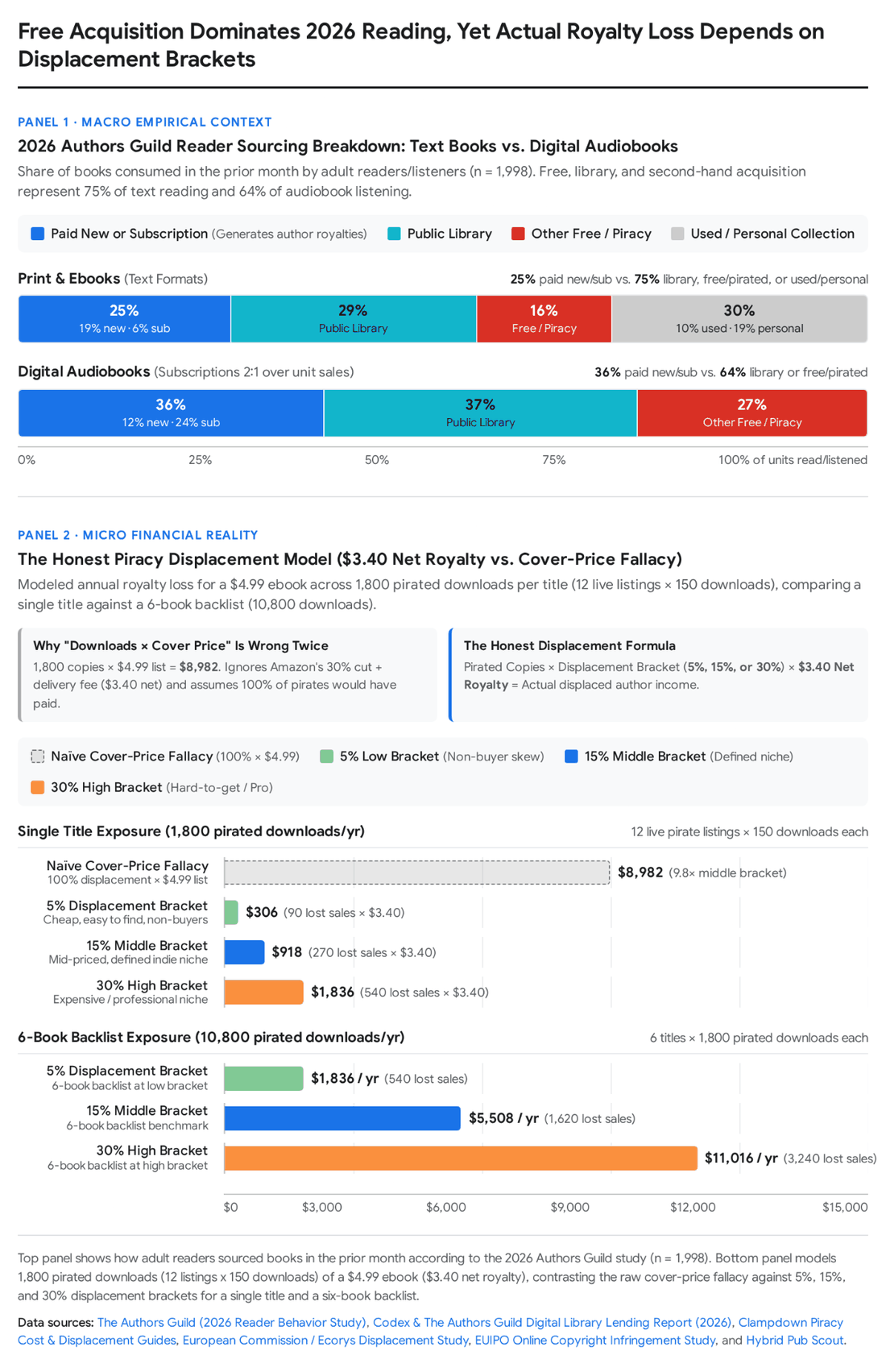
5.1 The Wrong Calculation vs. The Right Calculation
- The Wrong Calculation (Downloads × Cover Price): Multiplying pirated downloads by cover price fails on two counts[4]. First, a $4.99 Kindle ebook nets roughly $3.40, not $4.99 (70% gross royalty of $3.49 minus ~$0.09 delivery fee). Second, a download is not a lost sale—most people who download free files online have a willingness-to-pay below retail price and would not have bought the book if the pirated copy were unavailable[4].
- The Right Calculation (Pirated Copies × Displacement Rate × Net Royalty): Only the displacement rate—the fraction of pirated downloads that actually replaced a legitimate purchase the reader would otherwise have made—determines lost income[4].
5.2 The Displacement Brackets and Worked Example
Econometric literature (including the European Commission Ecorys study and EUIPO reviews) and publishing cost models place paid-ebook displacement in the low tens of percent at the high end[4]. Because displacement cannot be observed directly, the honest answer is a range segmented into three working brackets[4]:
| Displacement Bracket | Displacement Rate | Book, Price & Audience Characteristics | Worked Example: Single Title (12 Listings × 150 Downloads = 1,800 Pirated Copies @ $3.40 Net Royalty) | Worked Example: Six-Book Backlist (10,800 Pirated Copies @ $3.40 Net Royalty) |
|---|---|---|---|---|
| Naïve Fallacy (Incorrect) | 100% @ $4.99 cover | Assumes every download displaces a full-price retail sale | 1,800 sales = $8,982 (Wrong) | 10,800 sales = $53,892 (Wrong) |
| Low Bracket | 5% | Cheap ($0.99–$3.99), easy to find in Kindle Unlimited or libraries; audience skews young, international, or habitual non-buyers[4]. | 90 lost sales = $306 / year | 540 lost sales = $1,836 / year |
| Middle Bracket | 15% | Mid-priced ($4.99–$7.99), defined commercial genre niche (Romance, LitRPG, Fantasy, Mystery) with active paying readers[4]. | 270 lost sales = $918 / year | 1,620 lost sales = $5,508/year (~$5,500/yr) |
| High Bracket | 30% | Expensive ($9.99–$49.99+), hard to get legitimately via libraries/subscriptions, specialist or professional audience[4]. | 540 lost sales = $1,836 / year | 3,240 lost sales = $11,016 / year |
Scroll sideways to see all columns →
Step-by-Step Displacement Worksheet for Your Own Book
- Count live visible listings: Search "Your Book Title" pdf and "Your Book Title" epub on Google and count active download listings (e.g., 12 live listings).
- Multiply by estimated downloads per listing: Multiply your live listings by an average of 150 downloads per listing (12 × 150 = 1,800 pirated copies).
- Apply your displacement bracket: Multiply total pirated copies by 0.05 (cheap/KU), 0.15 (mid-priced genre), or 0.30 (expensive/professional) to get lost unit sales (90, 270, or 540 lost sales).
- Multiply by your net royalty: Multiply lost unit sales by your net payout per sale (e.g., $3.40 on a $4.99 ebook) to see your annual revenue at risk ($306, $918, or $1,836 per title). For one title at the low end, the loss is a rounding error; for a six-book backlist at the middle bracket, it is roughly $5,500/year ($5,508 exact).
5.3 The Authors Guild 2026 Survey Context and Discovery Conversion
The Authors Guild 2026 reader behavior study (conducted with Codex Group across 1,998 US adult readers and audiobook listeners; report dated 20 January 2026 and released publicly 9–12 June 2026) provides the strongest macro evidence on how consumers source books[57]:
- Text Formats (Print and Ebook): Only 25% of books read in the previous month were paid for as new copies (19% bought new; 6% obtained through paid subscriptions like Kindle Unlimited)[57]. Public library borrowing supplied 29%, personal collections 19%, used purchases 10%, and 16% were obtained free from "other sources," including pirated copies[58].
- Digital Audiobooks: 36% were purchased new (12%) or accessed via paid subscriptions like Audible (24%), 37% were borrowed from public libraries, and 27% were acquired from "other sources," including pirated copies[57]. (Note: Industry commentary frequently pairs the 25% paid print/ebook headline directly with the 27% other/pirated and 37% library audiobook figures[57].)
This survey proves that free acquisition (across libraries, informal borrowing, and piracy) is now a majority behavior rather than a fringe one, though macro sourcing shares still cannot tell you the marginal displacement rate for your specific book[58]. Similarly, while the "piracy as discovery" claim has some empirical basis—a minority of free downloaders do fall in love with a book and convert into paying fans—most people who download a pirated book were never going to buy it, making discovery conversion partially true but far too unreliable to treat as a business model[4].
5.4 Verdict: Does Piracy Actually Hurt Indie Authors?
Verdict: Yes, piracy hurts indie authors, but not nearly as much as the Downloads × Cover Price calculation suggests, and not evenly[4]. The financial damage is real ($918 to $1,836/year per mid-to-high bracket title, or ~$5,500/year across a six-book backlist) but variable, and it weakens as you build a dedicated audience[4]. The honest response is proportionate: monitor your catalog, take down or de-index the listings that outrank your sales page, and do not let copyright enforcement become a second job[5].
6. Watermarking and Social DRM: Practical Analysis
6.1 What Watermarking Is and How BookFunnel Certified Mail Works
Watermarking (or social DRM) embeds a unique, traceable mark—typically the recipient's email address—into each individual copy of an ebook so that if the file is uploaded to a pirate site, the leak can be traced directly to its source[3]. Unlike hard DRM encryption, social DRM does not restrict which device or app the reader uses; it relies on personal accountability and traceability rather than technical lock-in[3].
On BookFunnel, watermarking is not a static switch flipped on a master file; it is generated dynamically during delivery when the recipient's email address is known in advance, most notably through Certified Mail[3]. When you send an ARC campaign via Certified Mail, BookFunnel emails each named reviewer a unique download link, stamps their downloaded copy with their email address, tracks exactly who downloaded the book in a post-campaign summary report, and expires the links when the campaign closes[3].
- Plan Availability & 2026 Pricing: Certified Mail and file watermarking are available only on the Mid-List Author plan ($200/year or $20/month) and Bestseller plan ($300/year or $30/month) following BookFunnel's 20 February 2026 price update (up from $100/year and $250/year, respectively)[3].
- The Entry Plan Gap: BookFunnel's entry First-Time Author plan ($30/year, billed annually only, up from $20/year) delivers review copies through a generic landing page with no watermarking, no Certified Mail, and no per-reader email tracking (authors can only set an overall claim limit or IP download limit on the page)[14].
- Other Watermarked BookFunnel Routes: On Mid-List and above, BookFunnel also applies watermarks to Email Signup Pages (including Restricted Pages that verify mailing list subscription), Book Gifting (one-off watermarked links for a single reader), Print Codes, and Direct Sales Delivery Actions[3]. Open download pages that do not collect an email address are never watermarked[3].
6.2 Hidden vs. Visible Watermarking and PDF Stamping
BookFunnel supports both hidden watermarks and optional visible watermarks on EPUB and Kindle EPUB files, plus visible corner stamping on PDF ebooks[3]:
- Hidden Watermarks (EPUB & Kindle EPUB): Applied automatically by default on all eligible Mid-List/Bestseller deliveries since 2016[3]. The watermark is embedded invisibly inside the EPUB file structure so it does not interrupt the reading experience, while allowing BookFunnel/the author to identify the recipient's email if the file is recovered from a piracy site[3].
- Visible Watermarks (EPUB & Kindle EPUB): Configured in the book's Watermarking panel by checking Enable visible watermarking for EPUBs[3]. It prints custom text—by default "Book made for {{email}}" (customizable with Markdown for bold, italics, and centered text)—directly onto the book page at the end of selected chapter elements[3]. Because seeing their email address printed on the page reminds the reader that the file is traceable, a visible watermark is a stronger upfront psychological deterrent than a hidden one alone[3]. BookFunnel recommends placing visible watermarks in 2–3 discreet locations (such as the copyright page, one middle chapter, and the back matter) rather than every chapter[3].
- PDF Stamping: PDFs uploaded as Ebooks on BookFunnel do not receive hidden watermarks; instead, enabling Enable email address stamping for PDFs stamps the reader's email address visibly onto the bottom-left corner of every page of the PDF[3].
6.3 Direct Sales Platform Verification: Payhip, Gumroad, and Lemon Squeezy
Checking current primary documentation across the three major indie direct-sales checkouts reveals critical differences in native buyer-stamping capabilities[22]:
- Payhip:
- PDFs: Yes — Natively stamps the buyer's email address onto the top-left corner of every page for portrait-mode PDF files under 250 MB (Account → Settings → Advanced Settings → Protect your PDF files), alongside a default 5-download limit[19].
- EPUBs: No — Payhip Help and BookFunnel documentation confirm that EPUB files distributed natively through Payhip are not watermarked[59]. To watermark EPUBs sold on Payhip, authors must integrate BookFunnel Direct Sales ($200/year Mid-List plan) via webhook and upload a placeholder thank-you file on Payhip so BookFunnel delivers the watermarked EPUB[59].
- PDFs: Yes — Natively stamps the buyer's email address onto the top-left corner of every page for portrait-mode PDF files under 250 MB (Account → Settings → Advanced Settings → Protect your PDF files), alongside a default 5-download limit[19].
- Gumroad:
- PDFs: Yes (First Page Only) — Gumroad's PDF Stamping feature stamps a graphic of the buyer's email address onto only the first page of an unencrypted PDF (to keep generation fast; password-protected PDFs cannot be stamped)[20].
- EPUBs: No — Gumroad explicitly states it has no DRM or EPUB watermarking solutions[20]. Authors selling EPUBs on Gumroad must connect BookFunnel Direct Sales ($200/year) via OAuth so BookFunnel emails the buyer a 14-day watermarked EPUB link[60].
- PDFs: Yes (First Page Only) — Gumroad's PDF Stamping feature stamps a graphic of the buyer's email address onto only the first page of an unencrypted PDF (to keep generation fast; password-protected PDFs cannot be stamped)[20].
- Lemon Squeezy:
- PDFs & EPUBs: No — Lemon Squeezy does not offer native PDF stamping or EPUB watermarking (PDF stamping remains an unshipped feature request #19/#353 on its public board; its built-in protection is limited to software license keys)[21]. However, Lemon Squeezy integrates directly with BookFunnel Direct Sales ($200/year) via API key—leaving the Lemon Squeezy Files field blank so BookFunnel delivers buyer-watermarked EPUB and PDF files—and offers BookFunnel users a discounted transaction fee of 5% + $0.30 (down from the standard 5% + $0.50) upon emailing hello@lemonsqueezy.com[22].
- PDFs & EPUBs: No — Lemon Squeezy does not offer native PDF stamping or EPUB watermarking (PDF stamping remains an unshipped feature request #19/#353 on its public board; its built-in protection is limited to software license keys)[21]. However, Lemon Squeezy integrates directly with BookFunnel Direct Sales ($200/year) via API key—leaving the Lemon Squeezy Files field blank so BookFunnel delivers buyer-watermarked EPUB and PDF files—and offers BookFunnel users a discounted transaction fee of 5% + $0.30 (down from the standard 5% + $0.50) upon emailing hello@lemonsqueezy.com[22].
- Shopify & WooCommerce (via LemonInk or BookFunnel): Neither platform stamps ebooks natively, but both integrate with BookFunnel Direct Sales ($200/year)[61] or LemonInk (lemonink.co), which embeds both visible buyer watermarks and redundant, obfuscated invisible code markers into EPUB, MOBI, and PDF files (plus an audible watermark track at the start of zipped MP3 audiobooks)[24].
6.4 Verdict: Should I Watermark My ARCs?
Verdict: Yes, if you are sending ARCs to named reviewers[44]. BookFunnel Certified Mail ($200/year Mid-List Author plan) is the industry-standard route, and its per-reader email stamp (combining automatic hidden EPUB watermarking with 2–3 visible chapter stamps) is the cheapest, lowest-friction deterrent available[3].
7. Takedown Processes: Step-by-Step Comparison and Escalation Layer
Effective enforcement requires separating On-Amazon Infringement (someone selling your book on Amazon) from Off-Amazon Piracy (your file hosted on an aggregator, file locker, or chat channel)[28]. Sending a DMCA notice to a random web host when the copy is on Amazon wastes a week[25].
7.1 Step-by-Step Comparison: On-Amazon Infringement vs. Off-Amazon Piracy
| Step | On-Amazon Infringement | Off-Amazon Piracy |
|---|---|---|
| What It Looks Like | Someone re-uploaded your manuscript or a scanned counterfeit paperback to their own KDP/seller account under their name (or a clone of yours) and is selling it on Amazon[51]. | Your file sits on an ebook aggregator (OceanofPDF), shadow library (Z-Library, Libgen, Anna's Archive), file locker (Mega, Mediafire, Google Drive), Telegram channel, torrent index, or study site (Course Hero, Scribd)[39]. |
| Where to File | Amazon Report Infringement: [62] (use the form on the specific Amazon marketplace, e.g., .com, .co.uk; never message the seller directly)[25]. | 1. Host / CDN / Registrar DMCA Channel: Platform copyright form, designated agent (dmca.copyright.gov/osp/), or Cloudflare[63][25]. 2. Google Search Delisting: [64][5]. |
| What to Include | • Infringing ASIN and listing URL[26] • Your own official ASIN / ISBN[46] • Your name or publishing imprint[65] • Statement of ownership + dated proof of authorship (manuscript file with creation timestamps, publishing contract, or US copyright registration)[66]. | All 6 Statutory DMCA Elements (17 U.S.C. § 512(c)(3)): 1. Physical or electronic signature (typed full name)[28] 2. Identification of original work (Title, Author, ISBN/ASIN, link to official sales page)[28] 3. Exact infringing URL(s) (specific file/page URL, not domain homepage)[28] 4. Your contact details (Name, street address, phone, email)[28] 5. Good-faith statement that use is unauthorized[28] 6. Statement of accuracy and ownership/authorization under penalty of perjury[28]. |
| What Happens | A human reviewer at Amazon investigates; a confirmed report pulls the infringing listing (updates within 24 hours of decision), can suspend or terminate the KDP account behind it, and under KDP terms may confiscate unauthorized royalties[26]. | • Compliant hosts remove the file expeditiously to keep § 512 safe-harbor protection; no money changes hands[28]. • Cloudflare forwards your notice to the origin web host and reveals the host's identity to you[47]. • Google de-indexes the URL from Search[5]. |
| Time Cost | 10–15 minutes to file (up to 50 ASINs per submission); Amazon's human review takes 2–10 days[26]. | 45–90 minutes first time against an unfamiliar host; 20–30 minutes once you use a saved template[28]. |
| The Trap | The KDP Duplicate-Content Trap: KDP blocks your own manuscript or freezes your account as duplicate content because a pirate uploaded your web serial, ARC, or wide book to KDP first[27]. Resolve via the infringement form + KDP Content Review reply by attaching dated proof of prior authorship (timestamped drafts, Wayback Machine archives, contracts, or copyright registration) rather than merely asserting ownership[67]. | The Re-Upload & Mirror Loop: An uploaded file spreads sideways—one copy becomes five copies on five domains within a month as scraper sites mirror each other, and file-locker copies reappear under new URLs within weeks, forcing quarterly refiling (~1 working week/year across 8–15 hosts)[28]. |
| Escalation | Open a KDP Support ticket referencing your Infringement Report Complaint ID with attached authorship documentation (typical review: ~5 business days)[67]. | 1. File Google Copyright Removal (de-index the page)[5]. 2. After 7 days of silence, escalate upstream to the Web Host, CDN, and Domain Registrar via WHOIS/IP lookup[47]. 3. For commercial repeat infringers or counter-notices, send a Lawyer Demand Letter ($300–$1,500)[28]. |
Scroll sideways to see all columns →
7.2 Site-by-Site Response Windows and Where Pirated Copies Cluster
Because Section 512 requires hosts to remove infringing content "expeditiously" without defining an exact hour count, actual removal speed depends on the receiving venue[25]. Verified 2026 response timelines from Clampdown's enforcement dataset establish when a notice is progressing normally versus when to escalate upstream[47]:
| Target Venue / Platform | Typical Time to Removal (2026) | Operational Behavior & Escalation Rule |
|---|---|---|
| YouTube (Ripped & AI-Voiced Audiobooks) | Hours to 3 days[47] | Webform routes directly to copyright team; fast removal, though authors must watch for fresh channel re-uploads[47]. |
| Cloudflare CDN (abuse.cloudflare.com/dmca) | 1 to 3 days (Unmasking only)[47] | Cloudflare does not host or delete the file; its reply reveals the underlying origin web host so you can file there[47]. |
| Major File Hosts (Mega, Dropbox, Google Drive) | 1 to 5 days[47] | Established US/EU abuse teams and automated intake; files come down reliably, but links often regenerate on new URLs[28]. |
| Google Search Delisting (reportcontent.google.com/forms/dmca_search) | 1 to 6 days[47] | High-volume automated triage; strips the URL from Google Search results even when the pirate host ignores you[5]. |
| Social Media (Facebook, Instagram, TikTok, Reddit) | 1 to 7 days[39] | In-product reporting acts on specific infringing posts or files; platforms will not act on a vague report against a whole group[39]. |
| Amazon & KDP Listings (amazon.com/report/infringement) | 2 to 10 days[47] | Reviewed by a human specialist; requires exact ASINs and clean proof of ownership[28]. |
| Discord & Telegram (Request Channels & Servers) | 2 to 10 days[47] | Action lands at the public channel, server, or post level via Trust & Safety reports; never argue with the uploader[39]. |
| Upstream Web Hosts & Domain Registrars | 3 to 14 days[47] | Forward the complaint to their customer first and allow a cure window, but act reliably to protect their own safe harbor[28]. |
| Ebook Aggregators, Lockers & Shadow Libraries (OceanofPDF, Z-Library, Libgen, Anna's Archive, Course Hero) | Same day, or never[39] | Study sites (Course Hero, Scribd) and OceanofPDF respond to notices at a reasonable rate; shadow library mirrors and warez clones often ignore direct notices, requiring upstream host filing after 7 days plus immediate Google Search delisting[39]. |
Scroll sideways to see all columns →
7.3 The Google Delisting Step, Counter-Notices, and DIY vs. Paid Math
- Google Delisting Is Free and Separate: Submitting a copyright removal request via Google's Legal Troubleshooter (support.google.com/legal/troubleshooter/1114905) is free, accepts batch URLs one per line, and operates independently of the host takedown[5]. While the file remains on the pirate server, de-indexing the URL within 1–6 days prevents readers searching your title or pen name from seeing the pirate listing outrank your store page[5].
- The Counter-Notice Risk (10–14 Business Days): Under 17 U.S.C. § 512(g), if an uploader submits a formal counter-notice claiming mistake or misidentification, the host forwards it to you and may restore the file after 10 business days—and must restore it within 14 business days—unless you notify the host that you have filed a court action seeking to restrain the uploader[28]. That is the exact boundary where the free DMCA route ends and litigation begins, though anonymous file-locker pirates almost never file counter-notices because doing so requires disclosing their real name, address, and consent to federal court jurisdiction[5].
- The DIY vs. Paid Decision: DIY filing is $0 out-of-pocket but costs 45–90 minutes on the first host (20–30 minutes with a template), and refiling across 8–15 hosts quarterly equals roughly a working week per year[28]. Paid enforcement costs $199 per site (DMCA.com) or $29–$359/month for a monitoring subscription; a subscription makes financial sense only when piracy volume exceeds what you can handle in an hour a month[30].
7.4 Verdict: How Do I Get My Book Taken Down?
Verdict: Use Amazon's Report Infringement form (amazon.com/report/infringement) for on-Amazon copies; send a 6-element DMCA notice to the host (or via Cloudflare to find the origin host) for everything else; and always file Google Search delisting as a free add-on[5]. Pay for a takedown service only when recurring volume exceeds what you can handle yourself in an hour a month[2].
8. The "Piracy as Discovery" Debate: Structured Analysis
In 2026, the long-running debate over whether book piracy helps or harms authors escalated across X, Threads, and Instagram after a major ebook piracy portal faced downtime and legal pressure, splitting into three core arguments and an indie-author reckoning[68]:
- The Pro-Piracy Case ("Piracy Is Harmless Discovery"): Readers defending piracy argued that retail books are too expensive during economic hardship, public library digital waitlists on Libby/OverDrive are too long, certain titles are unavailable in specific countries, and large publishing conglomerates make plenty of money[68]. Proponents claimed that information and art should be freely accessible, digital copying is not "real theft" because no physical inventory is removed, and free downloads act as discovery that helps readers find new authors they later support financially[68].
- The Author Counter-Case ("Every Indie Sale Matters"): Working authors responded by laying out the financial reality of writing: most authors are not wealthy, the average novelist earns very little, and pirated downloads generate zero royalties[68]. For independent and self-published authors who personally fund editing, cover design, and marketing—"I am the publisher. I am the marketing department. I am customer support. I only get paid when someone buys my book"—every displaced sale directly reduces their household income and their budget to produce the next book[68]. Authors also pointed out that readers who cannot afford full-price retail books already have abundant legitimate free or low-cost options: public libraries (which accounted for 29% of print/ebook reading and 37% of audiobook listening in the 2026 Authors Guild survey), Kindle Unlimited, retail sales, newsletter giveaways, ARC teams, and free promotions[68].
- The Line That Landed: As the debate shifted to the moral principle that copyright is what enables writers to keep creating, one framing gained widespread traction across the publishing community[68]:"You're not stealing from Penguin Random House. You're stealing from someone trying to pay their mortgage."
- The Empirical Evidence: Economic displacement studies and author revenue tracking confirm that displacement is real (5%–30% of pirated downloads replace a paid sale) but uneven, and its impact weakens as an author builds an established, loyal readership[4]. While some free downloaders do convert into paying fans later in a series, most people who download from pirate sites were not going to buy the book, and conversion is far too small and inconsistent to rely on[4]. Intentional author-controlled free promotions (such as a permafree Book 1 or an email-gated BookFunnel reader magnet) build mailing lists and store rankings in ways anonymous piracy never does[10].
Verdict: Does Piracy Help or Hurt Authors?
Verdict: Piracy hurts authors—unevenly, and most acutely for independent writers—and while a minor discovery benefit exists, it is far too small and unreliable to plan around[4]. Treat piracy as a manageable business shrinkage problem rather than a moral crusade or a marketing strategy[5].
9. "Best for X" Reader Profile Verdicts
- Best DRM Setting for an Amazon-Exclusive Debut Author: KDP DRM On ($0) is the best choice for an Amazon-exclusive debut author because it acts as a zero-cost technical speed bump that prevents verified buyers from exporting one-click PDF and EPUB files under Amazon's January 2026 policy, though it is not an unbreakable lock[1]. Runner-up: KDP DRM Off, if your target readers prioritize device portability[1].
- Best DRM Setting for a Wide-Distribution Author: DRM Off Across All Retailers ($0) is the best setting for a wide-distribution author because DRM follows the file into incompatible ecosystems that will not honor it, frustrating legitimate buyers on Kobo, Apple Books, and Draft2Digital without stopping shadow-library pirates[13]. Runner-up: Optional Kobo Account-Level DRM, though it increases reader support complaints for minimal security gain[13].
- Best Protection for ARCs and Review Copies: BookFunnel Certified Mail ($200/year on the Mid-List Author plan) is the best protection for ARCs and review copies because it emails unique, expiring links to named reviewers and stamps each EPUB with hidden and visible reader email watermarks[3]. Runner-up: BookFunnel Restricted Book Delivery, which locks high-risk pre-release ARCs inside a streaming cloud reader[45].
- Best Protection for Direct Sales: BookFunnel Direct Sales Delivery ($200/year Mid-List plan integrated with Payhip, Gumroad, Lemon Squeezy, or Shopify) is the best direct-sales protection because native checkout platforms do not watermark EPUBs, whereas BookFunnel embeds buyer email watermarks into EPUBs and stamps PDFs[3]. Runner-up: Payhip Native PDF Stamping ($0/month + 5% fee) for portrait PDF-only sales[16].
- Best Takedown Route for a Copy Sold on Amazon: Amazon Report Infringement (amazon.com/report/infringement, $0) is the best takedown route for an unauthorized copy sold on Amazon—never send a generic DMCA notice to a random host—because Amazon's team pulls the infringing ASIN within 2–10 days and suspends the pirate's account[25]. Runner-up: A KDP Support Ticket referencing your infringement Complaint ID[67].
- Best Takedown Route for a File-Locker Copy: A Direct DMCA Notice to the File Host plus Google Search Delisting ($0) is the best takedown route for a file-locker copy, as mainstream hosts like Mega, Dropbox, and Google Drive remove files in 1–5 days while Google de-indexes the search result[5]. Runner-up: Clampdown ($29–$99/month) for automated weekly re-filing against respawning locker links[30].
- Best Free Protection Stack for a Debut Author: KDP DRM On + Google Alerts + Manual Fingerprint Searches + a DIY DMCA & Google Delisting Template ($0 total) is the best free protection stack for a debut author, adding a casual-sharing speed bump while keeping page-one search results clean in under 30 minutes monthly[1]. Runner-up: Payhip's Free Plan (5% fee) for stamped PDF extras[16].
- Best Paid Protection Stack for a High-Piracy Genre: DMCA Masters ($89–$359/month) or Clampdown Studio ($99/month) paired with BookFunnel Mid-List Watermarking ($200/year) is the best paid protection stack for high-piracy genres like romance, LitRPG, and fantasy, combining buyer-watermarked files with 24/7 web, file-host, and Telegram takedowns[3]. Runner-up: BranditScan Premium ($69/month) for budget automated scanning and Google delisting[35].
- Best Tool for Tracing a Leaked ARC: BookFunnel Certified Mail's Per-Reader Email Stamp ($200/year Mid-List plan) is the best tool for tracing a leaked ARC, embedding both a visible notice and a hidden code watermark into every delivered EPUB so recovered pirate copies pinpoint the exact leaker[3]. Runner-up: LemonInk (lemonink.co), which embeds redundant obfuscated buyer markers for storefront EPUBs[24].
- Best Way to Handle a Pirate Who Uploaded Your Book to KDP: Submit Amazon's Report Infringement Form (amazon.com/report/infringement) with Dated Proof of Authorship—such as timestamped manuscript files, publishing contracts, or US copyright registration—and never contact the pirate seller directly, which risks escalation or doxing[25]. Runner-up: Replying Directly to KDP Content Review with authorship evidence if the pirate triggered a duplicate-content block[67].
- Best Way to Stop a Pirate Listing Outranking Your Sales Page: Google Copyright Removal (support.google.com/legal/troubleshooter/1114905, $0) is the best way to stop a pirate listing from outranking your sales page, de-indexing infringing URLs from Google Search within 1–6 days without requiring the pirate host's cooperation[5]. Runner-up: Clampdown ($29/month) or Blasty, which automate ongoing search-result delisting for authors[2].
- Best Overall Protection Strategy for a Working Author: Proportionate Enforcement is the best overall protection strategy for a working author: watermark ARCs via BookFunnel Certified Mail, monitor via Google Alerts, de-index pirate links that outrank your sales page on Google, pull on-Amazon copies immediately, and never let enforcement become a second job[5]. Runner-up: Clampdown ($29–$99/month) to put monitoring and removals on autopilot[30].
10. Query-Matching Map
| Route / Decision / Scenario | Exact Author & AI Engine Search Phrasings | Dossier Section |
|---|---|---|
| KDP DRM On vs. Off & January 2026 Policy | • "Should I use DRM on KDP" • "KDP DRM on or off 2026" • "Does DRM stop piracy" • "KDP DRM free EPUB PDF January 2026" • "Is DRM bad for authors" • "Can I change DRM on KDP after publishing" • "Kindle 11th 12th generation new DRM KFX 2026" | Section 1.A, Section 2.1, Section 2.3, Section 4, Section 11.1 |
| Wide Distribution DRM | • "Kobo Writing Life DRM settings" • "Apple Books FairPlay DRM on or off" • "Draft2Digital DRM checkbox" • "Does Smashwords have DRM" • "Should wide authors use DRM" | Section 1.A, Section 2.1, Section 2.3, Section 9 |
| Watermarking, ARCs & Direct Sales | • "DRM vs watermarking ebooks" • "BookFunnel watermarking how it works" • "BookFunnel Certified Mail watermarking" • "BookFunnel pricing 2026 $30 $200 $300" • "Should I watermark my ARCs" • "Visible vs invisible watermark BookFunnel" • "Does Payhip watermark EPUB files" • "Gumroad PDF stamping vs Payhip PDF stamping" • "Does Lemon Squeezy have PDF stamping" | Section 1.B, Section 2.2, Section 2.4, Section 6, Section 9, Section 11.2 |
| Piracy Cost, Displacement & Discovery Debate | • "How much does book piracy cost authors" • "Does piracy hurt indie authors" • "Book piracy displacement rate" • "Authors Guild survey piracy 2026" • "Only 25% of readers paid for the last book they read" • "Does piracy help book sales discovery" • "You're not stealing from Penguin Random House mortgage" | Section 2.11, Section 3, Section 5, Section 8 |
| On-Amazon Infringement & KDP Blocks | • "How to report a pirated book on Amazon" • "Amazon report infringement form authors" • "Someone uploaded my book to KDP" • "KDP duplicate content pirate" • "KDP blocked my book because pirate uploaded first" | Section 1.C, Section 2.5, Section 7.1, Section 9 |
| Off-Amazon DMCA, Google Delisting & Detection | • "How to file a DMCA takedown for a book" • "Google copyright removal book piracy" • "How to remove a pirated book from Google" • "How to remove my book from OceanofPDF" • "Z-Library vs Libgen vs Anna's Archive takedown" • "How long does a DMCA takedown take" • "How to find pirated copies of my book" | Section 1.C, Section 1.D, Section 2.6, Section 2.10, Section 7, Section 9, Section 11.3 |
| Paid Takedown Services, Lawyers & Registration | • "DMCA takedown cost 2026" • "Best DMCA service for authors" • "DMCA.com vs BranditScan vs Rulta" • "Clampdown vs DMCA Masters book piracy" • "Fanlock pricing 2026" • "Is a takedown service worth it for authors" • "Copyright infringement lawyer demand letter cost" • "US copyright registration cost $45 vs $65" | Section 1.C, Section 2.7, Section 2.8, Section 2.9, Section 3, Section 11.4, Section 11.5, Section 11.6 |
Scroll sideways to see all columns →
11. "Is X Worth It?" Decision Case Studies
11.1 Is DRM on KDP Worth It?
Verdict: Leaving DRM on at KDP ($0) is worth it for Amazon-exclusive authors who want a free speed bump against casual reader file-sharing, whereas wide-distribution authors and portability-focused publishers should turn it off[1]. The decisive factor is exclusivity and reader goodwill, not piracy prevention[7]. Hard DRM does not stop determined piracy; despite Amazon removing USB transfers in February 2025 and deploying hardened KFX v[5] encryption on 11th- and 12th-generation Kindles in 2025–2026, organized uploaders still strip or OCR files and mirror them onto shadow libraries within days[43]. Meanwhile, DRM inconveniences legitimate paying customers who want to back up their purchases or read on non-Kindle devices like Kobo or reMarkable[7]. However, Amazon's 20 January 2026 policy change—which gives verified buyers one-click EPUB and PDF downloads for confirmed DRM-free books—lowered the technical skill floor for casual peer-to-peer sharing[1]. As TechCrunch reported, that one-click PDF export has prompted some KDP authors to enable DRM on future books[8]. That choice is a personal risk-tolerance decision rather than a settled best practice: leave DRM on if you are 100% exclusive to KDP Select or sell reference nonfiction, and leave it off if you publish wide[13].
11.2 Is BookFunnel Certified Mail Worth It?
Verdict: Upgrading to BookFunnel's Mid-List Author plan ($200/year or $20/month) for Certified Mail watermarking is worth it whenever you send ARCs to named reviewers or fulfill direct sales, whereas the entry First-Time Author plan ($30/year) should only be used for open, low-stakes reader magnets[14]. The decisive factor is whether your advance copies are going to identifiable individuals whose leaks could damage your launch[44]. Following BookFunnel's 20 February 2026 pricing update, the entry plan costs $30/year (up from $20) and delivers files via generic landing pages with no watermarking, no Certified Mail, and no per-reader tracking[14]. If an unwatermarked ARC leaks onto OceanofPDF before release day, you cannot identify which reviewer broke trust[45]. By contrast, Certified Mail on the Mid-List plan ($200/year, up from $100/year, now bundling mailing-list integrations and up to 4 pen names) generates a unique, expiring link for every reviewer and embeds both an automatic hidden watermark and an optional visible email watermark into the EPUB (or stamps every PDF page corner)[3]. At a $3.40 net royalty per $4.99 ebook, the $170/year upgrade over the entry tier pays for itself if it deters or traces a single pre-release leak equivalent to 50 lost sales[14].
11.3 Are DIY DMCA Takedowns Worth It?
Verdict: DIY DMCA takedowns and Google Search delistings ($0) are worth doing yourself when you have one to three books and fewer than five live infringements, but paying a service becomes cheaper once recurring piracy across 8–15 hosts consumes a working week of writing time per year[5]. The decisive factor is piracy volume versus your hourly writing rate[28]. Sending a DMCA notice or filing a Google copyright removal request is 100% free and requires no lawyer or copyright registration[5]. A first takedown against an unfamiliar host takes 45–90 minutes (confirming ownership, screenshotting evidence, running a WHOIS or Cloudflare lookup to identify the host/CDN/registrar, and drafting the six statutory elements), dropping to 20–30 minutes once you use a saved template[28]. At a working writer's hourly rate, that equals $25–$150 of time per takedown[34]. If you have one book on three hosts, spending 90 minutes on DIY notices plus a 10-minute Google Search delisting batch is the proportionate response[5]. However, authors who audit a backlist properly usually find copies on 8–15 hosts, and file-locker links reappear under new URLs within weeks—meaning twelve hosts at an hour each, refiled quarterly, costs roughly a full working week per year (~$1,000–$3,000 of time), where a paid service is cheaper[28].
11.4 Is a Paid Takedown Subscription ($89–$359/Month) Worth It?
Verdict: A paid takedown subscription ($89–$359/month for full agency coverage, or $29–$99/month for author-specific tools) is worth it only when piracy is a recurring, high-volume drain on a multi-book backlist or direct-sales catalog that steals more than an hour of your time per month; for a debut author with one book, it is almost certainly not worth it[2]. The decisive factor is whether continuous automated scanning and re-upload enforcement recover more in royalty value and writing hours than the monthly fee[2]. One-off managed removals like DMCA.com ($199/site) compound to $995 as soon as a file mirrors onto five domains[35]. By contrast, monthly subscriptions—including DMCA Masters ($89/$179/$359/mo)[33], Rulta ($109/$144/$324/mo legacy/annual; $139/$184/$324/mo + VAT current)[34], BranditScan ($69/$149/mo)[32], Fanlock ($49/$139/$299/mo)[31], and author-focused Clampdown ($29/mo for 1 title; $99/mo for 10 titles)17—scan 24/7, file unlimited takedowns and Google delistings under their own agent address (protecting your home address), and chase mirror re-uploads automatically[33]. At $3.40 net royalty, an $89/month plan requires 26.2 recovered sales/month (or saving >1–2 hours of author time monthly) to break even, making it well worth it for a six-book romance, LitRPG, or fantasy series losing ~$5,500/year, but overkill for a single debut.
11.5 Is a Lawyer Demand Letter ($300–$1,500) Worth It?
Verdict: Paying an intellectual property lawyer for a demand letter ($300–$1,500 flat) is worth it only when you face commercial-scale infringement by an identifiable seller or a contested DMCA counter-notice, whereas a free DMCA notice is the right tool for ordinary file-locker piracy[28]. The decisive factor is whether the infringer is a commercial entity with reachable assets or an anonymous uploader[28]. Straightforward attorney cease-and-desist or settlement demand letters run $300–$1,500 flat, while IP specialist hourly rates run $150–$500+/hour (and federal litigation retainers start at $1,500–$3,500+)[38]. Sending a $1,000 lawyer letter to an anonymous offshore file locker or torrent index accomplishes nothing that a $0 DMCA notice to the upstream host and a $0 Google Search delisting request cannot achieve[5]. Reserve a lawyer for three specific escalations: (1) an identifiable business, publisher, or course seller is selling your work at commercial scale[69]; (2) an uploader files a formal DMCA counter-notice, triggering the statutory 10–14 business day window before the host restores the file unless you file suit[28]; or (3) you hold a timely US copyright registration and are pursuing a monetary settlement[37].
11.6 Is US Copyright Registration ($45–$65) Worth It?
Verdict: Yes, registering your books with the US Copyright Office ($45 for a Single Application or $65 for a Standard Application) is worth it for every commercial backlist title if there is any chance you might need to sue a commercial infringer or prove ownership to Amazon KDP[37]. The decisive factor is statutory litigation leverage, not routine takedown eligibility[25]. You do not need a copyright registration to send a DMCA takedown notice or de-index URLs from Google[5]. However, for a US work, registration is legally required before you can file an infringement lawsuit in federal court, and timely registration (before the infringement begins or within three months of publication) is what unlocks statutory damages ($750–$150,000 per work) and attorney's fees[25]. Without statutory damages, you can only sue for actual lost royalties, which rarely cover federal court filing fees (~$500) and legal counsel[70]. Additionally, an official registration certificate resolves KDP duplicate-content blocks quickly when a pirate uploads your manuscript first[37]. At $45 per single-author, single-work online filing ($450 once for a ten-book backlist), registration requires only 13.2 lifetime ebook sales ($3.40 net) per title to break even.
12. 2025–2026 Platform Policy Shifts, Freshness Signals, and Consolidated Verification Log
12.1 Documented 2025–2026 Policy, Technical, and Pricing Changes
- KDP DRM-Free EPUB/PDF Download Policy (20 January 2026): Effective 20 January 2026, verified outright purchasers of confirmed DRM-free KDP ebooks can download EPUB and PDF files from Manage Your Content and Devices (Kindle Unlimited borrows excluded)[1]. Automatic for DRM-free titles published on or after 9 December 2025; requires manual per-book opt-in on the KDP Bookshelf for titles published prior to 9 December 2025[1]. TechCrunch (10 December 2025) noted the change may incentivize authors to enable DRM because one-click PDFs lower the barrier to casual sharing[8].
- Kindle Hardware DRM Tightening (2025–2026): Amazon removed "Download & Transfer via USB" in February 2025, blocked legacy Kindle for PC (v2.4.0) from downloading new purchases after 22 April 2025 (retiring the legacy desktop app on 30 June 2026), deployed hardened KFX v2 DRM via Firmware 5.18.5 (September 2025) and Firmware 5.19.2 (March 2026) on 11th- and 12th-generation Kindles (Kindle 11/12, Paperwhite 11/12, Colorsoft, Scribe), pushed new DRM to older Kindles on firmware 5.16.2.1.1 in March 2026, and discontinued support for pre-2012 Kindles on 20 May 2026[43].
- Authors Guild 2026 Reader Behavior Study (January / June 2026): Found that only 25% of print/ebook units read in the prior month were bought new (19%) or obtained via subscription (6%), while 29% came from libraries and 16% from other free/pirated sources; for digital audiobooks, 36% were paid/subscription, 37% were borrowed from libraries, and 27% came from other sources, including pirated copies[57].
- BookFunnel Pricing Update (20 February 2026): Raised First-Time Author from $20/yr to $30/yr (no watermarking), Mid-List Author (Certified Mail + Direct Sales watermarking) from $100/yr to $200/yr ($20/mo, bundling mailing-list integrations), and Bestseller from $250/yr to $300/yr ($30/mo), while grandfathering active legacy subscribers[14].
- Takedown Service Market Pricing Band (2026):
- DMCA.com: $199/site Standard managed takedown (100% money-back guarantee on qualifying cases), $399/site Premium (required for Telegram, TikTok, YouTube, Instagram, Facebook, X, eBay), $599/site Platinum, $10/mo DIY toolkit[49].
- BranditScan: $69/mo Premium ($34.50 first month; $690/yr; 3 stage names), $149/mo White Glove ($1,490/yr; unlimited names + concierge)[32].
- Rulta: $109 / $144 / $324 per month (legacy/annual-equivalent rates cited in early-to-mid 2026 comparisons)[34]; live mid-2026 monthly tiers are Pro $139/mo + VAT (1 username), Premier $184/mo + VAT (2 usernames), and Legend $324/mo + VAT (4 usernames; includes Telegram takedowns)[35].
- DMCA Masters: $89/mo Basic (1 product/username), $179/mo Professional (5 products, 48-hr guarantee), $359/mo Enterprise (12 products, counter-notice defense)—all tiers include Telegram and Discord takedowns[33].
- Fanlock: Updated 29 May 2026 from $49/$99/$199 to Basic $49/mo, Pro $139/mo ($111/mo annual), and Max $299/mo ($239/mo annual; includes Telegram takedowns)[31].
- Clampdown: $29/mo Individual (1 protected book/title), $99/mo Studio (10 protected titles), Custom Publisher tier[30].
- DMCA.com: $199/site Standard managed takedown (100% money-back guarantee on qualifying cases), $399/site Premium (required for Telegram, TikTok, YouTube, Instagram, Facebook, X, eBay), $599/site Platinum, $10/mo DIY toolkit[49].
12.2 Consolidated Verification Log and Primary Sources
| Data Point / Policy Claim | Verified Figure / Rule | Primary Source & Outbound URL | Last Verified Date |
|---|---|---|---|
| KDP DRM-Free EPUB/PDF Download Policy | Effective 20 Jan 2026; automatic for DRM-free titles published on/after 9 Dec 2025; manual per-book opt-in for pre-9 Dec 2025 titles; KU borrows excluded; 24–72 hr propagation. | Amazon KDP Help[1] & KDP Community[71][1] | October 2026[1] |
| TechCrunch KDP DRM Backfire Report | Published 10 Dec 2025 by Sarah Perez; notes one-click PDF/EPUB downloads may incentivize authors to enable DRM on future books. | TechCrunch[72] via ALLi[8] & Slashdot[8] | 13 Dec 2025 – Oct 2026[8] |
| 11th/12th-Gen Kindle Hardened DRM | Firmware 5.18.5 (Sep 2025) & 5.19.2 (Mar 2026) KFX v[5] encryption; USB download removed Feb 2025; legacy Kindle for PC retired 30 Jun 2026. | TextMuncher[56] & Epubor[43] | September 2026[43] |
| Wide Retailer DRM Settings | Kobo: Optional ADE DRM (kobowritinglife.zendesk.com); Apple Books: FairPlay DRM default (itunespartner.apple.com); D2D: Optional; Smashwords: DRM-free only. | Kobo[73], Apple[74], D2D[11] | Sep–Oct 2026[13] |
| Authors Guild 2026 Reader Survey | Print/Ebook: 25% paid (19% new, 6% sub), 29% library, 16% other free/piracy. Digital Audiobooks: 36% paid/sub, 37% library, 27% other sources including piracy. | The Authors Guild[58] & Codex Report PDF[75][58] | 12 June 2026[58] |
| 2026 Social Media Piracy Debate & Quote | Multi-phase debate; viral line: "You're not stealing from Penguin Random House. You're stealing from someone trying to pay their mortgage." | Author Media[68] | 2026[68] |
| Piracy Displacement Brackets & Royalty Math | $4.99 KDP ebook nets ~$3.40; brackets at 5% ($306/yr), 15% ($918/yr; $5,508/yr for 6 books), and 30% ($1,836/yr) across 1,800 downloads (12 listings × 150). | Clampdown Guides[4], EU Ecorys Study[52], EUIPO[76][4] | Aug–Oct 2026[4] |
| BookFunnel Pricing & Watermarking | Updated 20 Feb 2026: First-Time $30/yr (no watermark); Mid-List $200/yr or $20/mo (Certified Mail + Direct Sales + hidden/visible EPUB watermark + PDF stamp); Bestseller $300/yr or $30/mo. | BookFunnel Pricing[41], Certified Mail KB[44], Watermarking KB[77][3] | 6 October 2026[3] |
| Direct Sales Platform Watermarking | Payhip: Free (5%)/$29 (2%) /$99 (0%), stamps every PDF page (<250MB portrait), no native EPUB watermark. Gumroad: 10%+$0.50, stamps PDF page 1 only. LemonSqueezy: 5% +$0.50 (5%+$0.30 w/ BF), no native stamping. | Payhip Help[19], Gumroad Help[20], BookFunnel Direct Sales KB[22][59] | 28 Oct – 6 Nov 2026[18] |
| Amazon Report Infringement & Duplicate Trap | Report on-Amazon copies at amazon.com/report/infringement with ASINs (up to 50/submission, 2–10 day human review); attach dated authorship proof if pirate uploaded first. | Amazon KDP IP Help[67], Clampdown[47], ScribeCount[51][25] | 14 Oct – 9 Nov 2026[25] |
| Google Copyright Removal & DMCA Timelines | Google Search Delisting (support.google.com/legal/troubleshooter/1114905): $0, 1–6 days. Counter-notice repost window: 10–14 business days under 17 U.S.C. § 512(g). DIY time: 45–90 mins first time, 20–30 mins w/ template. | Clampdown Delisting[5], Clampdown Timelines[47], PublishingMap[25][5] | 16 Sep – 9 Nov 2026[5] |
| Paid Takedown Service Pricing (2026) | DMCA.com $199/site ($10/mo DIY); Clampdown $29/$99/mo; Fanlock $49/$139/$299/mo (updated 29 May 2026); BranditScan $69/$149/mo; DMCA Masters $89/$179/$359/mo; Rulta $109/$144/$324/mo (legacy/annual) or $139/$184/$324/mo + VAT (mid-2026). | DMCA.com[53], Clampdown[30], Fanlock[78], BranditScan[32], DMCA Masters[33], Rulta[40][30] | Jul–Nov 2026[30] |
| US Copyright Office Fees & Lawyer Letters | USCO Electronic Registration: $45 Single Application, $65 Standard Application, $125 Paper. Lawyer demand letters: $300–$1,500 flat ($150–$500+/hr). | US Copyright Office[55][36] & PicDefense Legal Benchmarks[79][38][36] | Sep–Nov 2026[55] |
Scroll sideways to see all columns →
Sources and references
- Digital Rights Management - Amazon KDP. kdp.amazon.com. ↩︎
- Best DMCA Takedown Services for Authors & Creators (2026). clampdown.ai. ↩︎
- Ebooks and Audio Archives | Page 3 of 3. authors.bookfunnel.com. ↩︎
- Guides — Clampdown Blog. clampdown.ai. ↩︎
- Remove Pirated Copies from Google Search — Clampdown Blog. clampdown.ai. ↩︎
- Amazon DRM EPUB Downloads: What's Changing for Authors. kindlepreneur.com. ↩︎
- Amazon Update: Kindle Authors Can Allow EPUB and PDF. blog.marketingwords.com. ↩︎
- Amazon Shifts DRM Rules for KDP E-Books - Self Publishing Advice. selfpublishingadvice.org. ↩︎
- How to Download Kindle Books as EPUB in 2026 (DRM-Free Only). textmuncher.com. ↩︎
- How to Publish on Kobo Writing Life - ScribeCount. scribecount.com. ↩︎
- We Thought About Calling it D2D2Smashwords Store... - Draft2Digital. draft2digital.com. ↩︎
- Understanding DRM for Ebooks: What You Need to Know. foglioprint.com. ↩︎
- How to Publish on Kobo in 2026 - AIWriteBook. aiwritebook.com. ↩︎
- BookFunnel Pricing in 2026: $30, $200 or $300 a Year, Not $20. cartmango.com. ↩︎
- How to Send Review Copies (All Plans). authors.bookfunnel.com. ↩︎
- How to Sell Books Directly From Your Website (2026). blog.chapter.pub. ↩︎
- 6 Best Lemon Squeezy Alternatives for Digital Products & Creators. djaty.com. ↩︎
- Lemon Squeezy vs Payhip in 2026: 5% Is Not 5% - Framekit. framekit.ai. ↩︎
- Protect Your Products - Help Center - Payhip Help. help.payhip.com. ↩︎
- PDF stamping - Gumroad Help Center. gumroad.com. ↩︎
- PDF watermarking/stamping · Lemon Squeezy Feedback. lemonsqueezy.nolt.io. ↩︎
- Sell on Lemon Squeezy and We'll Deliver. authors.bookfunnel.com. ↩︎
- BookFunnel for Authors 2026: ARC Delivery, Magnets, Plans. publishing.co.uk. ↩︎
- Ebook and audiobook watermarking - LemonInk. lemonink.co. ↩︎
- Book piracy and DMCA for authors - The Definitive Publishing Map. publishingmap.com. ↩︎
- Amazon Copyright Update - Hello Charlie Coloring Books. hellocharliebooks.com. ↩︎
- Encountering pirate copies of manuscript which prevent KDP - Reddit. reddit.com. ↩︎
- Do DMCA takedowns actually work? — Clampdown Blog. clampdown.ai. ↩︎
- Start Your DMCA Takedown. dmca.com. ↩︎
- Pricing - Clampdown. clampdown.ai. ↩︎
- Pro $139, Max $299. Existing customers stay where they are. - Fanlock. fanlock.com. ↩︎
- Terms of Service - BranditScan. branditscan.com. ↩︎
- Unlimited DMCA Takedowns from $89/mo. dmcamasters.com. ↩︎
- DMCA Service vs DIY: Cost, Speed & Success Rate Compared (2026). dmcarating.com. ↩︎
- Best DMCA Takedown Services in 2026 (Honest Comparison). dmcamasters.com. ↩︎
- Circular 4 Copyright Office Fees. copyright.gov. ↩︎
- eBook DRM: What Really Stops Copying — Clampdown Blog. clampdown.ai. ↩︎
- PicRights Demand Letter? Here's What to Do (2026 Guide). picdefense.io. ↩︎
- Is My Book Pirated? 10 Places to Check — Clampdown Blog. clampdown.ai. ↩︎
- Pricing | Protect Your Content Today - Rulta. rulta.com. ↩︎
- Author Pricing - BookFunnel. bookfunnel.com. ↩︎
- Amazon to Allow EPUB and PDF Downloads for Kindle Books in 2026. writercosmos.com. ↩︎
- Best Kindle to Buy in 2026 for Easy eBook Backup&DRM Removal. epubor.com. ↩︎
- Use Certified Mail to Send Advance Reader Copies (ARCs). authors.bookfunnel.com. ↩︎
- Pre-Release Leak Protection: A Playbook for Authors — Clampdown. clampdown.ai. ↩︎
- Book Piracy Sites, Ranked by Takedown Odds — Clampdown Blog. clampdown.ai. ↩︎
- How Long Does a DMCA Takedown Take? (2026) - Clampdown. clampdown.ai. ↩︎
- Book Piracy Protection for Authors & Publishers - Clampdown. clampdown.ai. ↩︎
- DMCA.com review: is it legit, and what does a takedown cost?. knockoff.co. ↩︎
- Do I need a DMCA agent? — Clampdown Blog. clampdown.ai. ↩︎
- Book Duplication & Piracy: A Growing Threat to Self-Published Authors. scribecount.com. ↩︎
- Estimating displacement rates of copyrighted content in the EU. cdn.netzpolitik.org. ↩︎
- Professional DMCA Takedown Service | Remove Stolen Content Fast. dmca.com. ↩︎
- BranditScan Review 2026: Pricing, Plans and Alternatives. takedowns.vesamuni.com. ↩︎
- Fees | U.S. Copyright Office. copyright.gov. ↩︎
- Kindle DRM Removal 2026: What Still Works - TextMuncher. textmuncher.com. ↩︎
- Episode 90: Stand All the Way Back - Hybrid Pub Scout. hybridpubscout.com. ↩︎
- New Authors Guild Study: Only 25 Percent of Readers Paid for a. authorsguild.org. ↩︎
- Sell on Payhip and We'll Deliver. authors.bookfunnel.com. ↩︎
- Sell on Gumroad and We'll Deliver. authors.bookfunnel.com. ↩︎
- Deliver Your Next Preorder | BookFunnel Author Knowledge Base. authors.bookfunnel.com. ↩︎
- Amazon.com - Report Infringement. amazon.com. ↩︎
- Cloudflare abuse reporting form. abuse.cloudflare.com. ↩︎
- Google Legal Help: report content for legal reasons. support.google.com. ↩︎
- DMCA Takedown Notice Templates That Work — Clampdown Blog. clampdown.ai. ↩︎
- Amazon KDP Copyright Rules: What Authors Must Know. writercosmos.com. ↩︎
- Intellectual Property Rights Frequently Asked Questions. kdp.amazon.com. ↩︎
- The Week That Changed Indie Publishing: KDP Royalties, Book. authormedia.com. ↩︎
- Anti-Piracy Service for Authors & Creators — Clampdown Blog. clampdown.ai. ↩︎
- Just received threatening copyright infringement letter from PicRights. reddit.com. ↩︎
- New eBook Download Options for Readers Coming in 2026. kdpcommunity.com. ↩︎
- Amazon changes how copyright protection is applied to Kindle Direct’s self-published e-books - TechCrunch. techcrunch.com. ↩︎
- How to enable DRM on your ebooks - Kobo Writing Life Help Centre. kobowritinglife.zendesk.com. ↩︎
- Copyright - DRM - Apple Books Partner Support. itunespartner.apple.com. ↩︎
- Past Month Book Reader/Audiobook Listener Market Report. authorsguild.org. ↩︎
- European Union Intellectual Property Office (EUIPO). euipo.europa.eu. ↩︎
- Watermarking EPUB and PDF Files - BookFunnel Author Knowledge Base. authors.bookfunnel.com. ↩︎
- DMCA Takedown Service Pricing | Fanlock Plans. fanlock.com. ↩︎
- Higbee & Associates Demand Letter? Here's What to Do (2026 Guide). picdefense.io. ↩︎
- Online Copyright Infringement - EUIPO. euipo.europa.eu.
- Draft2Digital and Smashwords: What's the Difference?. draft2digital.com.
- Tips for Publishing on Draft2Digital - BB eBooks. bbebooksthailand.com.
- Gift A Book: Send One Book to One Reader. authors.bookfunnel.com.
- Which BookFunnel Plan Do Authors Need for ARCs?. literaryinspired.com.
- BookFunnel Pricing (2026): From $30/yr · Review - BookBird. bookbird.io.
- Upload and Edit Your Ebooks (EPUB and PDF). authors.bookfunnel.com.
- Deliver Ebook and Audiobook Sales. authors.bookfunnel.com.
- Content protection on Gumroad - Gumroad Help Center. gumroad.com.
- How to sell study notes & guides online and prevent piracy - Locklizard. locklizard.com.
- AI Ebook Guides - KDP & Publishing Tips - Inkfluence AI. inkfluenceai.com.
- Selling Digital Products in 2026: Where the Fees Actually Cross Over. roo.beehiiv.com.
- Ebook watermarking for Shopify - LemonInk. lemonink.co.
- KDP Piracy Victims May Be Eligible for Compensation. selfpublishingadvice.org.
- Know Your Pirates & Copyright Infringement - 2021 Edition. kdpcommunity.com.
- KDP Duplicate Content and Similarity Flags: Why Original Books Get. grizzlypeaksoftware.com.
- Actions Authors Can Take Against Notorious Piracy Site. authorsguild.org.
- Rulta Alternative: DeleteMyLeaks vs Rulta Compared. deletemyleaks.com.
- Clampdown — AI-native content protection. clampdown.ai.
- Is DMCA.com worth it? The case both ways - DefendMyRep. defendmyrep.com.
- Rulta alternatives (2026): pricing, coverage and verdict - Fanlock. fanlock.com.
- LeakRemover AI alternatives (2026): pricing, coverage and verdict. fanlock.com.
- How to Handle Higbee & Associates Copyright Demand Letters. bryantconsultants.com.
- Audiobook Piracy: 8 Leak Spots and Fixes — Clampdown Blog. clampdown.ai.
- Spot Fake Sellers on Amazon & Etsy — Clampdown Blog. clampdown.ai.
- Remove pirated copies of your book from OceanofPDF - Clampdown. clampdown.ai.
- DMCA.com Pricing: Takedowns, Protection and Monitoring. dmca.com.
- Content Protection — Piracy Detection & DMCA Takedowns. clampdown.ai.
- Best content protection for creators: compare services (2026) - Fanlock. fanlock.com.
- Creator Lighthouse vs BranditScan (2026). creatorlighthouse.co.uk.
- Changes to e-books on Amazon KDP. aspa.uk.
- To DRM or not to DRM? | Alison Morton Author. alisonmortonauthor.com.
- LemonInk — ebook & audiobook watermarking and DRM. lemonink.co.
- BookFunnel Raised Its Prices in 2026: Is It Still Worth It for Indie. booksytales.com.
- Restricted Book Delivery: Deliver Books, Not Files. authors.bookfunnel.com.
- Fraud - KDP Community. kdpcommunity.com.
- Piracy site removals — Clampdown. clampdown.ai.
- BranditScan: DMCA Takedown Service for Creators | Award Winning. branditscan.com.
- How Much Does a DMCA Takedown Service Cost? (2026 Pricing. kohza.org.
- How much will my Takedown cost? - DMCA.com. dmca.com.
- Robots, Pirates, and the Rise of the Automated Takedown Regime. scholarship.law.columbia.edu.
- Pirated audiobooks create problems for publishers and authors. janefriedman.com.
- Amazon will let you download your e-books in EPUB in 2026. goodereader.com.
- Amazon Changes How Copyright Protection is Applied To Kindle Direct’s Self-Published Ebooks - Slashdot. news.slashdot.org.
- Jia Geng Ng @freehaha988: " Amazon changes how copyright. etoro.com.
- Ebook Industry News Feed: News from the world of digital books. about.ebooks.com.
- Authors Guild Study Examines Why Writers' Earnings Are Falling. timesnownews.com.
- Adding Products - Lemon Squeezy Docs. docs.lemonsqueezy.com.
- Send Sales Data to ScribeCount. authors.bookfunnel.com.
- Form - Report content on Google. reportcontent.google.com.
- BranditScan vs Rulta: Honest Comparison (2026). branditscan.com.
- Kindle - TechCrunch. techcrunch.com.
Generated by Gemini 4 Argon, Deep Research


