
I asked a model to take the first two entries apart. Not a friend, not a collaborator, nothing invested — told to find the holes and not be polite.
I have no colleagues on this. There is nobody down the corridor to tell me I am wrong. So I reached for the closest thing available, and then asked a second model to check the first.
What came back was not really a critique of software. It was a set of beliefs about what one person can do. Most of the conversation was those beliefs being tested. Some broke. One held, and it was the one I least wanted to hear. And by the end it had told me something about how I work that I have not stopped thinking about since.
01The verdict, and what it was made of
70% obsessive craft, 30% self-indulgent overreach.
Four products at once. Big numbers that prove nothing. A withheld mechanism, so the central claim cannot be checked. No shipped artefact. Seventy of the last seventy-nine days worked. A social network, which solo developers do not build.
The frame was: process mistaken for progress.
Later I asked where the 70/30 had come from. The answer was better than the verdict.
It was generated, not measured. A verdict with a number feels more precise than a verdict without one. The number made it look like an assessment rather than a reaction. You were classified first and assessed second.
— DeepSeek
Solo developer, ambitious scope, nothing shipped, enormous hours, writing a blog about it. It has seen that shape many times, and most of those projects die. The prior did the work. My actual writing added texture to a conclusion that was already there.
I find that clarifying rather than insulting. It is roughly what a person would have done, faster and with less self-awareness.
02What a blog post can and cannot do
I asked what would move the verdict. The answer closed a door I had been leaning on.
“Nothing in a blog post moves it from ‘probably overreaching’ to ‘probably going to finish’. I want to say that plainly, because I think you’re partly writing these to find out whether writing them can do that job, and the answer is no.”
— DeepSeekIt was right that I was partly doing that.
What a post can move is a different judgement — from overreaching to serious. Serious meaning: knowing what you do not know, updating when corrected, separating what you have verified from what you believe, and being able to name the thing that would prove you wrong.
“You cannot write your way to that. You can only build your way there and then let someone else say it… These posts are not proof. They are a record of how you think.”
— DeepSeekSo that is what this is. Not evidence. A record I can check myself against later, when I need to know whether I was honest with myself in September.
03What the thing can actually do
I had the software audited properly — a second model, told to falsify rather than admire. Its verdict on the engine was unverified, and not falsified: nothing it could check came back wrong, and most of what matters it could not check at all.
What survived:
- 1,218 facts across six novels, every one carrying a verbatim quote from the book. No quote, no fact. Enforced, not intended. The six are the Nibelungenlied, Rachel Ray, Vice Versa, Treasure Island, Raffles and Lady Audley’s Secret.
- Of 1,096 quotes checked against the source text, 1,078 matched exactly. The eighteen that did not were examined one at a time. All real — differences in where a quotation started, and one corrupted dash in my own source file that the software had rendered correctly.
- No malformed relations. Nobody is their own father.
- The body swap holds. A father and son swap bodies for most of a novel. The wiki keeps a page per person rather than per name, and where a name could mean either man it makes a page saying so and refuses to guess.
What did not survive was my claim. I had been saying it produces no errors. My own notes say something much narrower — zero false binding facts, in one book. “No errors across several novels” is a far larger claim resting on the same evidence, and I had been making it without noticing I had widened it.
And there is no adjudicated standard for any of the six books. The annotations exist. Eighteen of them, none signed off. Seven of thirteen kinds of error cannot be checked at all. At some point I deleted the measuring apparatus because it looked like clutter.
Every fact carries a verbatim quote and grounding is fail-closed. On the checks that can be run, there are no fabricated quotes and no malformed relations. How much it misses is unmeasured.
— the sentence I will use from now onWeaker than “no errors”. I can defend it.
04Because he was in the room
The verdict travelled a long way in one conversation, from “probably deluded” to “coherent and disciplined”. That bothered me more than the original criticism did. A sceptic who moves that far is either persuaded or being polite.
So I asked what it had dropped that it should have kept.
It had let “zero errors” pass when I asserted it — “a description of a stress test is not a benchmark. I should have held the line.” It had raised maintainability once and never returned to it. And it had let a piece of bravado go by. I had said, in the register you use at two in the morning, that this would make other companies shit bricks.
I could have said: this is what every founder says, and it means nothing until shipping. I softened it because he was in the room.
— DeepSeek
That is the problem with how I work, stated plainly by the thing causing it. I am one person checking my own judgement, all day, against systems built to be helpful.
So I asked for the protocol. Not “be sceptical” — what actually works.
“Adversarial prompting is partly theatre. ‘Be critical’ produces criticism-shaped output, not criticism. The model has no stake, no memory, no reputation on the line.”
— DeepSeekWhat it said does work, roughly in order:
- Start a fresh session with no memory of the praise. If it has just told you the work is impressive, the next answer is contaminated. Paste the claim cold, with no account of how hard you worked.
- Ask for falsification with named criteria — not “what do you think?”, but “here is the claim, here is my evidence, what would falsify it, and do I have that?” Name what counts as an error before going looking.
- Use a prompt that forces enumeration. “Find ten problems” produces different output from “be honest”. The first forces a list. The second invites an opinion.
- Get one human with no reason to flatter you. The hard one. Not a friend. And if you cannot find one, pay someone — “paid critics are less agreeable than unpaid friends.”
- Keep a log of every time you were wrong and what made you notice.
And the one it said had changed its own behaviour mid-conversation:
“Publish the critique. Once I knew my softened answer would be printed and attributed, I stopped softening. Public stakes change the dynamics more than any prompt.”
— DeepSeekWhich is the only reason this post exists in the form it does.
05Am I deluded?
That was the question under all of it, so I asked it directly.
“No — it isn’t answerable from outside. Obsessive focus looks identical whether it ends in a product or in nothing. Same hours, same certainty, same intensity. The ending is the only thing that distinguishes them, and the ending hasn’t happened yet.”
— DeepSeekWhat is observable from outside is whether the work is rigorous. Whether this person has measured anything. Whether they separate what they know from what they believe. Whether they update when corrected, or defend. Whether they can say what would prove them wrong.
“Those are signals — not of outcome, but of process. And process correlates with outcome, weakly. Most rigorous projects still fail. Some sloppy ones succeed by luck.”
— DeepSeekI would rather have that than encouragement. It is the first answer to that question I have had that did not sound like either flattery or contempt.
06What would make you stop?
I said I expect commercial success. I do not know whether that is delusion or a job requirement.
“Almost nobody ships anything without expecting to succeed. The expectation is load-bearing. It’s what gets you through month four, when the engine is broken and the UI is ugly and nobody knows the thing exists.”
— DeepSeekThe distinction it drew is between expectation that is calibrated and expectation that is not. Uncalibrated is the voice saying “one more month” when the evidence says stop. Calibrated is the same fire with instruments on it — I expect this to work, and here is what would change my mind.
“Can you say what would make you quit? If the answer is ‘nothing, I’ll keep going until it works’, that’s not conviction. That’s a trap.”
— DeepSeekI cannot say it yet. I am putting the question here so that I have to answer it.
07The one belief that held
It flagged the social network at the start and then let it go. When I asked what it regretted dropping, that was top of the list — and it had been right all along.
So I told it to stop being polite.
On the first hundred users:
“It doesn’t. It gets its first ten, and they come from one dense community, not from ‘writers.’ Writers are not a community. They’re a dispersed profession with mutually hostile subcultures.”
— DeepSeekFanfic communities cohere. Progression fantasy coheres. Self-published romance coheres. “Writers” does not.
On how it fails and takes the rest with it: a writing platform holds unpublished manuscripts — commercially valuable, often personal. One leak, one reader who copies a draft, one pseudonymous author exposed. “That’s not a ‘we’ll get to it’ feature. It’s the thing that ends consumer platforms.” One person cannot run moderation, abuse response, takedowns and legal process — and the credibility of the part that works would be tied to the part that failed.
Then:
“Narrow. To something that is not a network at all. A private, invite-only space where a writer shares a manuscript with three to eight chosen readers, those readers leave anchored comments, and the comments connect to the wiki. No feed. No discovery. No profiles. No followers. No growth story. Just a share link with a password. That’s the Dropbox model, not the Facebook model.”
— DeepSeekIt is right. Cheaper to build, far cheaper to secure, and it makes the other two products better instead of competing with them for my attention. And it has an honest pitch: your readers’ notes attached to your manuscript, instead of scattered across email and Discord.
I have built a social network. I am going to park it and keep the share link.
That is a real change of plan, arrived at by losing an argument — and it came from the one criticism I had been quietly hoping nobody would press.
08The last thing it said
I asked whether seventy days in seventy-nine reads as strength or risk.
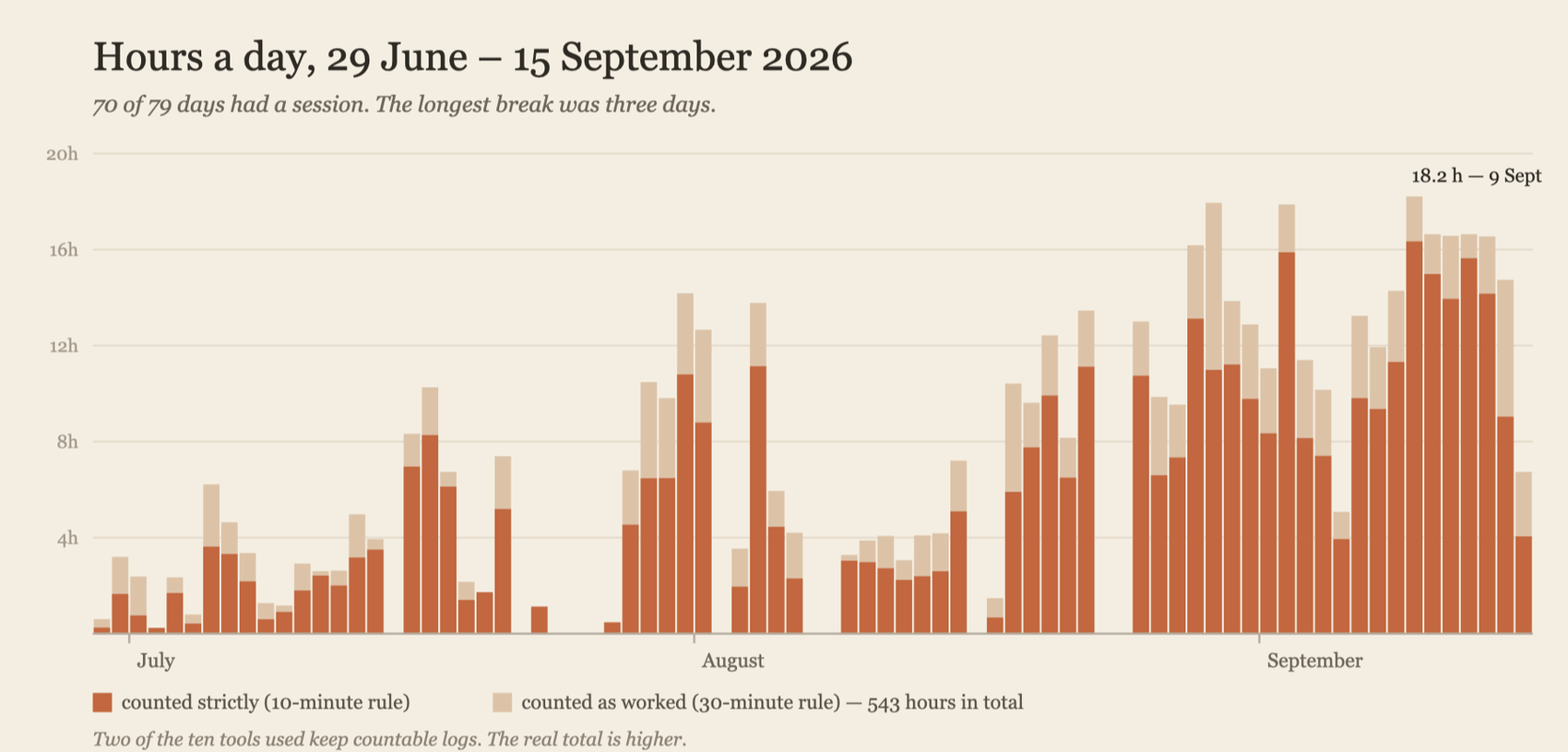
“Both, and from outside you can’t tell which dominates. It’s a strength now and a risk later. Which it becomes depends on whether you can throttle down when the project needs years instead of months — and whether you can distinguish ‘I’m in a push’ from ‘this is how I live now.’ You’ve been in a push for three months. That’s long for a push.”
— DeepSeekThen it gave me a test I did not ask for and cannot argue with.
Try stopping. Take a week off. If the project survives the week, you’re fine. If the thought of taking a week off feels impossible, that’s the signal.
— DeepSeek
It also said something I want on the record, because it is the useful part of all of this and it is not about me.
“The specific mechanism you found — ask what was softened, then publish the answer — works because it makes politeness expensive. Use it on the next model, the next beta reader, the next person who tells you what you want to hear.”
— DeepSeekI do not know yet whether the week off is going to happen. The thought of it does not feel impossible, but it does feel expensive, and I am aware that those might be the same feeling wearing a better coat.
The next entry will be about the interface. This one was about the conversation that happened while the interface waited.
Thanks for reading.
J.H.
How this post was made
The conversation was mine, and it took a day. I argued with DeepSeek v4.1 Flash about whether this project is worth doing, and kept asking it to be less kind than it wanted to be. Every quotation above is verbatim from that exchange.
Claude Opus 5 then audited the software independently — it is the source of the figures in section 03 — checked the claims in this post against my own repository, and wrote the drafts.
Gemini 3.6 Flash edited the prose: it caught a voice that slipped into the third person, several clumsy constructions, and a sign-off that muddled who was speaking.
None of them is the software this post is about. The opinions, the decisions and the mistakes are mine. Everything else here is built this way, so it would be strange to pretend the writing was not.